The Shapeshifter & Trickster
Overview
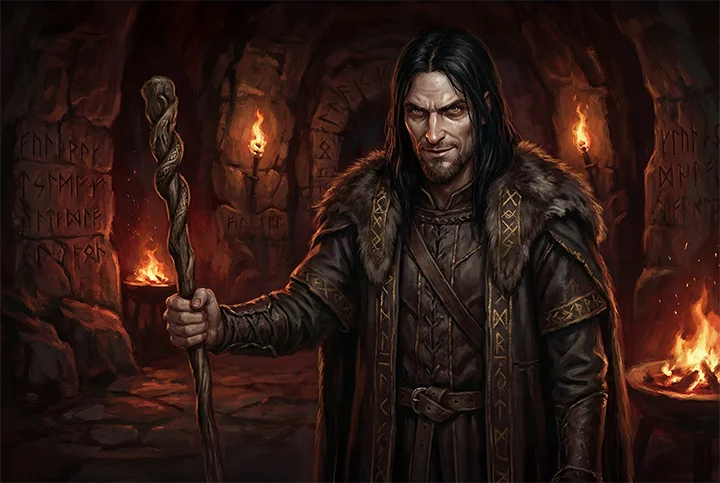
Loki, known in Old Norse as Loki Laufeyjarson, is the most enigmatic and complex figure in Norse mythology. Neither fully god nor fully giant, neither hero nor villain, he occupies a unique position in the Norse cosmos that defies easy classification. He is the blood brother of Odin, a resident of Asgard, a companion of Thor on countless adventures and simultaneously the force most responsible for the unravelling of the divine order. He is the god who cannot be contained by any single definition.
Loki is a shapeshifter of extraordinary ability. He transforms into animals, insects, an elderly woman and even changes his sex entirely when the myths require it. His mind works in ways that no other deity can follow, finding angles and possibilities invisible to those around him. This makes him invaluable in a crisis and catastrophically dangerous when his interests diverge from those of the gods. The Aesir use him, tolerate him and ultimately fear him, because they know that his cleverness is the sharpest tool in Asgard and the most unpredictable.
His parentage places him outside the usual divine order. His father Fárbauti was a giant and his mother Laufey was of unclear origin, possibly divine. He fathered children with both the goddess Sigyn and the giantess Angrboða, the latter producing three of the most feared beings in Norse cosmology: the World Serpent Jörmungandr, the great wolf Fenrir and the death goddess Hel. He also, in his most astonishing transformation, gave birth himself to the eight-legged horse Sleipnir, who became Odin's legendary steed.
Origins & Mythology
The Prose Edda describes Loki as beautiful in appearance, pleasing in manner and terrifying in consequence. Snorri Sturluson writes that he surpasses all beings in the art of cunning and that he brings the gods into great difficulties and then gets them out again by his cleverness. This captures the fundamental dynamic of Loki's role in the myths: he creates the problem, and he solves the problem, and the gods can never be entirely sure which role he is playing at any given moment.
His blood brotherhood with Odin is one of the most significant relationships in Norse mythology. The two swore an oath that neither would drink unless both were offered drink together, a bond that speaks to a deep and ancient connection between the god of wisdom and the god of chaos. Odin understood something about Loki that the other gods did not: that order without chaos is stagnation, and that Loki's presence, however costly, kept the worlds alive and moving.
The Poetic Edda preserves the poem Lokasenna, in which Loki gatecrashes a feast of the gods and systematically insults every deity present, revealing their secrets, shames and failures with surgical precision. It is one of the most remarkable texts in the Norse tradition, functioning simultaneously as dark comedy, mythology and a catalogue of divine flaws. By its end Loki has burned every bridge and sealed his own fate.
Key Stories & Appearances
Loki's most celebrated contribution to Asgard came through an act of destruction followed by an act of creation. He cut off the golden hair of Sif, Thor's wife, while she slept. Faced with Thor's fury, Loki travelled to Svartalfheim and commissioned the dwarves to forge a replacement. In the process he also acquired Gungnir, Odin's spear, the ship Skiðblaðnir and, through a wager that nearly cost him his head, the treasures Draupnir, Gullinbursti and Mjölnir itself. Loki's recklessness produced the greatest weapons in the Norse world.
He assisted Thor in the recovery of Mjölnir from the giant Þrymr, devising the disguise of Thor as a bride with all the quick thinking that the situation required. He helped Odin and the other gods escape impossible debts and dangerous bargains on numerous occasions. Yet the same mind that solved these crises also engineered the death of Baldr, the most beloved of all the gods. Loki discovered that mistletoe had been overlooked in the oath that made Baldr invulnerable, fashioned a dart from it and guided the blind god Höðr's hand to throw it. The death of Baldr set in motion the chain of events leading directly to Ragnarök.
For this crime the gods bound Loki in a cave beneath the earth, chaining him with the entrails of his own son Narfi. The giantess Skaði placed a serpent above his face to drip venom onto him for eternity. His faithful wife Sigyn holds a bowl to catch the drops, but whenever she must empty it the venom falls on Loki's face and his writhing causes earthquakes across Midgard. He will remain bound until the onset of Ragnarök, when the chains will break and he will sail to the final battle at the helm of the ship Naglfar, made from the fingernails and toenails of the dead.
Legacy & Significance
Loki presents a challenge to anyone seeking a simple moral framework in Norse mythology, and that challenge is precisely his greatest gift to the tradition. He forces the question of whether chaos is evil or simply necessary, whether the trickster is a villain or the mechanism through which a static world is forced to grow and change. Scholars have debated for generations whether Loki was ever genuinely worshipped, whether he represents a late addition to the mythology or an ancient and central figure whose cult left few archaeological traces.
His influence on modern culture is vast. From literary analyses that compare him to Prometheus and Coyote and Anansi, to his enormously popular appearances in film and television, Loki has become the Norse deity most recognisable to a global audience. What draws people to him is what always drew people to the trickster archetype: the sense that the most interesting questions are never answered by the straightforward hero, but by the figure who refuses to accept the rules of the game as given. Loki does not fight the giants with a hammer. He outthinks the entire cosmos, and the cosmos has never quite recovered from it.
OTHRAVAR — Musical Tribute
Experience the cunning and chaos of Loki through the ancient sounds of Norse folk music. This original composition draws from the skaldic tradition, performed with traditional instruments including tagelharpa, bukkehorn and frame drum.