God of Thunder & Lightning
Overview
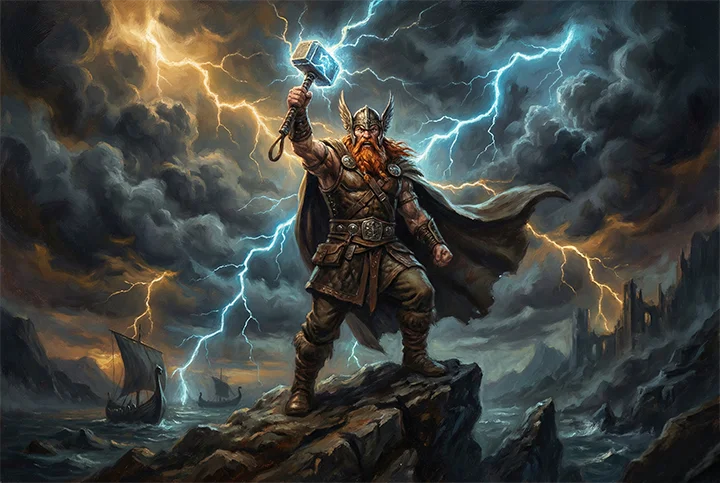
Thor, known in Old Norse as Þórr, is the god of thunder, lightning, storms and strength in the Norse pantheon. Son of Odin and the earth goddess Jörð, he is the mightiest warrior among the Aesir gods and the protector of both Asgard and Midgard, the realm of humans. Where his father Odin rules through cunning and wisdom, Thor rules through raw power and an unshakeable sense of duty to those he protects.
Thor is depicted as a massively built, red-bearded warrior of enormous physical strength. He rides across the sky in a chariot pulled by two goats, Tanngrisnir and Tanngnjóstr, and the rumble of thunder is said to be the sound of his chariot wheels crossing the heavens. He wears the belt Megingjörð which doubles his already extraordinary strength, iron gloves called Járngreipr and carries his legendary hammer Mjölnir, the most feared weapon in all the Nine Realms.
Despite being the son of the chief god, Thor is not a distant or aloof deity. He is approachable, straightforward and fiercely loyal. While Odin was worshipped primarily by kings, poets and warriors seeking glory, Thor was the god of the common people: farmers prayed to him for fertile harvests and protection from the storms, sailors called on him for safe passage across dangerous seas, and ordinary men and women wore the hammer amulet around their necks as a symbol of his protection.
Origins & Mythology
The Prose Edda and the Poetic Edda both establish Thor as one of the central figures of Norse cosmology. He was born of the union between Odin and Jörð, the personification of the earth itself, making him a bridge between the divine realm of Asgard and the physical world below. This connection to the earth reinforced his role as a protector of the natural order and a guardian against the chaos represented by the giants, the jötnar.
Thor's hammer Mjölnir was forged by the dwarven brothers Sindri and Brokkr as part of a wager with Loki. The handle came out shorter than intended because Loki transformed into a fly and bit Brokkr on the eyelid mid-forge, disrupting his work. Despite this flaw, Mjölnir became the greatest treasure of the Aesir. When thrown it always struck its target and always returned to Thor's hand. It could level mountains, call down lightning and consecrate marriages and births alike, making it a symbol of both destruction and creation.
Thor's marriage to the golden-haired goddess Sif produced the goddess Þrúðr. He also fathered Magni with the giantess Járnsaxa, and Móði, whose mother the sources do not clearly identify. Both Móði and Magni are among the few gods destined to survive Ragnarök, inheriting Mjölnir in the world that comes after.
Key Stories & Appearances
Thor's myths are among the most dramatic in the Norse tradition. In the Eddic poem Þrymskviða, the giant Þrymr steals Mjölnir and demands the goddess Freya as his bride in exchange for its return. Thor, with Loki's scheming assistance, disguises himself as a bride and travels to the giant's hall. When Mjölnir is brought out to consecrate the marriage, Thor seizes it and slaughters every giant in the hall. This tale is one of the most beloved in Norse mythology for its combination of high stakes, dark humour and Thor's characteristic directness.
Thor's greatest enemy is the World Serpent Jörmungandr, the monstrous offspring of Loki who lies coiled around Midgard at the bottom of the ocean. Their enmity is ancient and absolute. On one occasion Thor nearly succeeded in pulling the serpent from the sea while fishing, but the giant Hymir cut the line in fear before Thor could land his catch. Their final confrontation is foretold at Ragnarök: Thor will kill Jörmungandr but then take nine steps before falling dead from the serpent's venom, the two eternal enemies destroying each other at the end of the world.
Thor also journeyed to the hall of the giant king Útgarða-Loki with Loki and the young god Þjálfi, where he was tricked into a series of seemingly humiliating contests. He was unable to drain a drinking horn, lift a cat or wrestle an old woman to the ground. Only afterward did Útgarða-Loki reveal the truth: the horn was connected to the ocean, the cat was Jörmungandr in disguise, and the old woman was old age itself. Even in defeat, Thor had come closer to these impossible tasks than any being ever had.
Legacy & Significance
Thursday takes its name from Thor, derived from the Old English Þūnresdæg, Thor's day. His name lives on across Scandinavia in place names and personal names, and the hammer symbol remains one of the most recognisable icons of Norse heritage to this day. During the Viking Age, as Christianity spread across Scandinavia, many Norse people began wearing hammer amulets as a direct counterpoint to the Christian cross, a deliberate act of cultural and spiritual resistance.
Thor endures in modern culture with extraordinary vitality. He appears in countless works of literature, film and art, most prominently in Marvel's popular adaptations, though these bear little resemblance to the complex, deeply human deity of the original sources. The real Thor of the Eddas is something far more interesting: a god who gets tricked, who feels fear, who makes mistakes and who keeps fighting anyway. He is the protector who asks nothing in return, the warrior who stands between his people and the chaos that always waits at the edges of the known world.
OTHRAVAR — Musical Tribute
Experience the thunder and fury of Thor through the ancient sounds of Norse folk music. This original composition draws from the skaldic tradition, performed with traditional instruments including tagelharpa, bukkehorn and frame drum.