Realm of the Gods
Overview
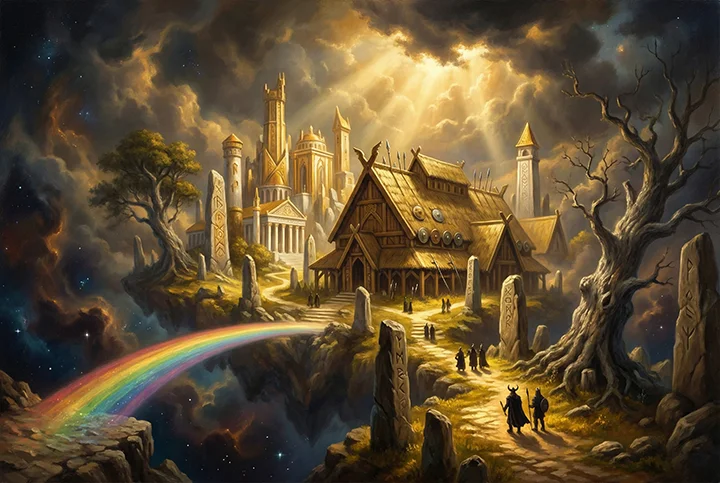
Asgard, known in Old Norse as Ásgarðr, is the realm of the Aesir gods, the divine citadel that stands at the highest point of the Norse cosmos and serves as the seat of divine authority over all the Nine Realms. It is connected to Midgard, the realm of humanity, by the Bifrost bridge, the shimmering rainbow road that arcs between the worlds and is guarded at its end by the watchman Heimdall. Asgard is not simply where the gods live; it is the physical expression of divine order, the point from which the cosmos is governed and from which the forces of chaos are held at bay.
The name combines Áss, the Old Norse word for a god of the Aesir tribe, with garðr, meaning enclosure or stronghold. It is literally the enclosure of the gods, and the image of enclosure is significant: Asgard is a defended space, a stronghold built and maintained against the constant pressure of the giants and other forces that would unmake the divine order if they could reach it. The great wall of Asgard, whose construction is itself the subject of one of the most famous Norse myths, is as much a statement about the precariousness of divine order as it is a piece of defensive architecture.
Within Asgard stand the halls of the individual gods: Odin's Valhöll and Valaskjálf, Thor's Bilskirnir, Freya's Sessrúmnir in Fólkvangr, Baldur's Breiðablik and many others. Each hall reflects the character of its divine occupant, and together they form a city of gods whose architecture is inseparable from the mythology of the beings who inhabit it. Asgard is simultaneously a place and a community, a realm and a society.
Origins & Mythology
Asgard was built by the gods after the creation of the world from the body of the primordial giant Ymir. The Prose Edda describes how the gods established their realm in the heavens, constructing their halls and setting up the forge Iðavöllr where they created the treasures and tools that would serve them throughout the age of gods. The plain of Iðavöllr is described as the first gathering place of the Aesir, the location where they met to divide the realms between them and establish the order of the cosmos.
The construction of Asgard's wall is one of the most dramatic stories in Norse mythology. A giant craftsman came to the gods and offered to build a wall so strong that no giant or troll could breach it, asking in payment the sun, the moon and the goddess Freya. The gods, advised by Loki, agreed on the condition that the work be completed in a single winter with no human help. The giant brought his enormous horse Svaðilfari to aid in the work and came so close to completing the wall on time that the gods panicked. Loki, who had engineered the agreement, was forced to sabotage it: he transformed into a mare and lured Svaðilfari away from the work. The wall was left unfinished, the giant was killed by Thor and Loki later gave birth to Sleipnir, Odin's eight-legged horse, as a result of his encounter with Svaðilfari.
Asgard sits at the crown of Yggdrasil, connected to the Well of Urð at the base of one of the tree's roots, where the gods ride each day across Bifrost to hold their divine assembly. The relationship between Asgard above and the well of fate below encapsulates the fundamental tension of the Norse divine order: the gods govern from above but the forces that determine their fate originate below, in the deep roots of the world where the Norns weave.
Key Stories & Appearances
Asgard is the setting for many of the most significant events in Norse mythology. It is where Baldur's prophetic dreams disturb the peace of the gods and set in motion the chain of events leading to his death. It is where Loki's insults at the feast of Ægir finally exhaust the gods' patience and lead to his capture and binding. It is where Odin sits on his throne Hliðskjálf and surveys all the Nine Realms, and where he returns after his wanderings with the knowledge he has gathered from every corner of the cosmos.
The theft of Iðunn's golden apples of immortality, which caused the gods to age and weaken until they were barely able to move, demonstrated how fragile Asgard's divine vitality truly was. The apples kept the gods young; without them, even the mightiest of the Aesir were subject to the same entropy that governs all mortal things. The story reveals that Asgard's power is not inherent and absolute but dependent on specific conditions that can be disrupted by a clever enough enemy.
At Ragnarök, Asgard itself becomes the final battleground. The forces of destruction cross the broken Bifrost bridge and converge on the plain of Vígríðr, and the gods ride out to meet them. The halls of Asgard, built with such effort and defended through so many ages, are ultimately consumed in Surtr's fire. Everything the gods built, all the beauty and order of the divine realm, is destroyed. And yet in the aftermath, the earth rises again, and some of the gods return to the field where Asgard once stood, and begin again.
Legacy & Significance
Asgard represents the Norse understanding of civilization itself: a defended space of order carved out of a cosmos that is fundamentally indifferent or hostile, maintained by constant effort and vigilance against the forces that would reduce everything to chaos. The gods are not omnipotent rulers of a universe that obeys them; they are inhabitants of a stronghold who must negotiate, fight and sometimes sacrifice to keep the walls standing. Asgard is magnificent, but it is also precarious, and the Norse tradition never lets you forget that.
The concept of Asgard has penetrated modern culture so deeply that it requires almost no introduction to contemporary audiences. From scholarly discussions of the Indo-European sky father traditions to blockbuster film adaptations, Asgard endures as one of the most vivid and recognisable divine realms in world mythology. What makes it endure is not spectacle but truth: the truth that order is not natural or inevitable, that it must be built and guarded, and that even the mightiest fortress is mortal.
NORSE MYTHOLOGY ENCYCLOPEDIA — Storytelling
Five hundred and forty doors. Each one wide enough for eight hundred warriors to march through side by side.