Overview
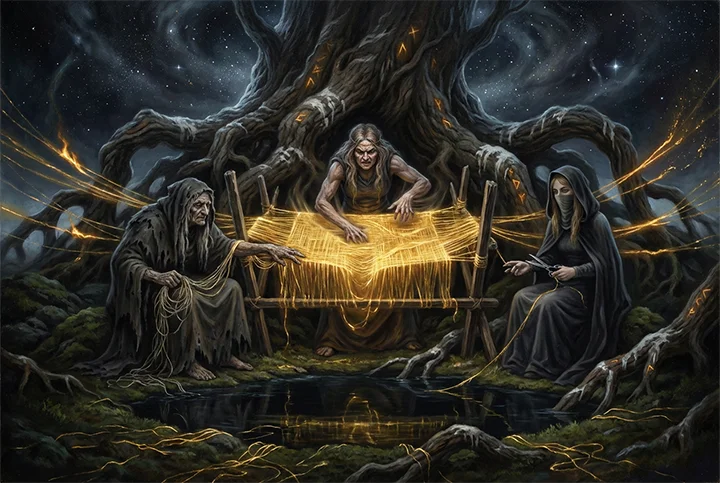
The Norns are the three beings who determine the fate of every living thing in Norse cosmology: gods, humans, giants, dwarves and all creatures that draw breath across the Nine Worlds. They sit at the base of the world tree Yggdrasil beside the Well of Urd, carving runes into the bark of the tree and weaving the threads of destiny into a fabric that nothing in creation can unravel. Their names are Urd, Verdandi and Skuld, words that carry within them the full weight of time: what has been, what is becoming and what shall be. No god overrules them. No prayer changes what they have set. Even Odin, who sacrificed his eye for wisdom and hung for nine nights on Yggdrasil to learn the runes, cannot alter what the Norns have woven.
The Norns occupy a unique position in the Norse pantheon because they belong to no faction and serve no master. They are not Aesir, not Vanir, not giants, not dwarves. They predate the current order of things and will presumably persist beyond it. They do not intervene in events; they determine the conditions within which events unfold. The distinction matters: the Norns are not puppet masters pulling strings but weavers setting the length and texture of each thread before it is lived.
Origins and Mythology
The primary sources for the Norns are the Prose Edda, the Poetic Edda, and scattered references in the skaldic poetry and the Eddic lays. Snorri Sturluson describes them in the Gylfaginning section of the Prose Edda, where the enthroned figure of High explains to Gangleri that three maidens came from the hall that stands under the ash beside the spring of Urd and that these maidens shape the lives of men. He names them Urd, Verdandi and Skuld and notes that they cut on pieces of wood, they make strings and they weave at a loom.
The Voluspa, the great prophetic poem that opens the Poetic Edda, places the Norns at a pivotal moment in the creation of the world. After the first gods have shaped the earth and given gifts to the first humans Ask and Embla, the seeress describes three mighty maidens coming from the hall beneath Yggdrasil beside the Well of Urd to establish fate. Their arrival marks the moment when time and consequence enter the world. Before the Norns came, things existed but did not yet have a destiny. After them, every life has a thread with a beginning, a middle and an end already implicit in its weaving.
The Well of Urd beside which the Norns dwell is one of three wells at the roots of Yggdrasil. The gods ride across Bifrost each day to hold their council at this well. The water of the well is so sacred that anything dipped into it comes out white as the membrane inside an eggshell. The Norns draw this water daily and mix it with the clay around the well, pouring both over the branches of Yggdrasil to keep the tree alive and prevent it from rotting. The tree sustains the worlds; the Norns sustain the tree. The chain of dependency is complete.
The Three and Their Meanings
Urd is the oldest of the three and the one most closely associated with the well that bears her name. Her name means what has happened or fate in the sense of the accumulated past, the weight of everything that has already occurred and cannot be changed. She is sometimes depicted as looking backward, her gaze fixed on what already exists.
Verdandi's name derives from a present participle meaning becoming or that which is happening now. She is the Norn of the present moment, of events as they unfold in real time, of the thread as it is actively being drawn through the loom. She represents the thin, moving edge between the past that cannot be changed and the future that has not yet hardened into certainty.
Skuld's name is most often translated as that which shall be or debt, carrying the sense of something owed or inevitably due. She is associated with the future, but not the open future of pure possibility: the Norse sense of Skuld's domain is closer to obligation, the future as the necessary consequence of what Urd has laid down and Verdandi is weaving. Skuld also appears in some sources among the valkyries, the choosers of the slain, which connects the determination of fate with the determination of who lives and who dies in battle.
Fate, Free Will and the Norse Worldview
The existence of the Norns raises a question that the Norse sources handle with remarkable consistency: if fate is fixed, what is the point of action? The answer embedded in the mythology is that the question is beside the point. A Norse warrior does not fight bravely because bravery will change his fate; he fights bravely because bravery is what a warrior is. The Norns have woven the thread of his death at a particular time and place, but they have also woven the thread of his character, and it is his character that determines how he meets what is coming.
This is the concept of wyrd in its most fully developed form, a word that gives the English word weird its origin and that means something closer to the shape of one's fate as it moves through time. A person's wyrd is not a sentence handed down from outside but a pattern inherent in who they are, emerging through their choices and encounters in ways they did not choose but are nonetheless entirely their own. The Norns weave the pattern; the person lives it.
Beyond the three great Norns, the sources also speak of lesser norns who attend every birth. Snorri notes that some are of the Aesir, some of the elves and some of the dwarves, and that those born to a good fate had good norns attending at their birth while those who suffered hardship or early death had norns who dealt harshly with them. This democratizes the concept of fate across the entire population of the Nine Worlds: every life has its norns, its specific weavers, not just the lives of heroes and gods.
Legacy and Significance
The Norns are among the most philosophically sophisticated elements of Norse mythology. They represent a cosmological framework in which fate is real and binding but not arbitrary: it emerges from the nature of things as they have been and are becoming, and it manifests through character rather than despite it. There is no cosmic injustice in their weaving because they do not impose fate from outside; they articulate the fate that is already implicit in the fabric of each existence.
Their image has proven remarkably durable. The Germanic concept of the three fate-weavers appears across multiple northern European traditions, connecting the Norse Norns to the Anglo-Saxon wyrd sisters, to figures in Old High German literature and to the broader Indo-European pattern of fate goddesses who spin, measure and cut the thread of life. The three Fates of Greek mythology, the Moirai, perform a structurally identical function, suggesting that the image of three women determining the length and quality of each human life is one of the deepest and most widespread structures in the mythological imagination of the ancient world.
In the Norse tradition specifically, the Norns represent the limit of divine power in a way that nothing else does. The gods can do extraordinary things. They can travel between worlds, transform themselves, command forces of nature, see into the future. But they cannot change what the Norns have set. Odin knows how Ragnarok will end and he cannot prevent it. The Norns did not decree Ragnarok as a punishment or a plan; they wove it because it is the consequence of what has been and what is becoming. That is, in the end, what makes the Norse tradition so honest and so stark: even the gods are inside the story, not above it.