The Primordial Realm of Ice and Mist
Overview
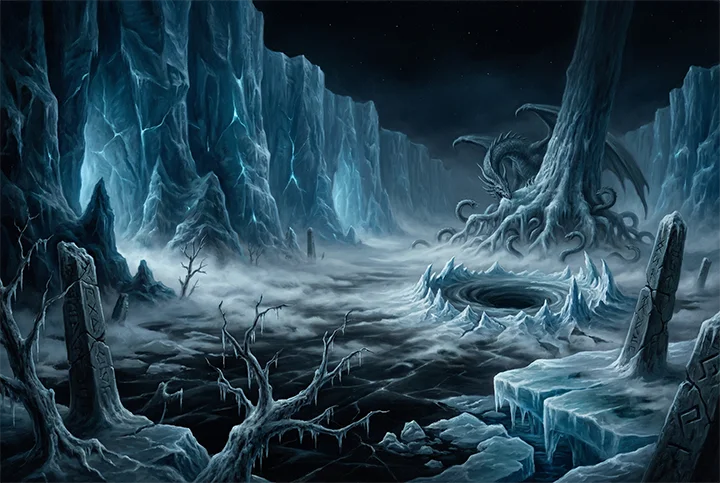
Niflheim, whose name means "World of Mist" or "Mist Home" in Old Norse, is one of the two primordial realms that existed before the creation of the world. It is the realm of darkness, cold, ice and primordial mist, the oldest of all the worlds and the source of all rivers in the Norse cosmos. Located in the far north, it predates the gods, predates the giants and predates humanity itself. Everything that exists in the Norse universe can trace its origins back to the interaction between Niflheim's ice and the fire of Muspelheim in the void of Ginnungagap, making it not merely the oldest realm but the foundation upon which all of existence rests.
At the heart of Niflheim lies the spring Hvergelmir, the Roaring Kettle, from which all the rivers of the Norse cosmos flow. The Prose Edda names eleven rivers collectively called the Élivágar, the Ice Waves, as flowing from Hvergelmir, and these rivers carry their icy waters outward into the void where they froze and accumulated to form the primordial ice that eventually met the fire of Muspelheim. Everything wet and cold in the Norse universe originates here, in the deepest and most ancient place beneath the roots of Yggdrasil.
It is important to distinguish Niflheim from Hel, with which it is sometimes confused. Niflheim is the primordial cosmological realm, ancient beyond reckoning, defined by cold and mist and the source of all rivers. Hel is the realm of the dead, ruled by Loki's daughter, situated in or near Niflheim but distinct from it. The two share a location at the lowest point of the Norse cosmos, beneath the roots of Yggdrasil, but they serve different functions and carry different mythological meanings.
Origins & Mythology
Niflheim's role in Norse creation mythology is fundamental. The Prose Edda describes the cosmos before creation as containing only two realms: Niflheim in the north and Muspelheim in the south, separated by the vast emptiness of Ginnungagap. From Hvergelmir in Niflheim, the Élivágar rivers flowed outward and eventually reached Ginnungagap, where their waters froze into layers of ice, rime and frost that accumulated over countless ages. When the heat and sparks from Muspelheim drifted northward into this frozen accumulation, they melted it, and from the melting emerged drops of water that condensed into the first living being: the primordial frost giant Ymir.
Ymir's emergence from the meeting of Niflheim's ice and Muspelheim's fire is the founding moment of Norse cosmology. From Ymir's body, Odin and his brothers later fashioned the world. This means that Midgard, the earth on which humanity lives, is ultimately made from the substance that Niflheim's rivers helped to create. The cold and the mist at the foundation of everything are not merely background conditions but the actual material from which existence was shaped.
The spring Hvergelmir also appears in the mythology as the location toward which the dragon Níðhöggr and his kin gnaw through the lower root of Yggdrasil. The World Tree's third root reaches down into Niflheim, and the constant gnawing of Níðhöggr at this root is one of the ongoing threats to the stability of the cosmos. The serpents and dragons that dwell in Niflheim below Yggdrasil represent entropy at its most fundamental: the slow, cold, relentless erosion of the structures that sustain existence.
Key Stories & Appearances
Niflheim appears most significantly in the Norse creation narrative, where its role as the source of primordial cold and the rivers that fed the creation of the first giant makes it foundational to everything that follows. Without Niflheim's ice, there would have been no meeting of opposites in Ginnungagap, no Ymir, no raw material from which the world could be fashioned, and no cosmos at all. Its significance is therefore cosmological rather than narrative: it is not the setting for dramatic stories so much as the precondition for any story being possible.
The spring Hvergelmir receives the bodies of those condemned to suffer in the Norse afterlife. The shore of Náströnd, within the realm of Hel but associated with the cold depths near Niflheim, is described in Völuspá as a place where oath-breakers, murderers and adulterers wade through rivers of venom. The dragon Níðhöggr gnaws at the corpses there, and the serpent Níðhöggr is described as flying over the field of the dead, carrying corpses in its wings, even after Ragnarök. Niflheim's cold is not passive; it actively processes and persists.
At Ragnarök, Niflheim contributes to the forces of destruction through its connection to Hel. The dead who dwell in Hel's realm, adjacent to Niflheim, sail on the ship Naglfar under Loki's command to join the assault on the gods. The primordial cold that created the world thus also contributes to its unmaking, completing the great cycle from creation to destruction that defines the Norse cosmological vision.
Legacy & Significance
Niflheim represents the Norse tradition's acknowledgment that cold, darkness and mist are not merely hostile conditions but the necessary preconditions of existence. Without the ice of Niflheim meeting the fire of Muspelheim, there would be nothing. The world was born from the interaction of extremes, and one of those extremes — the cold, the dark, the primordial — is as essential to creation as the warmth and light that opposed it. This is a profoundly different understanding of darkness and cold from many other mythological traditions, which tend to associate primordial darkness with evil or nothingness. In the Norse tradition, Niflheim is not where nothing is; it is where everything begins.
The image of rivers flowing from a primordial spring beneath the roots of the World Tree, feeding the cosmos with cold water that becomes ice that becomes the raw material of existence, is one of the Norse tradition's most striking cosmological conceptions. It places water, cold and the deep underground at the foundation of reality, and it does so not as metaphor but as literal cosmological description: this is how the universe actually works, from the Norse perspective, and Niflheim is where it starts.