The Eternal Realm of Fire
Overview
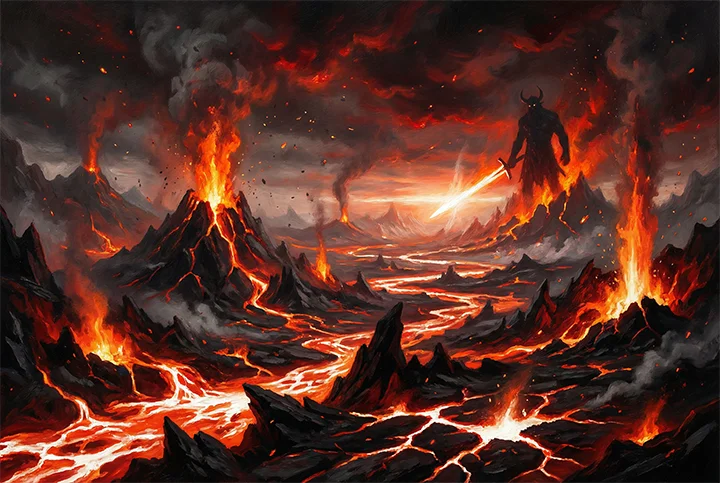
Muspelheim, known in Old Norse as Múspellsheim, is the primordial realm of fire, heat and light that existed before the creation of the world. It is the southern counterpart to Niflheim's northern ice, and the interaction between these two extremes in the void of Ginnungagap is the event from which all existence emerged. Muspelheim is not a realm that was built or governed or shaped by any deliberate act; it simply is, as fire simply is, burning at the edge of the cosmos with an intensity that precedes and exceeds anything the gods created. It is the oldest light in the Norse universe, and it will be the last fire when everything ends.
Muspelheim is ruled by Surtr, the black giant who stands at its boundary with a flaming sword that blazes brighter than the sun. He is not a creation of the gods but a primordial being as old as the realm itself, waiting with immovable patience for the moment when he will lead the Múspellsmegir, the Sons of Muspel, out of their burning realm to cross the Bifrost bridge and destroy the world at Ragnarök. Surtr and Muspelheim are inseparable: he is the agent of the fire, and the fire is the instrument of his eventual purpose.
Unlike most of the Nine Realms, Muspelheim has no complex internal geography described in the sources, no halls or springs or named locations within it. It is defined entirely by what it is rather than where things are in it: a world of fire, heat, brightness and destruction, existing at the southernmost extreme of the cosmos, inaccessible and uninhabitable to all beings except those born of fire themselves. It is the one realm in the Norse cosmos that is described as existing before Yggdrasil and the Nine Realms were organized, a fire that was burning before the world had a shape.
Origins & Mythology
Muspelheim's role in Norse creation mythology is equal in importance to Niflheim's. The Prose Edda describes the cosmos before creation as consisting of these two primordial realms on either side of the void of Ginnungagap. Where Niflheim produced ice, frost and cold that accumulated in the void, Muspelheim produced heat, sparks and embers that drifted northward into the frozen accumulation. When these two forces met, the ice began to melt, and from the meltwater emerged the first living being, the primordial frost giant Ymir, and the first cow, Auðumbla, who fed him.
The sparks and embers from Muspelheim that did not contribute to the creation of Ymir flew up to become the stars, the sun and the moon. When Odin and his brothers fashioned the world from Ymir's body, they used these sparks to illuminate the sky, placing the sun and moon in their courses and setting the stars in the firmament. The light by which all of creation is illuminated, therefore, originates in Muspelheim. The realm of fire did not merely help create the raw material of the world; it provided the light that makes the world visible and liveable.
Muspelheim is described as bright, hot and impassable to those who are not native to it. The sons of Muspel, the fire beings who inhabit it alongside Surtr, are themselves creatures of heat and flame who belong to no other realm and serve no other master. They are not described as intelligent beings in the manner of the gods or giants but as elemental forces, the living expression of Muspelheim's nature, waiting for the moment when they will be unleashed.
Key Stories & Appearances
Muspelheim's most dramatic narrative role is at Ragnarök, where it provides the fire that ends the world. In Völuspá and in the Prose Edda's account of Ragnarök, Surtr leads the sons of Muspel out of their realm, crosses the Bifrost bridge and breaks it beneath their weight, and advances on the gods with his flaming sword. After the great battle on the plain of Vígríðr, where the gods and the forces of destruction destroy each other, Surtr raises his sword and sweeps fire over the entire world. The earth burns, sinks beneath the sea and disappears.
The destruction that Muspelheim brings at Ragnarök is not punishment or malice but the completion of a process that began with creation. The same fire that provided the heat to melt the ice of Niflheim and create the conditions for Ymir's birth now returns to burn everything that was built from that creation. Muspelheim's fire is both the first and the last: the light at the beginning of the world and the conflagration at its end. The Norse tradition presents this not as tragedy but as cycle: the new earth that rises from the sea after Ragnarök will require a new beginning, and beginnings require the clearing of what came before.
Muspelheim also appears indirectly in the myth of the sun and moon. The sources describe the Norse sun as a woman named Sól who drives her chariot across the sky, pursued by the wolf Sköll who will one day catch her at Ragnarök. The light she carries originates in Muspelheim, and the warmth that sustains life in Midgard is ultimately the fire of that primordial southern realm, channelled through the divine mechanism of the sky into the human world below.
Legacy & Significance
Muspelheim represents the Norse tradition's understanding of fire as the most fundamental and most ambivalent of all forces. Fire creates: it provided the heat that generated the first life. Fire illuminates: it gave the stars, the sun and the moon. Fire destroys: it will consume everything at Ragnarök. No other element in the Norse cosmos plays all three of these roles, and Muspelheim is the source of all of them. It is the primordial fire that predates the gods and will outlast them, burning at the edges of existence from before the beginning to after the end.
The figure of Surtr waiting at the boundary of Muspelheim with his flaming sword is one of the Norse tradition's most striking images of inevitable destruction. He does not advance; he waits. He does not threaten or demand or negotiate; he simply stands with his sword drawn, patient beyond all reckoning, because he knows that everything will come to him in the end. Muspelheim does not need to conquer the world. It only needs to wait for the world to reach the point where it is ready to be remade.