Overview
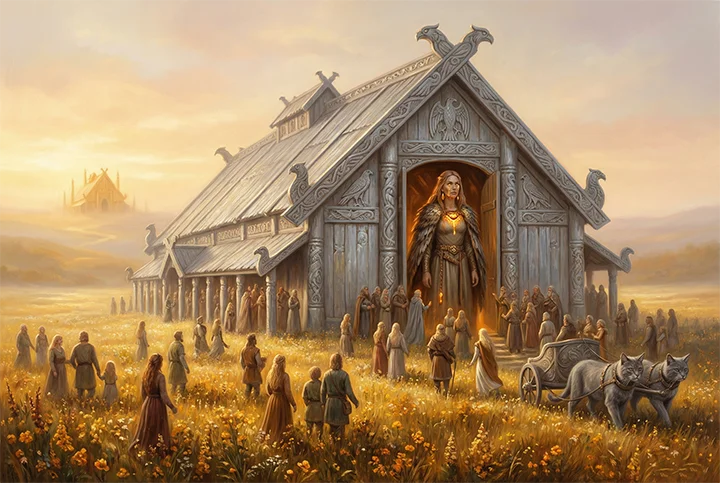
Fólkvangr, the Field of the People or the Field of the Host, is the realm presided over by the goddess Freya in Norse cosmology, where she receives half of those who die in battle. The other half of the battle-slain go to Valhalla, the hall of Odin. Fólkvangr is one of the least described of the significant Norse afterlife locations in the surviving sources, appearing primarily in the Grimnismal of the Poetic Edda and in Snorri Sturluson's Prose Edda, but its existence is cosmologically significant: it establishes that the Norse tradition recognized two primary destinations for the warrior dead, one presided over by the foremost god and one presided over by the foremost goddess, and that Freya's claim on the dead was equal to Odin's rather than subordinate to it. Within Fólkvangr stands Freya's hall Sessrúmnir, described as large and beautiful, the seat of Freya's power and the gathering place of those she has chosen from the battlefield.
Sources
The primary sources for Fólkvangr are the Grimnismal of the Poetic Edda, stanza 14, which states that the first choice of seats in battle belongs to Freya, that she receives half of the slain every day, and that Odin has the other half. Snorri's Gylfaginning in the Prose Edda repeats this information in prose, adding the description of Freya's hall Sessrúmnir as large and beautiful. These are the only substantial descriptions of Fólkvangr in the surviving sources; all other information about the realm must be inferred from what the sources say about Freya herself and about the Norse conception of the warrior afterlife more broadly.
The Division of the Slain
The statement in the Grimnismal that Freya has the first choice of the slain, with Odin receiving the rest, is one of the most theologically significant details in the Norse afterlife tradition. It establishes Freya's priority over Odin in the selection of the dead, at least in the formal order of precedence if not necessarily in the narrative tradition where Odin's Einherjar and Valhalla receive far more attention. The division of the warrior dead equally between the two most powerful divine figures, one associated with war in its martial-strategic aspect and one associated with war in its magical-prophetic aspect, reflects the dual character of Norse conceptions of battle as simultaneously a domain of physical violence and a domain of fate and seiðr magic.
The relationship between Freya's selection of the dead for Fólkvangr and her role as the primary practitioner of seiðr in the Norse tradition is suggestive but not made explicit in the sources. Seiðr, the trance-based prophetic and magical tradition that Freya taught to the Aesir, was associated with the ability to see fate, to know who would die and who would survive, and to influence these outcomes. A goddess with this knowledge and this ability would be ideally positioned to make informed choices about which of the dead to claim, and Freya's precedence in the choice of the slain may reflect her superior knowledge of the fates of individual warriors rather than a simple hierarchical precedence over Odin.
Sessrúmnir
Freya's hall within Fólkvangr is called Sessrúmnir, a compound meaning seat-room or seat-spacious, implying a hall with many seats, enough to accommodate the great number of the slain Freya receives. Snorri describes it as large and beautiful, the only physical description of the hall in any surviving source. Sessrúmnir serves as both Freya's residence and the gathering place of those she has chosen from the battlefield, paralleling the function of Valhalla as both Odin's hall and the dwelling of the Einherjar. The sources do not describe what the dead do in Sessrúmnir, whether they feast and prepare for Ragnarök as the Einherjar do in Valhalla or whether their existence there has a different character.
Fólkvangr and the Broader Norse Afterlife
The Norse afterlife tradition was not simple or monolithic. Different categories of dead went to different destinations: warriors chosen by Odin went to Valhalla; warriors chosen by Freya went to Fólkvangr; the ordinary dead who died of illness, old age or non-battlefield causes went to Helheim; the drowned dead were sometimes associated with the sea goddess Rán, who caught them in her net; and the dead buried in mounds were believed to retain a presence in their burial place. This multiplicity of afterlife destinations reflects the complexity of Norse religious thinking about death and the dead, which did not reduce to a single simple model but instead distributed the dead across multiple realms according to how they died, who chose them and what relationship they maintained with the living.
Fólkvangr's existence alongside Valhalla as a second warrior afterlife complicates the popular modern conception of Norse religion as oriented primarily toward Odin and the warrior elite of Valhalla. The equal division of the slain between Odin and Freya, with Freya's first choice giving her a formal precedence, suggests that in the actual Norse religious tradition Freya's claim on the dead was as significant as Odin's, and that the emphasis on Valhalla in the surviving literary record reflects the martial priorities of the skaldic tradition rather than the full range of Norse religious practice.
Freya and the Warrior Dead
Freya's association with the dead is consistent with her broader mythological profile. She is the foremost practitioner of seiðr, a magical tradition closely associated with death and the dead. She is the goddess most directly concerned with the fates of individuals, given her knowledge of destiny through seiðr. She weeps tears of gold when separated from her husband Óðr, a connection to grief and loss that is consistent with a role in receiving the dead. And she is described in the Lokasenna as having been with every god and every elf, a accusation whose sexual charge is the primary narrative purpose but whose scope, every god and every elf, suggests a universality of connection that encompasses even the dead who come to her field.
Legacy and Significance
Fólkvangr represents the dimension of the Norse afterlife tradition most closely associated with Freya and with the female dimension of divine power in the Norse cosmos. Its relative neglect in the surviving literary record, compared to the extensive descriptions of Valhalla, reflects the priorities of the skaldic and saga literature rather than the actual religious importance of Freya's realm. The equal division of the slain between Odin and Freya, with Freya's formal precedence, is one of the clearest statements in any Norse source of the parity between the male and female principles of divine power, a parity that the literary tradition's focus on Odin and the warrior elite tends to obscure.