The Realm of the Dwarves and the Forge at the Heart of the Norse Cosmos
Overview
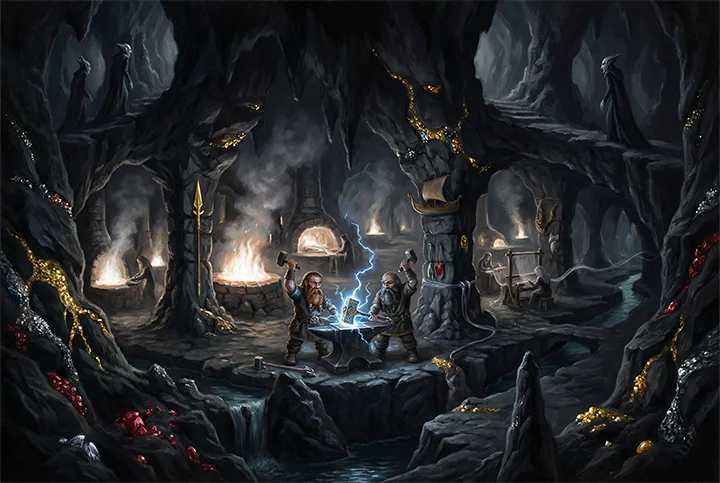
Svartalfheim, also called Niðavellir in some sources, is the realm of the dwarves in Norse cosmology, one of the Nine Worlds held in place by the branches and roots of the world tree Yggdrasil. It is the underground or subterranean world in which the dwarves live and work, and it is above all the world from which the finest objects in Norse mythology originate. The dwarves of Svartalfheim are the foremost craftsmen in the Norse cosmos, beings whose skill with metal, stone and other materials exceeds that of any other race, including the gods themselves. Without the dwarves of Svartalfheim, Odin would have no spear, Thor no hammer, Freyr no ship, Sif no golden hair, the Aesir no walls around Asgard, and Odin no ring from which eight equal rings drip every ninth night. The entire material infrastructure of Norse divine power was manufactured in the underground world by beings who themselves originated from the maggots found in the body of the first giant Ymir.
Sources
The primary sources for Svartalfheim are the Prose Edda of Snorri Sturluson, particularly the Gylfaginning and the Skaldskaparmal, and the Poetic Edda poems including the Voluspa, the Alvissmal, and the Lokasenna. The Voluspa contains a catalogue of dwarf names in stanzas 9 through 16 that lists dozens of individual dwarves and provides the mythological foundation for their existence as a race created by the gods from the maggots in Ymir's body. The Skaldskaparmal preserves the most detailed accounts of dwarf craftsmanship in the context of explaining the mythological origins of kennings for the objects they made. Snorri uses the names Svartalfheim and Niðavellir in different contexts, and scholars have debated whether these names refer to the same realm or to different underground regions; the most common scholarly position treats them as alternative names for the same world.
The Origin of the Dwarves
The dwarves of Svartalfheim originated from the body of Ymir, the primordial frost giant whose killing by Odin, Vili and Vé provided the raw material from which the world was constructed. When the gods examined Ymir's flesh after his death, they found maggots moving in it. The Prose Edda records that they gave these maggots intelligence and the form of men. The dwarves thus share the same material origin as the earth, the mountains and the rocks they inhabit: they are, in a literal sense, the transformed flesh of the first giant, alive and active within the body of the world that was built from that flesh. This origin connects the dwarves to the chthonic, underground dimension of the Norse cosmos in a way that is more fundamental than simple residence: they are of the earth in a way that the gods, who live above in Asgard, are not.
The Voluspa's catalogue of dwarf names provides the most extensive list of individual dwarves in any Norse source, naming figures including Modsognir, identified as the mightiest of all dwarves, Durinn, Dvalin, Nain, Dain, Bifurr, Bafurr, Bombor, Nori, Ori, Onar, Oin, Mjodvitnir, Viggr, Gandalf, Fili, Kili and many others. The names in this list overlap substantially with the dwarf names used by J.R.R. Tolkien in The Hobbit and The Lord of the Rings, where he drew directly on the Norse mythological tradition for his dwarf characters and their names, making the Voluspa catalogue the single source most responsible for the popular conception of dwarves in modern fantasy literature.
Dwarf Craftsmanship: The Great Works
The mythological record preserves accounts of several specific objects made by the dwarves of Svartalfheim that became central elements of Norse divine power. Gungnir, the spear of Odin, was made by the dwarves known as the Sons of Ivaldi along with the golden hair of Sif and the ship Skidbladnir for Freyr. These three objects were made after Loki, having cut off Sif's hair while she slept as a prank, was threatened by Thor and sent to Svartalfheim to have the damage repaired. The Sons of Ivaldi produced the three gifts, and Loki, emboldened by their quality, wagered his head with another dwarf named Brokkr that Brokkr and his brother Sindri could not make three objects of equal value. Brokkr and Sindri accepted the challenge and produced the golden boar Gullinbursti for Freyr, the gold ring Draupnir for Odin, and the hammer Mjolnir for Thor.
Loki attempted to prevent the completion of the hammer by transforming himself into a fly and biting Brokkr's eyelid as he worked the bellows, causing him to pause and allowing the hammer to come out with a handle slightly shorter than intended. When the objects were presented to the gods, the gods judged Mjolnir the most valuable of all six gifts despite its imperfect handle, because its ability to protect them from giants made it worth more than any other object. Loki lost his wager and his head, but argued successfully that the terms of the wager gave Brokkr his head but not his neck, making it impossible to remove the head without touching the neck. His mouth was sewn shut instead. The account of these six objects and their making is the fullest single narrative of dwarf craftsmanship in the Norse sources and demonstrates how completely the divine armory of the Aesir depended on the skill of the underground makers.
Other significant objects attributed to dwarf manufacture include Gleipnir, the silken fetter used to bind Fenrir, which the dwarves made from six impossible ingredients: the sound of a cat's footfall, the beard of a woman, the roots of a mountain, the sinews of a bear, the breath of a fish, and the spittle of a bird. The apparent lightness and softness of Gleipnir made the bound Fenrir more reluctant to allow it to be placed on him than any iron chain had done, because he correctly suspected that magic was involved. The fetter held where iron had not.
The Mead of Poetry
One of the most mythologically significant objects attributed to dwarf manufacture is the Mead of Poetry, brewed by the dwarves Fjalarr and Galarr from the blood of the wise being Kvasir mixed with honey. Kvasir was created from the saliva of the Aesir and Vanir gods mixed together at the conclusion of the Aesir-Vanir War as a symbol of the peace between them, and he was so wise that he could answer any question put to him. The dwarves Fjalarr and Galarr invited Kvasir to visit them, killed him, mixed his blood with honey and brewed it into the Mead of Poetry, which gave the ability to compose poetry and speak wisdom to anyone who drank it. The mead eventually came into the possession of the giant Suttungr, from whom Odin stole it in the form of a snake by boring through a mountain, seducing Suttungr's daughter Gunnlöð for three nights in exchange for three sips, and transforming into an eagle to fly back to Asgard with the mead in his stomach. The Mead of Poetry is the mythological explanation for the ability of human poets to compose verse, which is understood as a gift of Odin passed on through the stolen mead.
Dwarves and Light
The dwarves of Svartalfheim are associated with darkness and with the underground in a way that connects them directly to their chthonic origin. Snorri distinguishes in the Gylfaginning between the light elves, ljósálfar, who are more beautiful than the sun and live in Alfheim, and the dark elves, dökkálfar, who are blacker than pitch and live underground. The dark elves are often equated with the dwarves, or at least described in terms that make them functionally equivalent. A further detail preserved in several sources is that dwarves are turned to stone by sunlight, which both explains their exclusively underground existence and connects them to the stone of the mountains and cave-systems they inhabit. The dwarf Alviss in the Alvissmal attempts to win the hand of Thor's daughter by demonstrating his wisdom in a riddling contest, but Thor keeps him talking until dawn, when the sunlight strikes Alviss and turns him to stone.
Legacy and Significance
Svartalfheim and the dwarves who inhabit it represent the creative-technological dimension of the Norse cosmos, the underground source of the material power that the gods wield above. Without Svartalfheim, the gods are militarily and materially vulnerable; with it, they command the finest weapons, armor and magical objects in the cosmos. The dwarves' origin from Ymir's flesh and their residence within the earth connects them to the oldest stratum of Norse cosmological thinking, the understanding of the world as a body whose deepest creative power lies not in the heavens where the gods live but underground where the transformed flesh of the first being still works and makes. The influence of the Voluspa's dwarf catalogue on Tolkien's naming of his dwarf characters ensures that the dwarves of Svartalfheim have a continuous cultural presence in the popular imagination through one of the most widely read works of twentieth-century fiction.