The Ancient Realm of the Vanir Gods and the Source of Norse Fertility Magic
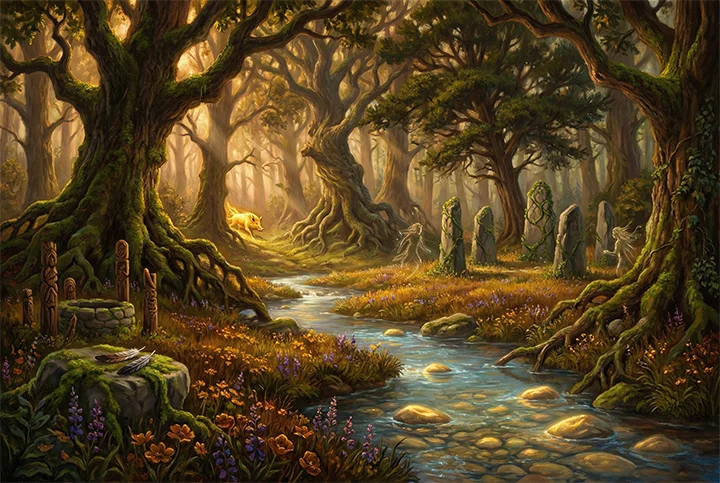
Overview
Vanaheimr is one of the Nine Worlds of Norse cosmology, the realm of the Vanir gods, an older and in some respects more ancient family of deities than the Aesir of Ásgarðr. The Vanir are associated with fertility, nature, the sea, wealth, and the magical practices of seiðr and galdr, and their homeland Vanaheimr is described in the sources as the place from which they governed these domains before the Aesir-Vanir War and the subsequent truce that brought the principal Vanir gods, Njörðr, Freyr and Freya, to live in Ásgarðr as hostages. Vanaheimr is one of the least described of the Nine Worlds in the surviving sources: what the texts say about it is almost entirely what can be inferred from what they say about its inhabitants.
Sources
Vanaheimr is mentioned by name in the Vafthrudnismal of the Poetic Edda, where Odin in disguise asks the giant Vafthrudnir where Njörðr came from. Vafthrudnir replies that Njörðr was created in Vanaheimr by the Vanir themselves, that he was given to the Aesir as a hostage at the end of the war, and that at Ragnarök he will return to the wise Vanir. This passage is the most direct statement in any surviving source that Vanaheimr exists as a distinct realm and that it remains Njörðr's true home. Snorri Sturluson mentions Vanaheimr in several places in the Prose Edda and in the Ynglinga saga.
The Vanir and Their Realm
The Vanir are consistently distinguished from the Aesir by their association with different domains of divine power. Where the Aesir are primarily gods of war, kingship, wisdom, poetry and fate, the Vanir are gods of fertility, agricultural abundance, the sea, fishing, wind, and the magical practices associated with prophecy and natural forces. The principal Vanir are Njörðr, the god of sea, wind and fishing; Freyr, the god of sunlight, rain, fertility and abundance; and Freya, the foremost practitioner of seiðr magic in the Norse cosmos.
The seiðr tradition, the magical practice that Freya brought to the Aesir after the war, is specifically associated with the Vanir and distinguished from the runic magic of Odin and the Aesir. Seiðr involved entering a trance state, traveling in spirit through the cosmos, and gaining prophetic knowledge or the ability to influence events at a distance. Its association with the Vanir marks it as a practice that originated outside the martial culture of Ásgarðr.
The Aesir-Vanir War and Its Consequences for Vanaheimr
The Aesir-Vanir War ended in a truce that included the exchange of hostages. The Vanir sent Njörðr, Freyr and Freya to live in Ásgarðr; the Aesir sent Hœnir and Mímir to live in Vanaheimr. The exchange did not go equally well: the Vanir discovered that Hœnir was incapable of making decisions without Mímir's guidance, felt cheated, cut off Mímir's head and sent it back to Odin. After this exchange, the principal Vanir remained in Ásgarðr permanently, and Vanaheimr recedes almost entirely from the mythological narrative.
Njörðr's Return to Vanaheimr
The Vafthrudnismal passage describing Njörðr's eventual return to Vanaheimr at Ragnarök is one of the most theologically significant details associated with the realm. It distinguishes Njörðr from the Aesir gods who die at Ragnarök or survive into the new world: Njörðr neither dies in the battle nor inhabits the post-Ragnarök renewal. He returns to his own people, the wise Vanir, in his own realm. This suggests that Vanaheimr exists independently of the Ragnarök catastrophe and that the divine order after Ragnarök includes the Vanir realm as a continuing element.
Legacy and Significance
Vanaheimr represents the dimension of Norse religious life that predates and persists alongside the more fully documented mythology of Ásgarðr. The Vanir gods and their realm represent an older stratum of religious practice and belief, associated with the fertility cults, nature worship and shamanic magical traditions that the archaeological and historical evidence suggests were widespread across Scandinavia before the martial culture of the Viking Age gave the Aesir their dominant position in the surviving literary tradition.