Overview
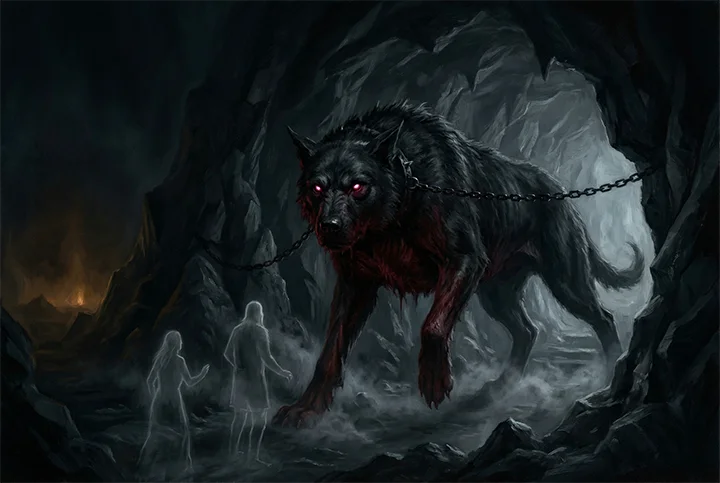
Garm is the great hound of Norse mythology, described in the sources as the foremost of all hounds, the guardian of the entrance to Hel, the realm of the dead, and one of the creatures whose release signals the onset of Ragnarök. He is bound at the cave Gnipahellir, the cave at the entrance to Hel, and howls there until the end of the world, when his chains will break and he will run free. At Ragnarök Garm fights the god Tyr, and they kill each other, both dying in the same encounter. Garm is one of the less extensively described figures in the Norse mythological tradition, appearing primarily in the Voluspa and the Grimnismal of the Poetic Edda and in the Prose Edda of Snorri Sturluson, but his position at the boundary between the world of the living and the world of the dead gives him a structural importance in Norse cosmology that exceeds what the surviving texts describe in detail.
Sources
The primary sources for Garm are the Voluspa and the Grimnismal in the Poetic Edda, and the Gylfaginning of the Prose Edda. The Voluspa mentions Garm four times, using the same or similar stanzas at different points in the poem to mark the escalating approach of Ragnarök: the hound howls before Gnipahellir, the bonds are broken, the wolf runs. This repeated refrain functions as a structural marker in the poem, each repetition signaling a further advance of the forces of dissolution. The Grimnismal identifies Garm as the best of hounds in the context of a list of superlatives about the various creatures and objects in the Norse cosmos. Snorri's Prose Edda in the Gylfaginning describes Garm's fight with Tyr at Ragnarök and their mutual death.
Garm and Gnipahellir
Garm is bound at or before the cave Gnipahellir, which the sources identify as the entrance to Hel. The name Gnipahellir means overhanging cave or cave at the cliff, and it functions in Norse cosmology as the threshold between the world of the living and the world of the dead, the point through which the dead pass on their way to Hel and at which any living being attempting to reach Hel must pass. In the myth of Hermod's ride to Hel to beg for Baldur's return, Hermod passes through Hel's gate and crosses the Gjöll bridge over the river of the dead without any mention of Garm, suggesting that the sources do not entirely agree on the details of Hel's geography or on exactly what role Garm plays in controlling access to it.
The image of a great hound guarding the boundary between the living and the dead is one of the most widespread in world mythology, appearing in Greek tradition in the three-headed hound Cerberus and in several other mythological traditions. Whether the Norse Garm is a development of the same ancient Indo-European conception of a death hound or an independent parallel development cannot be established from the surviving sources, but the structural similarity between Garm's role and Cerberus's role is noted consistently by comparative mythologists.
Garm and Tyr
The pairing of Garm and Tyr at Ragnarök, resulting in the mutual death of both, is described by Snorri in the Gylfaginning in the same sequence as the other paired deaths of the final battle: Odin and Fenrir, Thor and Jörmungandr, Freyr and Surtr, Heimdall and Loki. Each of these pairings involves a predetermined adversary relationship, a specific being prepared to fight a specific opponent at the end of the world. Tyr's association with law and justice, and his earlier sacrifice of his right hand in the binding of Fenrir, make his role as the one who fights and kills the hound of the underworld consistent with his character as the god who upholds divine order against the forces of dissolution, even at the cost of his own life.
Garm and Fenrir
A longstanding question in Norse scholarship concerns the relationship between Garm and Fenrir. The Voluspa's use of the phrase the wolf runs in the Garm stanzas, and its ambiguity about whether this wolf is Garm himself or Fenrir, has led some scholars to argue that Garm and Fenrir were originally the same figure who was subsequently differentiated into two separate beings as the mythology developed. The argument notes that both are described as the greatest of their kind in the sources, that both are associated with the forces of Ragnarök, and that the wolf imagery in the Garm stanzas overlaps with the wolf imagery associated with Fenrir elsewhere in the tradition. Most modern scholars accept that the sources as they survive treat Garm and Fenrir as distinct entities, while acknowledging the possibility that an earlier mythological tradition may not have maintained the same distinction.
The Howling of Garm
The Voluspa's description of Garm howling before Gnipahellir is one of the poem's most atmospherically powerful images. The howling of the hound at the entrance to the underworld serves as an audible marker of the boundary between living and dead: the sound that emanates from the threshold between worlds, continuous and inescapable, a reminder that Hel exists and that Garm waits at its entrance. At Ragnarök the howling intensifies and the bonds break, the containment of the underworld's guardian failing along with every other structure that has held the forces of dissolution in check throughout the history of the cosmos.
Legacy and Significance
Garm occupies a specific structural position in Norse cosmology as the guardian of the boundary between life and death, a role whose importance is disproportionate to the amount of narrative material the surviving sources devote to him. His repeated mention in the Voluspa as a marker of Ragnarök's approach gives him a thematic weight beyond what a simple description of his character would suggest. He is less a character in the mythological narrative than a signal, a recurring sound that marks the progression from the order of the present cosmos toward the dissolution of Ragnarök. His fight with Tyr and their mutual death is one of the last acts of the old world, the guardian of Hel's entrance and the god of justice destroying each other in the fire that consumes everything.
OTHRAVAR — Musical Tribute
Experience the howling at Gnipahellir and the breaking of the bonds at the onset of Ragnarök through the ancient sounds of Norse folk music. This original composition draws from the skaldic tradition, performed with traditional instruments including tagelharpa, bukkehorn and frame drum.