Baldur's Wife Who Died of Grief and Sent Gifts from the Land of the Dead
Overview
Nanna is one of the Aesir goddesses of Norse mythology, the wife of Baldur and the mother of Forseti, the god of justice. She is defined above all by her relationship to the most celebrated death in Norse mythology: when Baldur was killed by Höðr's mistletoe dart guided by Loki, Nanna died of grief at Baldur's funeral pyre before the ship could be launched, and her body was burned alongside his on the ship Hringhorni. In death she accompanies Baldur to Hel, and when Hermod rides to Hel to petition for Baldur's return, both Baldur and Nanna are found in Hel's hall. Nanna sends gifts back to Asgard with Hermod: a linen robe for Frigg and a ring for the handmaiden Fulla. She is the only figure in the Norse mythological tradition described as dying of grief, and this death, which has no parallel in the sources, gives her a quality of absolute devotion whose completeness no act of heroism could match.
Sources
The primary sources for Nanna are the Gylfaginning of Snorri Sturluson's Prose Edda, which provides the account of Baldur's death, Nanna's death of grief, the funeral on Hringhorni, Hermod's ride to Hel, and the gifts Nanna sends back, and the Voluspa of the Poetic Edda, which describes Baldur's fate in prophetic terms. Snorri also mentions Nanna in the Skaldskaparmal as a basis for kennings. Saxo Grammaticus in his Gesta Danorum presents a euhemeristic account of Baldur and Nanna as historical figures in which Nanna is a human princess rather than a goddess, providing a different tradition that suggests the myth had a wider range of narrative forms than the Eddic sources alone preserve.
Baldur's Death and Nanna's Grief
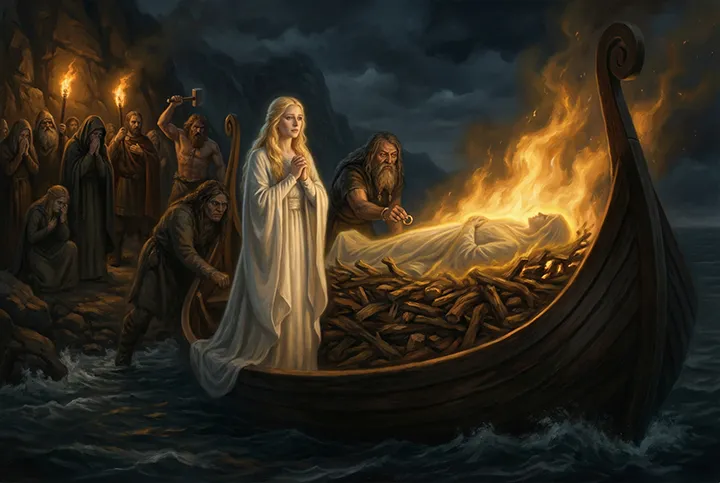
The death of Baldur is the central catastrophe of the pre-Ragnarök mythological narrative. Baldur had begun having dreams of his own death, and Frigg, his mother, extracted oaths from every being in the world not to harm him, making him effectively invulnerable. Loki discovered that Frigg had not asked the mistletoe because it seemed too young to swear, fashioned a dart from it, and guided Höðr's hand in throwing it at Baldur as the gods amused themselves by throwing things at the invulnerable god. Baldur died. The sources describe the grief of the gods at his death as the greatest grief they had ever suffered, but Nanna's grief exceeded theirs: it killed her. When Baldur's body was being prepared for the funeral on the great ship Hringhorni, Nanna's heart burst and she died, and her body was placed alongside Baldur's on the funeral pyre.
The death from grief is mythologically unusual. The Norse tradition does not generally present emotional suffering as physically fatal; the saga literature and the heroic poetry are full of bereaved survivors who continue to function, sometimes for decades, after the loss of those they love. Nanna's death as a direct physical consequence of her grief positions her love for Baldur as something categorically beyond the ordinary, a love so complete and so total that survival without its object was not physically possible for her. This is not described as a choice but as an involuntary physical event: her heart burst. She did not decide to die; her body decided that Baldur's death made continued life impossible.
The Funeral on Hringhorni
Baldur's funeral is the most elaborate and most described funeral ceremony in any Norse source. His body was carried to the ship Hringhorni, the greatest of all ships. The ship could not be launched even with the strength of all the gods; the giantess Hyrrokkin was summoned from Jötunheimr to launch it, arriving on a wolf bridled with serpents. She launched the ship with a single push so powerful that the rollers caught fire and the earth shook. On the ship, the funeral pyre was built. Baldur's wife Nanna's body was placed beside his. Odin placed his ring Draupnir on Baldur's arm. Thor consecrated the pyre with his hammer. A dwarf named Litr ran between Thor's feet and was kicked into the pyre. Baldur's horse was led onto the pyre with all its harness. The pyre was lit and the ship burned at sea.
Nanna in Hel: Gifts from the Dead
In Hel, both Baldur and Nanna are found by Hermod in positions of honor. Nanna sends back with Hermod a linen robe for Frigg, Baldur's mother, and a golden ring for Fulla, Frigg's handmaiden. The gifts from Nanna are remarkable for what they demonstrate about her presence in Hel: she is there with her husband, she is functional enough to have things to send back, and she chooses to send gifts to the two women most closely associated with Baldur's mother and household. The linen robe for Frigg is a personal gesture, a daughter-in-law's gift to a mother-in-law, connecting the world of the dead to the world of the living through the gesture of female domestic gift-giving that was one of the primary social acts of Norse women. The ring for Fulla adds a personal dimension to a gesture that might otherwise seem purely symbolic, reflecting Nanna's knowledge of the specific women who would be most affected by her absence.
Nanna and the Return of Baldur
When Hel agrees to release Baldur if every being in the world weeps for him, and the messengers go through all the worlds asking everything to weep, Nanna is in Hel weeping alongside Baldur. Both Baldur and Nanna are understood to remain in Hel after the petition fails, because the giantess Þökk, Loki in disguise, refuses to weep. Baldur's return to the world of the living after Ragnarök, described in the Voluspa, is understood to include Nanna: the renewal of the world after the final destruction is also a renewal of their union, the couple who died together returning to the new world together.
Legacy and Significance
Nanna is among the most moving figures in Norse mythology precisely because her story is so simple and so complete. She loved Baldur. He died. She died of loving him. They are in Hel together. When the world is renewed after Ragnarök, they will return together. This arc requires almost no elaboration to be effective; the Norse sources provide it in a handful of sentences that are more powerful for their compression than any extended narrative could make them. The detail of the gifts she sends from Hel, the linen robe for Frigg and the ring for Fulla, gives the simplest possible indication of her continued consciousness and care from beyond death, transforming what could be merely a tragic conclusion into something that insists on the continuation of relationship across the boundary of death.
OTHRAVAR — Musical Tribute
Experience the burning ship on the sea, the broken heart and the gifts sent from Hel through the ancient sounds of Norse folk music. This original composition draws from the skaldic tradition, performed with traditional instruments including tagelharpa, langeleik and frame drum.