The Squirrel Who Runs the World Tree and Keeps the Cosmos in Conflict
Overview
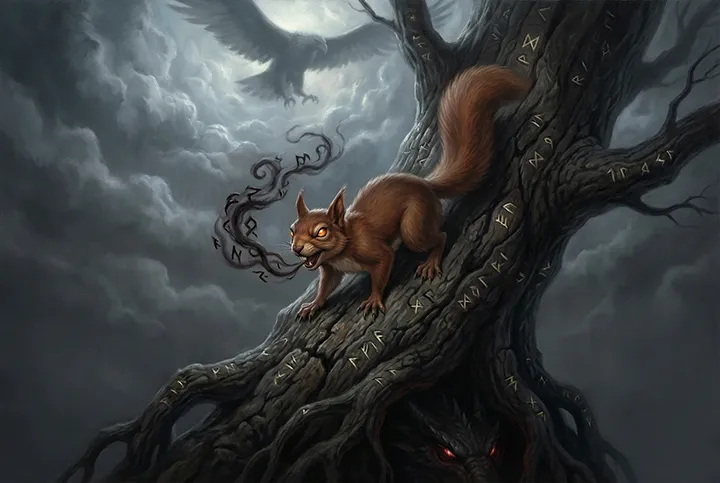
Ratatoskr is the squirrel who lives on the world tree Yggdrasil and runs up and down its trunk carrying messages between the eagle who perches at the top of the tree and the serpent Níðhöggr who gnaws at its roots in the depths of Niflheim. The name Ratatoskr has been interpreted as drill-tooth, bore-tooth or gnaw-tooth, from the Old Norse elements rata or ratan, meaning to gnaw or bore, and tönn, tooth, a name that connects the squirrel both to its rodent nature and to its role as the sharpened instrument of conflict between the beings at the extremities of the cosmos. Ratatoskr is not a god, not a monster in the sense that Fenrir and Jörmungandr are monsters, and not a dwarf or an elf; he is a feature of the world tree itself, as natural and as permanent as the tree's roots and branches, and his function is one of the most structurally important in the Norse cosmos despite the brevity of the sources that describe him.
Sources
The primary source for Ratatoskr is the Grimnismal of the Poetic Edda, stanzas 32 and 35, which describe the eagle at the top of Yggdrasil and Níðhöggr at its roots, and identify Ratatoskr as the squirrel who runs between them carrying malicious messages. Snorri Sturluson's Prose Edda in the Gylfaginning repeats and elaborates on the Grimnismal account, describing the eagle at the top as wise and having a hawk named Veðrfölnir sitting between its eyes, and confirming Ratatoskr's role as the carrier of the messages that keep the eagle and Níðhöggr in a state of perpetual enmity. No other substantial sources describe Ratatoskr, making the Grimnismal and Snorri's elaboration of it essentially the entire textual record for this figure.
Yggdrasil and Its Inhabitants
To understand Ratatoskr's function, it is necessary to understand the ecology of Yggdrasil as the sources describe it. The world tree is not simply a cosmological structure; it is a living environment inhabited by a complex community of beings whose activities define the character of the Norse cosmos. At the top of the tree sits an eagle of great wisdom, associated with the ordering and surveying of the world from above. Between the eagle's eyes sits a hawk named Veðrfölnir, whose name means storm-pale or weather-bleached, possibly connected to the capacity to see clearly across the cosmos. At the roots of the tree, gnawing perpetually at the root that extends into Niflheim, is Níðhöggr, the corpse-gnawer, the serpent or dragon whose continuous destruction of the tree's root represents the force of dissolution working against the structure of the cosmos from below.
On the branches of Yggdrasil there also live four stags, named Dáinn, Dvalinn, Duneyrr and Duraþrór, whose continuous feeding on the foliage of the tree causes damage from the middle, supplementing the damage done by Níðhöggr at the roots and by unnamed serpents who also gnaw at the roots. The tree is thus in a constant state of assault from below, from the middle and from the sides, maintained in existence despite these pressures by the water of the three sacred wells that flow to its roots and by the ministrations of the Norns, who pack the roots with clay and water from the well of Urð to prevent the damage from being fatal.
The Function of Malicious Messaging
Ratatoskr's specific role in this ecology is to carry messages between the eagle at the top and Níðhöggr at the bottom, but the Grimnismal specifies that these messages are malicious, öfundarorð in Old Norse, words of envy or spite or slander. Ratatoskr does not carry neutral information or practical communications between the extremities of the tree; he carries insults, provocations and accusations, messages specifically designed to increase the hostility between the eagle and the serpent and to maintain them in a state of permanent enmity. He is, in modern terms, a troll, a deliberate instigator of conflict between parties who might otherwise have no direct relationship with each other.
The structural significance of this function is considerable. The eagle and Níðhöggr occupy opposite ends of the cosmic axis; without Ratatoskr, there would be no communication between them and no dynamic relationship between the ordering force at the top of the cosmos and the dissolving force at its roots. Ratatoskr creates and maintains this relationship, but by making it a relationship of enmity rather than a relationship of cooperation or indifference, he ensures that the tension between the ordering and dissolving forces of the Norse cosmos is active, ongoing and personally charged rather than simply structural. The cosmos is in conflict not because of abstract cosmological forces but because a squirrel has been telling the eagle and the serpent what each one says about the other.
Ratatoskr as Cosmic Principle
Several scholars have read Ratatoskr's function as the representation of a cosmic principle rather than simply as a colorful detail of the mythology. The squirrel who connects the extremities of the world tree through deliberately provocative messaging can be understood as the personification of the principle of conflict that keeps opposing forces in perpetual tension, preventing either the complete triumph of order or the complete triumph of dissolution and maintaining the dynamic balance that characterizes the living cosmos. Without Ratatoskr, the eagle might ignore Níðhöggr and Níðhöggr might gnaw its root in silence; with Ratatoskr, each is constantly reminded of the other's existence and provoked into continued hostility. The cosmos is alive, in this reading, because it is in conflict, and it is in conflict because Ratatoskr keeps it that way.
This interpretation is consistent with the broader Norse understanding of the cosmos as maintained by tension rather than by harmony. The tree is damaged by the stags, the serpents and Níðhöggr; it is repaired by the Norns and the sacred wells; the balance between damage and repair is what keeps it alive and functional. Ratatoskr's contribution to this ecology is to ensure that the relationship between the forces of damage at the root and the forces of order at the crown is personal, active and ongoing rather than impersonal, passive and potentially negligible.
Legacy and Significance
Ratatoskr is one of the most economically described figures in Norse mythology, appearing in only a handful of lines across the entire surviving textual tradition, and yet his structural function in the ecology of the world tree is as important as that of any of the more extensively described beings who inhabit it. He is the Norse cosmos's messenger, but a specifically malicious messenger whose messages do not facilitate communication or understanding between the parties they connect, but rather deepen their mutual hostility and keep the fundamental tension of the cosmos alive. The squirrel who runs Yggdrasil is a small creature who performs a cosmologically essential function: he is the reason the world tree is still a place of conflict rather than merely a place of gradual decay, and he does this by being, in the most literal sense, a troublemaker.
OTHRAVAR — Musical Tribute
Experience the rushing of Ratatoskr on the bark of Yggdrasil, carrying his malicious words between the eagle in the heights and the serpent in the depths, through the ancient sounds of Norse folk music. This original composition draws from the skaldic tradition, performed with traditional instruments including tagelharpa, bone flute and frame drum.