The Loyal Wife Who Holds the Bowl Above Loki's Face
Overview
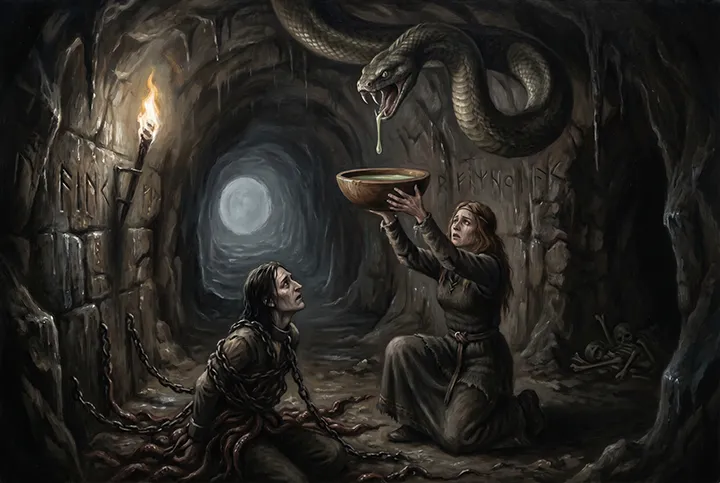
Sigyn is one of the Aesir goddesses of Norse mythology and the faithful wife of Loki, known above all for the act of loyalty for which she is remembered: holding a bowl over Loki's face to catch the venom that the gods have arranged to drip on him as punishment for his role in the death of Baldur, an act whose repetitive and unending nature gives it a character closer to Sisyphean endurance than to heroic sacrifice. Her name has been interpreted as meaning victory-woman or she who wins, from the Old Norse elements sigr, victory, and vín or vin, a feminized suffix, though the full etymology is debated. She appears briefly in the Voluspa, in the Lokasenna, and in the account of Loki's punishment in the Prose Edda, and her story is one of the most quietly devastating in the Norse tradition: a woman whose loyalty to a husband who has done monstrous things condemns her to an eternity of holding a bowl in a cave while the world above continues without her.
Sources
The primary sources for Sigyn are the Voluspa of the Poetic Edda, which mentions her briefly in the stanzas describing Loki's punishment, the Lokasenna in which she appears at the feast before Loki's crimes are punished, and the Gylfaginning of Snorri Sturluson's Prose Edda, which provides the most detailed account of Loki's punishment and of Sigyn's role in it. The Voluspa's reference to Sigyn crouching over her unwilling husband, unhappy beside her burden, is one of the most compressed and powerful images in the poem, conveying her loyalty and her suffering in a single stanza. Skaldic kennings occasionally refer to Sigyn as a term of reference for Loki, identifying him as Sigyn's husband or Sigyn's burden, reflecting the centrality of their relationship to Loki's identity in the poetic tradition.
Loki's Punishment
After the death of Baldur, which Loki had engineered by guiding the blind god Höðr's hand in throwing the mistletoe dart that killed him, and after Loki had prevented Baldur's return from Hel by refusing, disguised as the giantess Þökk, to weep for him as every other being in the world did, the gods pursued Loki and captured him. He had hidden in a waterfall in the form of a salmon, a transformation that the gods discovered by reasoning about how a net would need to be made to catch such a creature, and they were able to catch him with a net made on the model he himself had inadvertently demonstrated. The gods took Loki to a cave in the mountains. They brought the intestines of his son Nari, whom they had killed, and with these they bound Loki to three rocks, and the bowels turned to iron. They placed a serpent above him arranged to drip its venom onto his face.
Sigyn's response to this situation is the entirety of what we know about her character. She took up a bowl and held it over Loki's face to catch the venom before it could reach him. She holds it there still, in the mythological present. When the bowl fills and she must go to empty it, the venom falls on Loki's face and he writhes in agony, and the writhing of his body shakes the earth, which is the Norse explanation for earthquakes. The act of holding the bowl is repetitive, unending and productive of nothing permanent: the bowl fills, she empties it, she returns, it fills again. She cannot prevent Loki's suffering, only moderate it; she cannot end his punishment, only make it more bearable moment by moment; she cannot leave because her loyalty will not allow it. She is the most perfectly captured figure of tragic loyalty in the Norse tradition, condemned by her own virtue to an eternity of futile endurance.
Sigyn's Children
Sigyn is the mother of two sons by Loki: Narfi and Váli, or in some sources Nari and Narfi, whose names have led to confusion across the sources. In the account of Loki's punishment in the Gylfaginning, Snorri describes the gods transforming Váli into a wolf who tears his brother Nari apart, and then using Nari's intestines to bind Loki. The transformation of one of Loki's sons into the instrument of the other's destruction is one of the most brutal elements of the punishment narrative, ensuring that Loki's family is destroyed before his own suffering begins and that the bonds that hold him are made from the remains of his murdered child. Sigyn is not described as present at this point in the narrative; she arrives, or is understood to arrive, after the punishment is already established, bringing the bowl that is her only remaining expression of love for a husband she cannot free.
Sigyn at the Feast: The Lokasenna
In the Lokasenna, Sigyn is present at the feast from which Loki is eventually driven when the gods reveal the full weight of his crimes. She is not given dialogue in the poem; she is present but silent, a figure in the background of the scene at which her husband is making his most catastrophic social choices. Her presence in the Lokasenna as a silent witness to Loki's increasingly destructive behavior, followed by her presence in the punishment cave as the only being who remains loyal to him after everyone else has abandoned or imprisoned him, gives her character a consistency that the sources, despite their brevity, make powerfully clear.
Sigyn at Ragnarök
The Voluspa implies that Loki will escape his bonds at Ragnarök and sail to the final battle on the ship Naglfar. Sigyn's fate after Loki's escape is not described in the surviving sources. Her role in the mythology is defined by the time of his captivity, not by what follows it, and the sources that describe Ragnarök do not mention her among the beings whose fates are traced in the final destruction. She is, in the mythological tradition, a figure of the interregnum between Baldur's death and the end of the world, the period of punishment and waiting that is her eternal present.
Legacy and Significance
Sigyn is one of the least narratively elaborated goddesses in the Norse tradition and simultaneously one of the most emotionally immediate. Her story requires almost no elaboration because the single image of a woman holding a bowl in a cave while her bound husband suffers below her is sufficiently complete: it contains loyalty, love, futility, endurance, loss and the specific kind of courage that has nothing heroic about it and is simply the refusal to abandon someone. The Norse tradition, which is on the whole more interested in warriors and gods than in the human quality of loyalty in impossible circumstances, preserves in Sigyn one of its most moving portraits of what it costs to stay.
OTHRAVAR — Musical Tribute
Experience the cave, the bowl and the eternity of loyal endurance through the ancient sounds of Norse folk music. This original composition draws from the skaldic tradition, performed with traditional instruments including tagelharpa, langeleik and frame drum.