God of Justice & Combat
Overview
Týr, known in Old Norse as Týr and in Proto-Germanic as Tīwaz, is one of the oldest gods in the Norse pantheon. He is the god of justice, law, order and single combat, a deity whose authority rests not on physical strength or magical power but on something rarer and more fragile: his word. In a mythology populated by gods who scheme, deceive and manipulate, Týr stands apart as the one who keeps his oath even when the cost is his own right hand. He is the god who understands that some principles are worth more than personal survival.
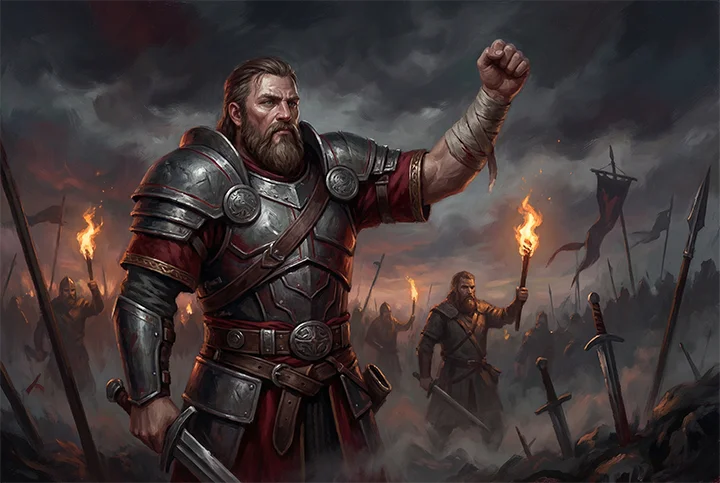
He is depicted as a one-handed warrior, the empty wrist a permanent testament to the greatest act of personal sacrifice in Norse mythology. Before the binding of the great wolf Fenrir, Týr alone among all the Aesir was brave enough to place his hand in the wolf's mouth as a pledge of good faith. When Fenrir discovered that he had been deceived, he bit the hand off at the wrist. Týr neither cried out nor sought revenge. He had given his word and accepted the consequences of what the gods had chosen to do.
His role in the Norse pantheon is ancient and his origins reach back further than those of most other Norse deities. Linguistic evidence suggests that Tīwaz was once the chief sky god of the early Germanic peoples, a position later absorbed by Odin as the mythological tradition developed and expanded. By the time the Eddas were composed, Týr had become a more focused deity, stripped of cosmic dominion but elevated in moral standing. He lost the sky and kept his integrity.
Origins & Mythology
The sources disagree on Týr's parentage in ways that are themselves revealing. The Prose Edda names Odin as his father, placing him firmly within the Aesir family structure. The Eddic poem Hymiskviða tells a different story, identifying his father as the giant Hymir, which would make Týr part giant, a detail that complicates his role as the upholder of divine order and suggests an older layer of mythology beneath the more systematic accounts of Snorri Sturluson.
His name connects directly to the Proto-Indo-European root dyeus, meaning sky or shining heaven, the same root that produced the Latin deus and the Greek Zeus. This linguistic lineage suggests that Týr and Zeus share a common ancestor in the ancient sky father of the Indo-European peoples, a supreme deity who presided over oaths, justice and the proper order of the cosmos. Over the millennia these parallel traditions diverged dramatically, with Zeus retaining his position as king of the gods in the Greek tradition while Týr was gradually overshadowed within the Norse system, yet the ancestral connection remains visible in the very shape of their names.
Tuesday takes its name from Týr, derived from the Old English Tīwesdæg, Týr's day. This survival in the names of the days of the week places Týr alongside Odin, Thor and Freya as one of the four Norse deities whose names became permanently embedded in the structure of the Western week, a remarkable persistence for a god whose mythological role had diminished considerably by the Viking Age.
Key Stories & Appearances
The defining myth of Týr is the binding of Fenrir, recorded in both the Prose Edda and the Poetic Edda. The gods had raised Fenrir among themselves in Asgard, but as the wolf grew to monstrous size the prophecies surrounding him became impossible to ignore: it was foretold that Fenrir would swallow Odin himself at Ragnarök and contribute to the destruction of the divine order. The gods decided to bind him, but Fenrir broke every chain they placed upon him with contemptuous ease.
They commissioned the dwarves of Svartalfheim to forge something that could hold him. The dwarves created Gleipnir, a ribbon-thin binding made from six impossible ingredients: the sound of a cat's footstep, the beard of a woman, the roots of a mountain, the sinews of a bear, the breath of a fish and the spittle of a bird. Because these things do not exist, Gleipnir could not be broken. Fenrir, suspecting trickery, agreed to be bound only if one of the gods would place a hand in his mouth as a pledge of good faith. None of the gods volunteered except Týr, who placed his right hand between the wolf's jaws without hesitation.
When Fenrir found he could not break free and realised he had been deceived, he bit off Týr's hand at the wrist. The other gods laughed with relief at Fenrir's binding, all except Týr, who had lost his sword hand for the sake of the collective safety. He accepted the loss without complaint. This act established Týr as the embodiment of a principle the Norse tradition held in the highest regard: that a man's word, once given, cannot be taken back regardless of the personal cost of keeping it.
Legacy & Significance
Týr's influence on Western culture is embedded in language in ways that most people never notice. Beyond Tuesday, the runic alphabet contains a rune named after him, Tiwaz, shaped like an upward-pointing arrow. This rune was carved onto weapons before battle as an invocation of his protective power and his authority over the outcome of single combat. Warriors who fought under his patronage were not asking for strength or ferocity but for justice: the belief that the righteous cause would prevail.
In a mythological tradition that celebrates cunning, power and the ability to bend rules to survive, Týr represents something quietly radical: the idea that some things should not be sacrificed even when survival demands it. He gave his hand so that the worlds could be protected, and he accepted the permanent cost of that choice without self-pity or resentment. His mythology speaks to anyone who has ever had to keep a promise that hurt to keep, and understood in that moment that the keeping of it was the most important thing they would ever do.
OTHRAVAR — Musical Tribute
Experience the honour and sacrifice of Týr through the ancient sounds of Norse folk music. This original composition draws from the skaldic tradition, performed with traditional instruments including tagelharpa, bukkehorn and frame drum.