The Silent God Who Will Avenge Odin at the End of the World
Overview
Víðarr is one of the most enigmatic figures in the Norse pantheon, a god defined almost entirely by silence and by a single act that has not yet happened. He is the son of Odin and the giantess Gríðr, raised in Asgard as one of the Aesir, described in the sources as the strongest of the gods after Thor. He speaks almost nothing in any surviving text. He attends the councils and the feasts. He is present at the great events of the mythological tradition without ever acting in them. He has been preparing, since before the mythological narratives begin, for one moment: the moment at Ragnarok when Fenrir swallows Odin, and Víðarr steps forward to kill the wolf.
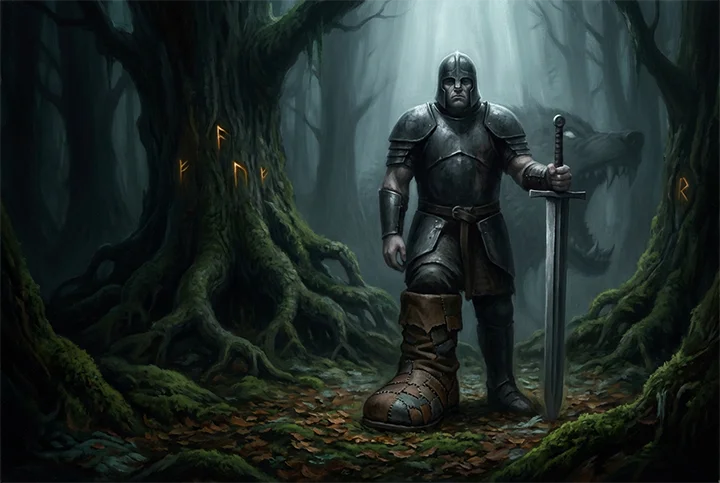
This single act of vengeance is the reason for everything about Víðarr that the sources choose to record. The thick shoe he wears, built from the leather scraps that cobblers have been accumulating since the beginning of the world, is made specifically for the moment when he will plant his foot in Fenrir's lower jaw and tear the wolf apart. His silence in the present is the silence of a being who has already committed himself entirely to a future event, who has nothing to say before the moment comes and everything to do when it arrives. Víðarr is Norse mythology's most patient figure: a god who has been waiting, since before his story begins, for the ending that will define him.
Origins and Mythology
The primary sources for Víðarr are the Prose Edda of Snorri Sturluson and several poems of the Poetic Edda, particularly the Voluspa and the Vafthrudnismal. Snorri describes him in the Gylfaginning as the silent god, noting that he is nearly as strong as Thor and that the gods rely greatly on him in all difficulties. He is given his own domain, a place described as overgrown with brushwood and long grass, called Víðr, whose name means wide or perhaps wilderness, a place apart from the cultivated order of Asgard and the other divine halls.
His mother Gríðr appears briefly in the Thor mythology as a giantess who helped Thor before his encounter with the giant Geirrod, lending him her magical belt of strength, iron gloves and staff. That the silent, powerful god of vengeance has a giantess for a mother is consistent with a pattern in Norse mythology in which the most decisive divine actors carry both orders of blood in their veins: Odin's wisest counsel comes from the giant Mimir, his most formidable son is half giant, and the being capable of killing the wolf that swallows the Allfather is the product of the divine and the monstrous combined.
The Shoe of Víðarr
The most distinctive detail associated with Víðarr is his shoe, and it is one of the more unusual pieces of practical mythology in the Norse tradition. The sources explain that the shoe Víðarr will use to brace his foot against Fenrir's lower jaw at Ragnarok is built from the leather scraps that cobblers trim from shoes during the making process. For this reason, the Norse tradition held that cobblers should throw away these scraps rather than keeping them, because any scrap discarded contributed to the strength of Víðarr's shoe and therefore to the possibility of vengeance for Odin's death.
This detail is remarkable for what it reveals about the Norse conception of cosmic time and collective responsibility. The shoe has been under construction since before the current age of the gods and will not be needed until after their deaths. Every cobbler in the Norse world who discards a scrap of leather is participating, without knowing it, in a cosmic act of preparation, contributing to the instrument of divine vengeance across a timeframe that no individual human life could encompass. The mythology of Víðarr's shoe turns an ordinary craftsman's offcut into a fragment of eschatology.
Víðarr at Ragnarok
The Voluspa and the Prose Edda both describe Víðarr's role at Ragnarok in similar terms. When Fenrir has swallowed Odin and the wolf runs with his mouth open so wide that his upper jaw touches the sky and his lower jaw drags along the earth, Víðarr steps forward. He places his iron-shod foot on Fenrir's lower jaw and takes the wolf's upper jaw in his hands. He tears the wolf apart. Odin is avenged.
The Prose Edda specifies that Víðarr stabs Fenrir through the palate with his sword, while the Voluspa emphasizes the tearing action. Both accounts agree on the essential fact: Víðarr kills Fenrir, and in doing so fulfills the sole purpose for which the sources establish him. He is the answer to Fenrir's existence, the equal and opposite force that the Norse cosmos required to exist as a counterweight to the wolf that would devour the Allfather.
After Ragnarok, Víðarr is among the gods who survive. The Voluspa lists him among those who will inhabit the new world that rises from the sea after the old one has burned, sitting in the fields of the renewed earth and speaking of the things that were. Having fulfilled the purpose for which he existed in the old world, he begins again in the new one. The silent god, having spoken through the single decisive action of his life, enters the world after the end with his oath kept and his father avenged.
The Significance of Silence
Víðarr's silence is one of the most carefully maintained characteristics in the Norse tradition, and it is worth asking what it means in a culture that valued speech as highly as the Norse did. In a world where skalds were divine in their art, where Odin sacrificed enormously for the power of words, where the bragarfull ceremony bound men to their oaths through public declaration, a god who says nothing is a god who has chosen to exist outside the primary medium through which Norse culture expressed and sustained itself.
One reading is that Víðarr's silence is a form of integrity: he has nothing to say because everything he has to do lies in the future, and speaking about it would neither hasten it nor change it. Another reading connects his silence to the nature of his role. Víðarr is not a god of ongoing divine governance, of wisdom or poetry or fertility or war in the present tense. He is a god of a single future event, and his silence in the present is proportional to the enormity of what that event represents. He is the most certain thing in Norse mythology: the one figure whose role is not subject to the interpretations of fate but is identical with it, the embodiment of the specific answer that the cosmos has prepared for the specific catastrophe of Odin's death.
Legacy and Significance
Víðarr is less prominent in modern popular engagement with Norse mythology than figures like Thor, Loki or Odin, partly because his mythological role gives him little narrative presence before the moment that defines him. He is not a character who develops through story; he is a function waiting to become an event. But this quality is precisely what makes him theologically interesting. In a tradition that treats fate as absolutely real and absolutely binding, Víðarr is the embodiment of fate's other face: not the doom it imposes but the answer it has already prepared. Fenrir will swallow Odin, and Víðarr will kill Fenrir. Both are inevitable. The wolf's destruction of the Allfather and the god's destruction of the wolf are two sides of the same predetermined sequence, and Víðarr is the element that ensures the sequence does not end with the wolf's victory.
His survival into the new world after Ragnarok gives him a significance that goes beyond vengeance. He is not merely the instrument of a single act but one of the gods who carries the continuity of divine existence across the catastrophe of Ragnarok into what comes after. In a tradition haunted by endings, Víðarr is one of the very few figures who stands on both sides of the world's destruction, present before it, present after it, silent through all of it, and defined by the one moment in between when he was not.