The Great Wolf Chained
Overview
The binding of Fenrir is one of the most psychologically complex stories in Norse mythology, a myth about the moment when trust is permanently destroyed between two parties who both know, from the beginning, exactly what they are doing and why. The gods needed to chain the great wolf Fenrir, son of Loki and the giantess Angrboða, because the prophecies made clear that he would one day swallow Odin himself at Ragnarök. Fenrir agreed to be bound in a test of his strength because he trusted the gods to release him when he asked. The fetter held. The gods refused to release him. And the one god who had given his word as surety lost his hand. Both sides understood the transaction perfectly. Neither side had any good options. The result was a betrayal that will be repaid at the end of the world.
Fenrir is one of three monstrous children born to Loki and Angrboða, the others being the World Serpent Jörmungandr and the death goddess Hel. All three were considered so dangerous that the gods took action against them before they could fulfil their prophesied roles. Jörmungandr was thrown into the ocean encircling Midgard. Hel was sent to rule the realm of the dead. Fenrir alone was raised in Asgard, among the gods, because no one was willing to make the journey to fetch him from Jötunheimr. Only the god Týr, the bravest of the Aesir, was willing to feed him as he grew.
And Fenrir grew. The sources describe his growth as terrifying in its pace and its scale, and the gods' alarm increased proportionally. When it became clear that he would eventually grow large enough to break any fetter they could forge, they turned to the dwarves of Svartalfheim for a solution that ordinary craft could not provide. What the dwarves made was not a chain but a paradox: a ribbon so impossibly fine and light that nothing could have been stronger.
Origins & Mythology
The story of the binding is told in the Prose Edda with unusual attention to the moral complexity of what the gods are doing. They are not heroes in this myth; they are frightened authorities taking preemptive action against a being whose only crime is what he will do, not what he has done. Fenrir has not yet harmed anyone. He is growing, and he is dangerous by nature, and the prophecies say he will swallow Odin. On the basis of that prophecy alone, the gods chain him for eternity.
The dwarves created the fetter Gleipnir from six impossible things: the sound of a cat's footstep, the beard of a woman, the roots of a mountain, the sinews of a bear, the breath of a fish and the spittle of a bird. Each of these things does not exist in the world, and their non-existence is the source of Gleipnir's power: it is made from what cannot be found, and therefore it cannot be broken by anything that exists. It looked like a silken ribbon. It was in fact the strongest thing ever made.
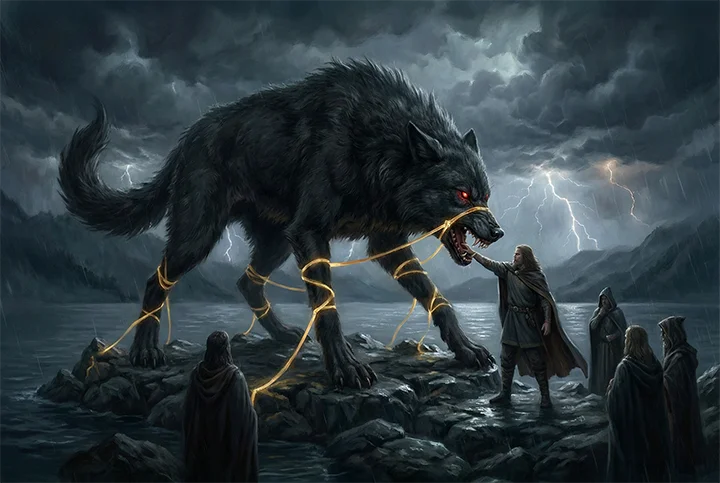
The gods took Fenrir to the island Lyngvi in the lake Ámsvartnir and suggested a game: they would test their new fetter on him, as they had tested others before, and if he broke it, as he had broken all the others, they would free him and acknowledge his strength. Fenrir agreed to the test, but he was not stupid. He could see that this ribbon was something different, and he demanded a surety: one of the gods must place a hand in his mouth as a pledge of good faith. If the gods did not free him when he asked, the god would lose the hand.
Every god refused. Only Týr placed his right hand in Fenrir's mouth. Fenrir tested Gleipnir and found he could not break it. He called for release. The gods laughed. Týr lost his hand. Fenrir was secured with a sword propped under his jaw to keep his mouth open, and he will remain there, howling at the injustice, until Ragnarök releases him.
Key Stories & Appearances
The binding of Fenrir establishes several of the most important fixed points of Norse eschatology. Fenrir's howl from his imprisonment echoes through the Norse cosmos as a reminder of what was done and what will be undone. At Ragnarök, the chain will break — Gleipnir is not eternal, merely sufficient for the age — and Fenrir will run with his mouth open so wide that his upper jaw scrapes the sky and his lower jaw drags along the earth, devouring everything in his path until he reaches Odin. Their confrontation is one of the most inevitable and most terrible events in the Norse mythological tradition.
Týr's sacrifice deserves particular attention as a study in the Norse concept of honour and duty. He knew exactly what would happen when he placed his hand in Fenrir's mouth. He knew the gods would not release the wolf. He knew he would lose his hand. He placed it there anyway, because someone had to, and because the honour of the gods required a surety even for a promise they had no intention of keeping. It is one of the most honest accounts of political necessity in any mythological tradition: the recognition that maintaining order sometimes requires doing things that cannot be defended on purely ethical grounds.
The sword propped under Fenrir's jaw, holding his mouth open, is not named in the primary sources, but the description of the bound wolf with the sword in his mouth, his saliva forming the river Ván as it drips from his jaws, is one of the most vivid and disturbing images in Norse mythology. It is not a comfortable image: a being bound not for what it has done but for what it will do, restrained by a trick rather than by justice, waiting with certainty for the moment of release.
Legacy & Significance
The binding of Fenrir is unusual among Norse myths in its refusal to present the gods as straightforwardly right. The wolf is bound through deception. The one god who acted with genuine honour lost his hand for it. The being who was wronged will eventually be released and will contribute to the destruction of everything. The myth does not pretend that the gods made a good choice; it presents a situation in which no good choice was available and follows the consequences of the choice that was made to their logical conclusion.
This is the Norse tradition at its most honest and most unsentimental. The gods are not omnipotent and they are not always right. They do what they must do to preserve the current order, knowing that what they must do is itself a cause of the eventual destruction of that order. Fenrir is chained because the prophecy says he will swallow Odin. Fenrir will swallow Odin because the gods chained him in a way that made his vengeance inevitable. The chain that was meant to prevent Ragnarök is itself one of its causes.
OTHRAVAR — Musical Tribute
Experience the weight of chains and the howl of the great wolf through the ancient sounds of Norse folk music. This original composition draws from the skaldic tradition, performed with traditional instruments including tagelharpa, bukkehorn and frame drum.