The Dragon, the Cursed Gold and the Hero Who Could Not Escape His Fate
Overview
The story of Sigurd and Fafnir is the great heroic saga of Norse mythology, the tale of a dragon slayer who wins the most cursed treasure in the world and discovers that winning it was the easier part. Sigurd, son of Sigmund of the Volsung line, is the supreme hero of the Norse tradition: stronger than any man, fearless in battle, guided by the wisdom of Odin himself. Fafnir is the dragon who guards the gold of Andvari, a hoard so thoroughly cursed that it has already destroyed everyone who has touched it and will destroy everyone who touches it again. The two are bound together by fate before they ever meet, and the story of their encounter is only the first movement of a tragedy that will consume Sigurd, his wife, his brothers-in-law, and the entire dynasty of the Nibelungs before it is done.
What makes this myth endure is not the dragon fight, spectacular as that is, but what follows it. Sigurd defeats Fafnir with intelligence as much as strength, kills him from below through a pit dug in the earth, tastes the dragon's blood and gains the ability to understand the speech of birds, and learns from the birds themselves that he is about to be betrayed by his own companion. The hero who can hear what birds say cannot change what fate has already arranged. He rides forward anyway, into the fire that surrounds the sleeping valkyrie Brynhild, and from that moment everything that follows is already determined.
Origins and Mythology
The Sigurd legend is one of the most extensively documented in the Norse and Germanic tradition. The primary Norse sources are the Volsunga Saga, a prose compilation drawing on older Eddic poetry, and the heroic lays of the Poetic Edda including the Fafnismal, the Reginismal and the Sigrdrifumal. The same legend appears in the Old High German Nibelungenlied in a significantly different form, which tells us that the story was ancient and widespread across the Norse-Germanic world long before it was written down.
The gold itself has a history before Sigurd. It belonged to the dwarf Andvari, who kept it in a pool in the form of a pike. The gods Odin, Loki and Hoenir accidentally caused the death of a man named Otter, who was the son of the sorcerer Hreidmar, and were forced to pay compensation. Loki captured Andvari and took all his gold, including a ring called Andvaranaut. Andvari cursed the gold before surrendering it, declaring that it would be the destruction of everyone who possessed it. Hreidmar took the gold. His son Fafnir killed him for it, drove his brother Regin away, transformed himself into a dragon, and has been lying on the hoard ever since, poisoning the earth around him with his venom.
Regin and the Sword Gram
Regin, the surviving brother, becomes the foster father of Sigurd after the death of Sigurd's father Sigmund. Regin is a master craftsman, the greatest smith in the world, and he shapes Sigurd into the hero he needs for his own purposes: Regin wants the gold and wants Fafnir dead, and Sigurd is the instrument he has been waiting for. He forges Sigurd a sword, but Sigurd tests each blade by striking the anvil and each one shatters. Sigurd eventually brings Regin the fragments of his father Sigmund's sword Gram, broken in Sigmund's last battle by Odin himself, and asks Regin to reforge it. Regin does. Sigurd tests the reforged Gram on the anvil and it does not break. He tests it on the Rhine by floating a piece of wool downstream and holding the blade against the current: the wool is cut in two. Gram is the sword he needs.
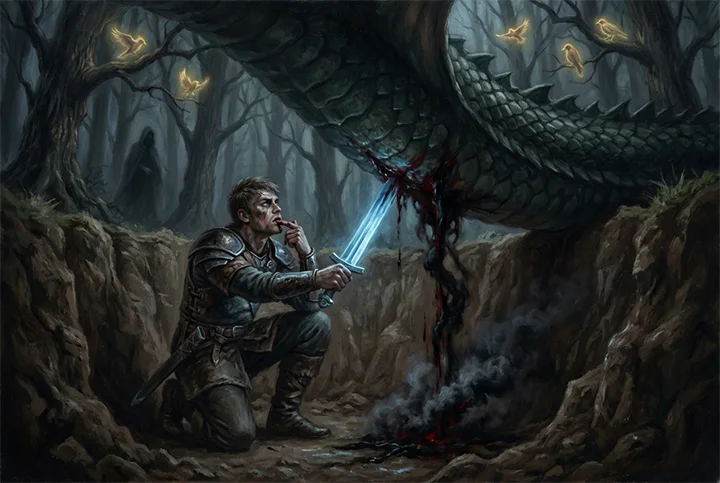
Before turning to Fafnir, Sigurd fulfills a duty of vengeance: with a warband of King Hjalprek, he hunts down and kills the men who murdered his father. Only after this is done does he ride with Regin to the heath of Gnitaheidr where Fafnir crawls each day from his lair to drink from the water. Odin, disguised as an old man, advises Sigurd to dig a pit in the path Fafnir takes to the water and to strike upward into the unprotected belly as the dragon passes over. Sigurd does exactly this. When Fafnir passes over the pit, Sigurd drives Gram upward into his heart. Fafnir falls, the earth shakes, and the great dragon dies slowly, long enough to have a conversation with the man who has killed him.
The Death of Fafnir and the Betrayal of Regin
Fafnir's death scene is one of the most philosophically charged in the Norse tradition. The dying dragon speaks to Sigurd and tells him that the gold will destroy him as it has destroyed everyone else. Sigurd does not deny this. He says that a man must die once and that no one escapes his fate, but that he would rather die rich than live poor. Fafnir warns him specifically about Regin, telling him that his foster father will betray him. Sigurd already suspects this. He returns to Regin and cuts out Fafnir's heart to roast it.
Regin asks Sigurd to roast the heart while he sleeps, recovering from a wound. Sigurd roasts it. When he touches the heart to test whether it is done, a drop of the blood burns his finger and he instinctively puts it in his mouth. The moment Fafnir's blood touches his tongue he can understand the speech of birds. The birds in the tree above him are discussing his situation: Regin plans to kill him and take all the gold. They advise Sigurd to kill Regin first and take the gold himself. Sigurd draws Gram and kills Regin. He eats Fafnir's heart himself, loads the cursed gold onto his horse Grani, and rides away.
Brynhild and the Beginning of the End
The birds also tell Sigurd where to go next: to the mountain Hindarfjall, where a valkyrie lies sleeping inside a ring of fire, placed there by Odin as punishment for disobeying him in battle. Her name is Brynhild. Sigurd rides through the fire, cuts the armor from the sleeping figure, and wakes her. Brynhild teaches him wisdom and runes. They swear oaths of love to each other. Sigurd rides on, into the world, carrying the cursed gold and the memory of Brynhild's face, into the hall of the Nibelungs and the sequence of enchantments and betrayals that will end with his death in his marriage bed, stabbed through a single vulnerable point in his body while he sleeps, by a man who was once his closest friend.
The curse of Andvari's gold runs true. Everyone who touches the hoard is destroyed. Sigurd knew it when Fafnir told him and he took it anyway. The Norse tradition does not present this as stupidity or hubris. It presents it as the condition of being alive in a world where fate is real: knowing what is coming does not change what is coming, and the alternative to riding forward into what the birds described was not safety but simply a different kind of diminishment.
Legacy and Significance
The Sigurd legend is the closest thing the Norse world has to a central heroic myth, the story that was told more widely, adapted more frequently and remembered longest across the Germanic north. Its influence extends from the carved wooden portals of Norwegian stave churches, several of which depict scenes from the Sigurd legend, to Richard Wagner's Ring Cycle, which drew heavily on the Nibelungenlied version of the same story. The figure of Sigurd himself, the hero who knows his fate and accepts it, who fights with perfect courage in a world where courage cannot prevent the end, is one of the defining images of the Norse heroic ideal.
The dragon Fafnir is equally significant as a mythological figure. He is not simply a monster to be overcome: he is a man who became a monster through greed, and he retains enough of his original intelligence in death to hold a philosophical conversation about fate with the hero who has just killed him. The Norse tradition's tendency to give its monsters interiority, to make them capable of speech and reflection even at the moment of their destruction, is one of its most distinctive qualities, and Fafnir is its most fully realized example.
OTHRAVAR — Musical Tribute
Experience the thunder of Gram striking true and the dragon's dying words on the heath of Gnitaheidr through the ancient sounds of Norse folk music. This original composition draws from the skaldic tradition, performed with traditional instruments including tagelharpa, bukkehorn and frame drum.