The Nine Nights, the Runes and the Price of Wisdom
Overview
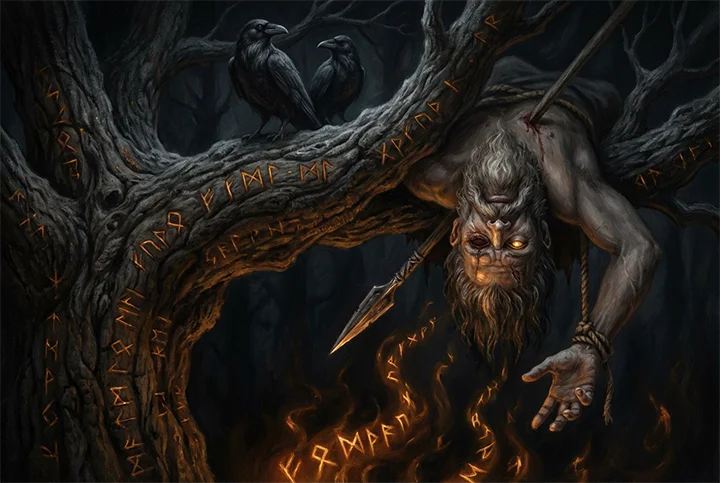
The myth of Odin's self-sacrifice on the world tree Yggdrasil is the account of how the runes were discovered and how the knowledge they encode entered the world. It is preserved primarily in the Hávamál, one of the poems of the Poetic Edda, in a section called the Rúnatal, the Rune's Account. Odin hangs himself on Yggdrasil, wounded by a spear, for nine days and nine nights, looking down into the darkness below, without food or drink, without anyone to help him, until the runes rise up to meet him from the depths and he seizes them and falls back from the tree. The act is described explicitly as a sacrifice of himself to himself, performed in order to gain the knowledge that the runes represent, which encompasses the full understanding of the deep structure of the cosmos that the characters encode.
This myth is among the most structurally important in the entire Norse tradition. It connects Odin's primary identity as the god of wisdom and knowledge directly to a specific act of self-mortification whose cost was precisely calculated and freely chosen. It establishes the runes not as an invention or a gift from above but as a discovery made through suffering, found in the depths below the world tree that holds the cosmos in place. And it frames the acquisition of knowledge, in the Norse tradition, as something that always has a cost proportional to its value.
The Hávamál Text
The primary source is the Hávamál, the Words of the High One, a collection of wisdom verses attributed to Odin in the Poetic Edda. The Rúnatal section, stanzas 138 to 145 in the standard numbering, describes the hanging in the first person. The relevant stanzas are among the most important in the Old Norse poetic tradition and have been translated and commented on extensively.
Stanza 138 states that Odin knows he hung on the wind-cold tree for nine whole nights, wounded by a spear and given to Odin, himself to himself. The phrase given to Odin, himself to himself, identifies the sacrifice as reflexive: Odin is simultaneously the sacrificer and the sacrificed, offering himself to himself in a transaction that takes place entirely within his own nature. The tree is not named in this stanza but is identified by other stanzas as Yggdrasil, whose name means Odin's horse or the horse of the terrible one, the tree being the instrument on which Odin hangs as a gallows-tree.
Stanza 139 continues by saying that no one gave him food or drink from a horn. He looked down; he took up the runes, screaming he took them, and from there he fell back. The screaming is significant: the acquisition of the runes is not a calm intellectual achievement but a moment of violent, physical crisis, a cry that corresponds to the effort of reaching down into the darkness of the well below the tree and seizing the shapes that rose to meet him.
Stanzas 140 to 141 describe Odin beginning to grow and to thrive, gaining wisdom from word to word and deed from deed, with each rune giving him knowledge that allows him to gain more knowledge, a recursive process in which the runes teach him how to use the runes. Stanza 142 names the sources of runic knowledge: Óðrerir, the mead of inspiration brewed from Kvasir's blood, the sea and the sacred well. Stanza 143 acknowledges that the runes were carved by Óðinn, by Dáinn for the elves, by Dvalinn for the dwarves, and by Ásviðr for the giants, establishing that the runic system is known across all the orders of beings in the Norse cosmos.
Stanzas 144 and 145 list eighteen magical applications of runic knowledge that Odin commands as a result of his acquisition of the runes, covering healing, protection from fire and water, breaking fetters, blunting the weapons of enemies, making warriors unable to fight, redirecting spells back to their senders, extinguishing fire, calming storms, awakening the dead to speak, winning love, making a shield effective, and a final charm so powerful that Odin will tell it only to his wife or his sister, keeping it from any man.
The Spear
The spear with which Odin wounds himself is Gungnir, Odin's own spear, made by the dwarves of Svartalfheim, the finest weapon in the Norse mythological armory. The use of his own spear to wound himself before hanging is consistent with the sacrificial context: the victim in a Norse sacrifice was typically killed by the same means that Odin uses, by hanging or by spear or by both, and the method of Odin's self-sacrifice mirrors exactly the method of sacrifice practiced in his honor. Adam of Bremen's eleventh-century description of the sacrifices at the temple of Uppsala describes human and animal bodies hanging from the sacred grove beside the temple, a practice that corresponds directly to the mode of Odin's own sacrifice on Yggdrasil.
The Nine Nights and the Number Nine
The number nine is among the most significant in Norse mythology and cosmology. There are nine worlds in the Norse cosmos. Odin hangs for nine nights. Heimdall was born of nine mothers. The serpent Níðhöggr gnaws at Yggdrasil's root and the ring Draupnir produces eight rings every ninth night. The repetition of nine in cosmologically significant contexts suggests that it carried a specific symbolic weight in Norse religious thought, possibly connected to the phases of the moon or to a calendrical cycle, though the precise meaning is not recoverable from the surviving sources.
Yggdrasil as Gallows and Axis
The hanging of Odin on Yggdrasil involves a complex identification between two different aspects of the world tree. Yggdrasil is the axis mundi, the column that holds the Nine Worlds in their proper arrangement and at whose roots the Norns weave fate and the water of the sacred well maintains the tree's life. It is also, in the context of Odin's sacrifice, a gallows, the tree on which the god hangs in the manner of a sacrificial victim. The same structure that sustains the cosmos is the instrument of the suffering through which its deepest knowledge is accessed. This dual identity is consistent with Norse cosmological thinking more broadly, in which the same element often serves both a sustaining and a threatening function simultaneously.
The name Yggdrasil itself encodes this dual identity. Yggr is one of Odin's names, meaning the terrible one, and drasill means horse, with the compound understood as the horse of the terrible one, a kenning for the gallows as the horse that carries the hanged man. The world tree, the axis of the cosmos, is named in the Norse tradition by a word that means the tree from which the hanged man dangles, specifically identified as Odin's own gallows.
Parallels and Context
The myth of Odin's hanging on Yggdrasil has attracted extensive comparative analysis. Its structure, a god who undergoes voluntary death and resurrection in order to acquire transformative knowledge, has been compared to shamanistic initiation practices documented in Siberian and central Asian cultures, in which the initiating shaman undergoes a symbolic death, typically involving a vision of being dismembered and reassembled, before returning with new spiritual knowledge. The wounded condition, the hanging, the nine-night duration, the looking down into the dark and the violent seizure of the runes all correspond to elements of the shamanic initiatory pattern.
The identification of Odin as a practitioner of seidr, the Norse magical tradition that was closely connected to the shamanic practices of the Sámi people, provides additional context for understanding his hanging as an initiatory experience rather than simply a suffering. The specific knowledge gained, the runes, is not abstract wisdom but a set of operational characters whose correct use produces concrete effects in the world. This is consistent with the instrumental character of shamanic knowledge as documented in ethnographic sources.
Legacy and Significance
The myth of Odin's hanging on Yggdrasil is the foundational narrative of Norse runic culture and one of the most structurally important myths in the entire tradition. It establishes that the most valuable knowledge in the Norse cosmos was found in the darkness below the world tree through an act of voluntary suffering, and that the god who is the paradigmatic seeker of wisdom paid for it with his own body and his own pain. Combined with the myth of Odin's sacrifice of his eye at Mimir's well, it presents a consistent portrait of the Allfather as a being whose pursuit of knowledge is defined by what it costs rather than by what it provides: a deity who has bought his wisdom through suffering, and who holds it with the authority that only suffering can bestow.
OTHRAVAR — Musical Tribute
Experience the nine nights of wind and darkness on the world tree and the violent moment when the runes rise up from below through the ancient sounds of Norse folk music. This original composition draws from the skaldic tradition, performed with traditional instruments including tagelharpa, bone flute and frame drum.