From the Void to Yggdrasil: How the Norse Gods Made the World
Overview
The Norse creation myth is the account of how the cosmos came into being from primordial nothingness, how the first giant was formed from ice and fire, how the gods were born, how they killed the first giant and shaped the world from his body, and how they created human beings from two trees found on the edge of the land. It is preserved primarily in the Voluspa of the Poetic Edda and in the Gylfaginning of Snorri Sturluson's Prose Edda, and it presents a cosmology of unusual completeness, tracing the origins of every significant element of the Norse world from the void through the formation of the first being to the creation of the world tree, the Nine Worlds, the gods, the dwarves, the giants and finally humanity.
The Norse creation is not a creation from nothing in the theological sense used by later monotheistic traditions. It begins with a void called Ginnungagap, but this void already contains the potential for the two primordial forces, heat and cold, fire and ice, whose interaction generates the first life. The gods who shape the world do not create matter; they arrange and transform what already exists, killing the first giant and using his body as the raw material of the cosmos.
Sources
The primary sources are the Voluspa, stanzas 1 to 18 of which give the seeress's account of creation, and Snorri's Gylfaginning, which provides a more detailed prose account drawing on the Voluspa and on other poetic material now lost. The Vafthrudnismal contains additional cosmological detail, and the Grimnismal describes the structure of the created world including the Nine Worlds and the halls of the gods.
Ginnungagap: The Primordial Void
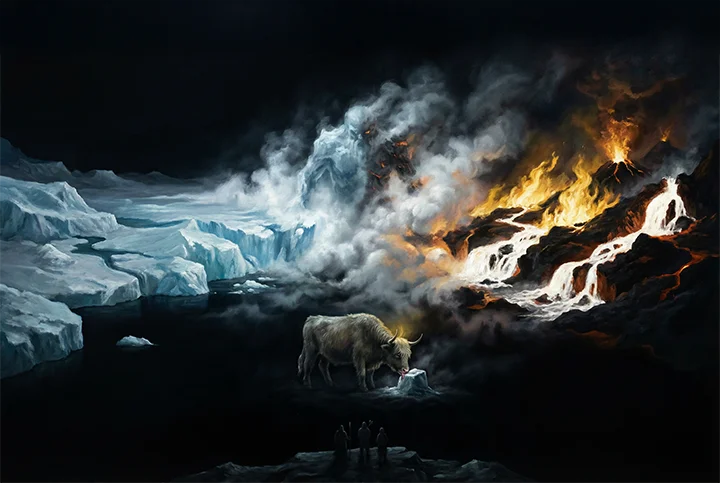
Before the world existed there was Ginnungagap, a void or gap of magical potential. To the north of Ginnungagap lay Niflheim, the world of ice, mist and cold, from which eleven rivers called the Élivágar flowed outward and eventually froze. To the south lay Muspelheim, the world of fire, blazing and impassable, ruled by Surtr who guards it with his flaming sword. Where the ice from the north met the warmth from the south at the center of Ginnungagap, the ice began to thaw and to drip. From the dripping ice emerged the first living being, the frost giant Ymir.
Ymir and the First Beings
As Ymir slept, he sweated, and from his sweat emerged the first giants. The cow Auðumbla was also formed from the dripping ice, and she fed Ymir with her four rivers of milk. Auðumbla herself fed by licking the salty ice blocks. As she licked, a man emerged from the ice: first his hair appeared on the first day, then his head on the second, and by the third day his entire body was free. This man was Búri, the first of the divine lineage. Búri had a son named Borr, and Borr married the giantess Bestla. From this union were born three sons: Odin, Vili and Vé, the three brothers who would kill Ymir and make the world.
The Killing of Ymir and the Making of the World
Odin, Vili and Vé killed Ymir. When Ymir died, so much blood flowed from his wounds that it drowned all the frost giants except Bergelmir and his wife, who survived. The three brothers took Ymir's body to the center of Ginnungagap and began to make the world from it. His flesh became the earth. His blood became the sea and all the waters of the world. His bones became the mountains. His hair became the trees. His skull became the sky, held at its four corners by four dwarves named Norðri, Suðri, Austri and Vestri. His brain was thrown into the air and became the clouds. His eyelashes became the fence that surrounds Midgard. The brothers took sparks and burning embers from Muspelheim and placed them in the sky to become the stars, the sun and the moon.
The Making of the Dwarves
The gods discovered maggots in Ymir's flesh, and they gave these maggots intelligence and the form of men, but they dwell in the earth and in rocks. These are the dwarves, the foremost craftsmen in the Norse cosmos, responsible for making Gleipnir, Skidbladnir, Gungnir, Mjolnir, the golden hair of Sif, and the Mead of Poetry.
The Making of Midgard and Ásgarðr
The world the brothers made from Ymir's body is organized concentrically. At its center is Midgard, the Middle World, protected by the fence made from Ymir's eyelashes. Surrounding Midgard is the ocean, and in the ocean lives Jörmungandr. Beyond the ocean is Útgarðr, including Jötunheimr where the giants live. Above, in the branches of the world tree Yggdrasil and accessible across the rainbow bridge Bifrost, is Ásgarðr, the realm of the gods.
Yggdrasil: The World Tree
Yggdrasil, the immense ash tree that holds the Nine Worlds in their proper arrangement, stands at the center of the Norse cosmos. Its three roots extend to three different wells: one root extends to Ásgarðr and the well of Urð where the Norns weave fate; one extends to Jötunheimr and the well of Mimir where wisdom is kept and from which Odin drank at the cost of his eye; and one extends to Niflheim and the well of Hvergelmir, the source of all rivers, where Níðhöggr gnaws at the root from below. The Nine Worlds that Yggdrasil connects and sustains are Ásgarðr, Vanaheimr, Midgard, Jötunheimr, Niflheim, Muspelheim, Álfheimr, Svartálfaheimr and Hel.
The Creation of Humanity: Ask and Embla
Three gods were walking along the shore when they found two trees, Ask and Embla, with no life and no fate. The gods gave them life, sense, warmth, color and speech. They were placed in Midgard, which was made ready for them, and from them all human beings descended. The separation of the making of the world from the making of its human inhabitants is characteristic of the Norse creation account: humans are not the purpose of creation but beings who were discovered and gifted with consciousness in a world that already existed.
The Role of the Norns
The creation account in the Voluspa includes the arrival of the Norns as a separate and crucial event. After the gods have made the world and human beings have received their gifts, three maidens arrive from the hall of the giants and establish fate. Their arrival marks the moment when time in the full sense enters the world. The creation of the world is not complete until fate has been established, because a world without fate is a world without history.
Legacy and Significance
The Norse creation myth is one of the most complete and internally consistent cosmogonic narratives in world mythology. Its account of a world made from a body places violence at the foundation of existence in a way that is unusually honest about the relationship between creation and destruction. The world is not made from nothing; it is made from Ymir, and Ymir's descendants will spend the entire mythological tradition working to reclaim what was taken from their ancestor. Ragnarök is, among other things, the world returning to the condition from which it was made.