The Primordial Void at the Beginning of the Norse Universe
Overview
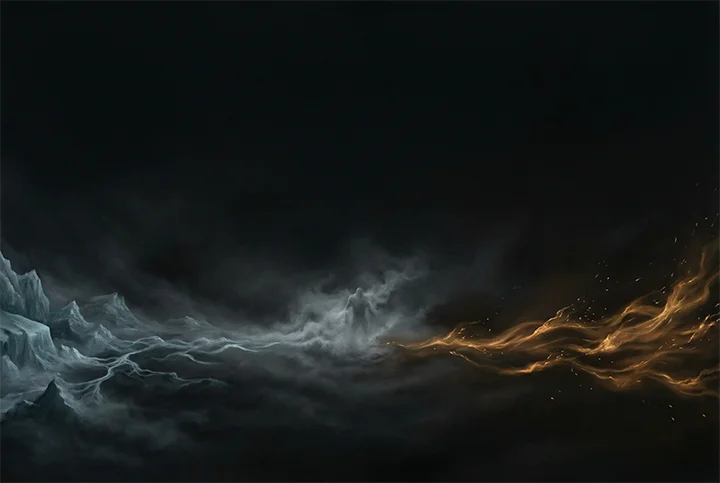
Ginnungagap is the primordial void or gap that existed before the Norse cosmos came into being, the nothing from which everything emerged, the space of pure potential in which the forces of fire and ice first met and from whose interaction the first living being was generated. The name is Old Norse and has been interpreted in several ways by scholars: the most common readings are the yawning void, the gap full of magical potential, or the gap of gaps, a superlative form suggesting the most complete possible absence. Whatever the precise etymology, the concept is clear: Ginnungagap was what was there before anything was there, and its function in the Norse creation narrative is to provide the space and the conditions within which the primordial forces could interact to produce the first life.
Sources
The primary sources for Ginnungagap are the Prose Edda of Snorri Sturluson, particularly the Gylfaginning, which provides the most detailed prose account of its nature and role in the creation narrative, and the Vafthrudnismal and the Voluspa in the Poetic Edda, which allude to the primordial void in their cosmogonic passages. Snorri's account in the Gylfaginning is the fullest single description of the pre-creation state and of the events that transformed the void into the first living being and eventually into the world. The Voluspa begins with the image of a time before the world existed, when there was neither sand nor sea nor cool waves, neither earth below nor sky above, only a yawning gap and nowhere was there grass, presenting one of the most evocative images of primordial nothingness in any world mythology.
The Structure of the Void
Ginnungagap did not exist in isolation. To its north lay Niflheim, the primordial world of ice, mist and cold, from which the eleven rivers called the Élivágar flowed outward into the void. As these rivers moved further from their source in Niflheim, the venomous matter they carried froze, and layers of ice and frost built up in the northern region of Ginnungagap, filling it with rime and drizzle. To the south of Ginnungagap lay Muspelheim, the world of fire, blazing and impassable, ruled by the giant Surtr who guards it with his flaming sword and who will lead the sons of Muspel to destroy the world at Ragnarök. The heat and sparks from Muspelheim spread northward into Ginnungagap toward the accumulating ice from Niflheim.
The region of Ginnungagap closest to Muspelheim was mild and warm. The region closest to Niflheim was filled with ice, rime and drizzle. In the middle, where the two regions met, the heat of Muspelheim began to melt the ice of Niflheim, and from the dripping of the melting ice the first living being emerged: the primordial frost giant Ymir, who appeared passively and without any divine agency, the spontaneous product of the interaction of the two primordial forces.
Ginnungagap as Creative Space
The concept of Ginnungagap as a space of magical potential rather than simply as a void or emptiness is significant for understanding the Norse creation narrative. The void was not nothing in the absolute sense; it was a space charged with potential, a gap in which things could happen because neither of the two organizing forces that would eventually shape the world, the divine order of Odin's line or the giant world of Ymir's descendants, had yet asserted itself. Ginnungagap was the condition of possibility before possibility was actualized: the space in which fire and ice could meet without the intervention of will or design, and from whose meeting the first life and eventually the world itself emerged.
This understanding of creation as emerging from the interaction of opposing forces without a creator's intention is distinctive in world mythology. Most creation narratives involve either a creator who shapes the world from pre-existing matter or a creator who generates matter ex nihilo through will or speech. The Norse narrative begins instead with two forces and a space between them, and the creation that results from their interaction is unintended, undesigned and in some respects unavoidable given the structure of the primordial geography. The world that results from this process is therefore not created by a god but discovered by gods who then inhabit and shape what has already, without their intervention, come into being.
The Transformation of Ginnungagap
After the killing of Ymir and the construction of the world from his body, Ginnungagap as a distinct entity effectively ceased to exist: the void was filled by the world the gods built from Ymir's flesh. The ocean that surrounds Midgard and in which Jörmungandr lives is Ymir's blood filling what was once the void. The earth is Ymir's flesh. The sky is Ymir's skull. The world is, in a literal sense, the filling of the primordial gap, the transformation of the void into substance through the violence of the gods' killing of the first being. Ginnungagap survives in the Norse cosmological tradition not as a place that continues to exist but as a memory of what was there before the world, the nothing against which the something of the world defines itself.
Ginnungagap at Ragnarök
The relationship between Ginnungagap and Ragnarök is implicit rather than explicit in the sources, but it is cosmologically consistent. Ragnarök is, among other things, the world returning to the condition from which it was made: the fire of Surtr, who comes from Muspelheim, burns everything; the sea rises and swallows the burning land; the world that was built from Ymir's body comes apart. The new world that rises from the sea after Ragnarök begins the process again, though the sources do not describe the new creation in terms that explicitly reference Ginnungagap. The structure of the Norse cosmos is cyclical in a way that makes the void a permanent condition underlying the manifest world, always present beneath the surface of things, waiting for the moment when the world returns to the state from which it came.
Comparative Mythology
The concept of a primordial void or gap from which the world emerges through the interaction of opposing forces appears in several other world mythological traditions. The Greek chaos, from which the first beings emerged, shares with Ginnungagap the character of a formless potential from which differentiation emerges. The Mesopotamian Tiamat and Apsu, the salt water and fresh water whose mingling generates the first gods, parallel the Norse ice and fire whose meeting generates the first being. Whether these parallels reflect a shared Indo-European cosmogonic tradition, independent parallel developments of similar concepts, or the universal human tendency to imagine the beginning of the world as a state of undifferentiated potential, they demonstrate that Ginnungagap belongs to a worldwide tradition of thinking about origins that is among the most philosophically sophisticated achievements of pre-scientific human culture.
Legacy and Significance
Ginnungagap is the foundational concept of Norse cosmology, the condition from which everything else derives. Its character as a space of magical potential rather than absolute nothingness, its role as the meeting place of the primordial forces whose interaction generated the first life, and its transformation into the world through the violent death of that first life give the Norse creation narrative a philosophical structure that is as sophisticated as any in world mythology. The understanding that the world was not created by a god but emerged from the interaction of opposing forces in a space of pure potential, and that it will return to that space when the forces of dissolution finally overcome the order imposed upon it, is among the most distinctive and most intellectually interesting contributions of the Norse tradition to human thinking about origins and endings.