The Realm of the Dead and the Domain of Hel, Daughter of Loki
Overview
Helheim, the realm of Hel, is the world of the dead in Norse cosmology, the place to which the majority of the dead travel after death regardless of how they lived or how they died. It is one of the Nine Worlds connected by Yggdrasil, located in Niflheim, the primordial world of ice and mist, and presided over by the goddess Hel, the daughter of Loki and the giantess Angrboða. Unlike Valhalla, which is a place of honor for warriors chosen by Odin to prepare for Ragnarök, Helheim receives all other dead, the sick, the old, those who die of illness, accident or in ways not considered glorious in battle. The Norse tradition gives Helheim less attention than Valhalla in the surviving literary sources, but this disproportion reflects the bias of the saga and skaldic literature toward the warrior elite, not the actual importance of Helheim in Norse religious belief, where it was the destination of the overwhelming majority of the dead and therefore one of the most practically significant concepts in Norse eschatology.
Sources
The primary sources for Helheim are the Gylfaginning of Snorri Sturluson's Prose Edda, the Voluspa and the Baldrs draumar in the Poetic Edda, and scattered references throughout the Kings' Sagas and the family sagas. The myth of Hermod's ride to Hel to petition for Baldur's return, preserved in the Gylfaginning, provides the most detailed description of the journey to Helheim and the world itself. The Baldrs draumar, the Dreams of Baldur, describes Odin riding to Helheim before Baldur's death to consult a dead völva about the prophecy of his son's fate, providing a second perspective on the world of the dead and its relationship to the living world of the gods.
Hel: The Goddess and the Realm
The goddess Hel, whose name is also used as a name for the realm she rules, is described by Snorri in the Gylfaginning as half black and half flesh-colored, with a downcast and grim appearance. She is the daughter of Loki and Angrboða, and her siblings are Fenrir the wolf and Jörmungandr the world serpent. When the gods became aware of these three monstrous children through prophecy, they acted against each of them: Fenrir was brought to Asgard and eventually bound, Jörmungandr was thrown into the ocean, and Hel was thrown by Odin into Niflheim and given authority over the nine worlds of those who die of sickness and old age. Snorri specifies that she has great wealth, as all those who die flow to her realm, and that her hall is called Éljúðnir, her dish Hungr, her knife Sultr, her threshold Fallandaforad, her bed Kör, and her bed curtains Blíkjandaból. These names, meaning respectively Hunger, Famine, Stumbling-block, Sick-bed, and Gleaming Disaster, give Helheim a grim domestic character that is consistent across the sources.
The Journey to Helheim
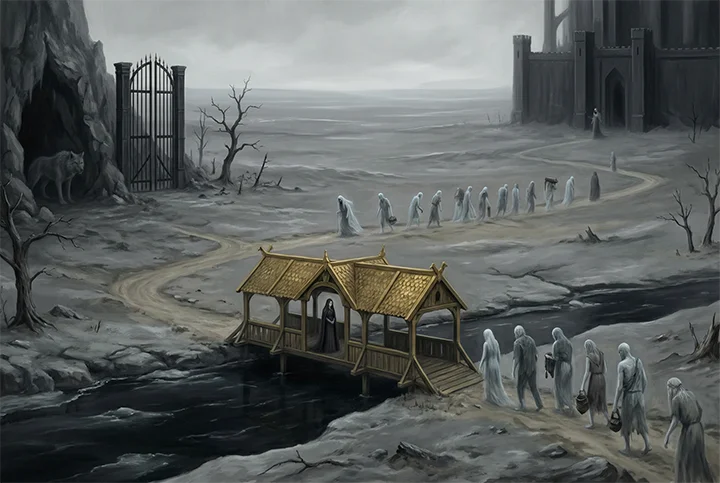
The geography of the journey to Helheim is described most fully in the Gylfaginning's account of Hermod's ride. After Baldur's death, Frigg asked if any of the gods would ride to Hel and offer her a ransom for Baldur's return. Hermod, described as the swift god, agreed to go. He took Odin's horse Sleipnir, the eight-legged son of Loki and the stallion Svaðilfari, and rode for nine nights through valleys so deep and dark that he could see nothing. He came to the river Gjöll, the river of the dead that separates the world of the living from the world of the dead, and crossed the Gjöll bridge, a bridge covered with gleaming gold, guarded by the maiden Módguðr. She told him that he was the fifth group of dead men to cross that day, but that he lacked the color of death and asked his business. He told her he sought Baldur and she directed him onward.
Hermod continued until he reached Hel's gate, the barrier that marks the boundary of Helheim itself. He put the spurs to Sleipnir and jumped the gate without dismounting. Inside Helheim he found Baldur sitting in the seat of honor. He spent the night there and in the morning petitioned Hel to release Baldur. Hel replied that she would release him if every being in the world, living and dead, wept for him. The Aesir sent messengers throughout all the worlds asking everything to weep. Everything wept except one giantess named Þökk, who was Loki in disguise, and Baldur remained in Hel.
Náströnd and the Wicked Dead
The Voluspa describes within Helheim a place called Náströnd, the Corpse Shore, which is distinct from the general realm of the dead and reserved specifically for those who committed the most serious moral crimes: murderers, oath-breakers, and those who seduced the wives of others. Náströnd is described as a hall whose doors face north, built from woven serpents whose heads point inward and drip venom, and through whose streams of venom the guilty must wade. This distinction between the general undifferentiated realm of the dead and a specific place of punishment for the worst offenders is unusual in the Norse tradition, which does not generally operate with a strong concept of moral judgment after death, and the Náströnd passage has been interpreted by some scholars as reflecting Christian influence on the later recension of the Voluspa.
Helheim at Ragnarök
At Ragnarök, Hel releases the dead from her realm to join the forces that destroy the old world. The ship Naglfar, built from the fingernails and toenails of the dead and crewed by the inhabitants of Hel, floats free and sails to the battle on Vígríðr. Hel herself is listed among the powers of dissolution at Ragnarök, and the dead she has accumulated over all of mythological time become part of the army that ends the world. This role at Ragnarök gives Helheim a cosmological significance beyond its function as the destination of the dead: it is a reservoir of dissolution that empties at the end, returning its accumulated dead to the world at the moment of maximum destruction.
Hel in Old Norse Language and Culture
The Old Norse word hel, from which the English word hell derives through the Germanic linguistic tradition, originally referred to the covered or concealed realm, from a root meaning to cover or conceal, the same root as in the word helmet. The English hell acquired its specifically Christian associations with damnation and punishment only through the influence of the Christian theological tradition on an originally more neutral Old Norse concept of the world of the dead as a covered, hidden place beneath the earth. The Norse Hel was not inherently a place of punishment for the wicked, though Náströnd represented such a place for the worst offenders, but simply the destination of the ordinary dead, a fact reflected in the originally neutral etymology of the word.
Legacy and Significance
Helheim represents the Norse tradition's primary account of what happens to the majority of the dead, and its relative neglect in the surviving literary sources compared to Valhalla reflects the literary preferences of the warrior elite who produced and transmitted the skaldic and saga traditions rather than the actual religious importance of the realm. The concept of Hel as a figure who presides over a realm of the dead, the journey across the river of death to reach it, the golden bridge guarded by a female figure, and the detailed domestic nomenclature of Hel's hall all suggest a rich and well-developed conception of the afterlife that the surviving sources preserve only partially.