The Realm of the Giants at the Edge of the Norse Cosmos
Overview
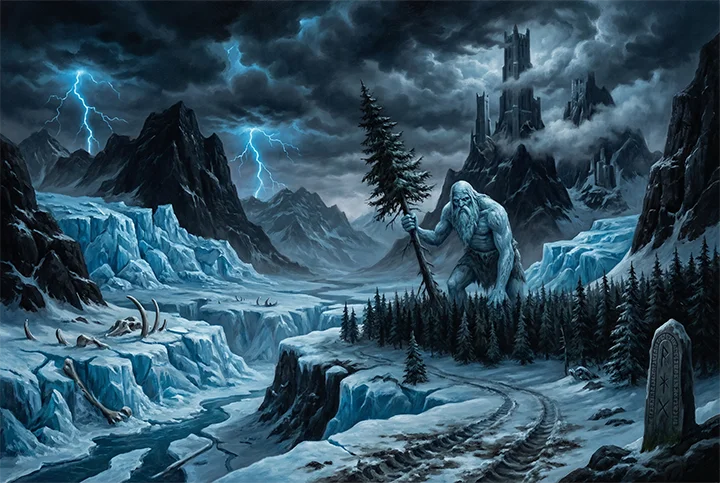
Jötunheimr is the realm of the giants in Norse cosmology, the world that lies beyond the boundaries of Midgard and Ásgarðr, inhabited by the jötnar, the race of beings from whom the gods were originally descended and with whom they exist in a relationship of perpetual conflict, uneasy alliance and sometimes intermarriage. The word jötunheimr means giant-home or home of the giants, and the realm is described as existing beyond the great ocean that encircles Midgard and to the east or north of the inhabited worlds. It is the place from which the principal threats to the divine order originate. Yet it is also the source of wisdom: Mímir's well is in Jötunheimr, the giant Vafthrudnir is the wisest being Odin can find to question, and several of the gods have mothers who are giantesses.
Sources
Jötunheimr is mentioned extensively throughout the Poetic Edda and the Prose Edda, and it is the setting for several of the most important mythological narratives including Thor's journeys to retrieve the cauldron from Hymir, Thor's visit to Útgarðaloki, Thor's journey to the hall of the giant Geirrod, and Odin's visit to the giant Vafthrudnir in the Vafthrudnismal.
The Jötnar: Giants of the Norse Cosmos
The jötnar are not simply large humanoids; they are the oldest order of beings in the Norse cosmos, the race from which Ymir descended and whose blood flows through the gods themselves, since Odin's mother Bestla was a giantess and the mothers of several other gods were giants. The jötnar range in character from the straightforwardly monstrous to the deeply wise, from Surtr who will burn the world to Mímir who advises Odin. The jötnar also include important female figures: Skaði was a giantess, Jörð the earth and Thor's mother is a giantess, and Gerðr whom Freyr loves is the daughter of the giant Gymir.
Útgarðr and the Structure of Jötunheimr
The name Jötunheimr is sometimes used interchangeably with Útgarðr, the outer regions, reflecting the conceptual identification of the giants' world with everything that lies beyond the protected center of the cosmos. The concentric structure of the Norse cosmos places the gods at the center, humans in Midgard, and the giants in the wild regions beyond. Within Jötunheimr several specific locations are named: Útgarðaloki's hall, Hymir's hall, the hall of Þrymr who stole Mjolnir, and the hall of Geirrod.
Mímir's Well and the Wisdom of Giants
One of the most significant features of Jötunheimr is the presence of Mímir's well, the well of wisdom from which Odin drank at the cost of his eye. The location of the deepest wisdom in the cosmos in Jötunheimr reflects the Norse understanding that wisdom cannot be separated from its origins in the chaotic, dangerous regions beyond the ordered divine world. The giants know things the gods do not, precisely because they are older than the gods and exist outside the order the gods imposed on the cosmos.
Thor and Jötunheimr
No god makes more journeys to Jötunheimr than Thor. The Hymiskviða records his journey to Hymir's hall. The Þrymskviða records the theft of Mjolnir by Þrymr and Thor's disguised journey to recover it. The episode of Thor and Útgarðaloki records his visit to a giant king whose illusions make Thor's extraordinary strength appear mediocre. These narratives establish Jötunheimr as both the primary source of danger in the Norse cosmos and the primary arena in which divine power is tested.
The Giants and Ragnarök
At Ragnarök the giants of Jötunheimr join the forces that destroy the old world. The frost giants come from the north. The fire giants of Muspelheim come from the south under Surtr. The convergence of all these forces represents the ultimate inversion of the cosmic order that the gods established when they killed Ymir: the giants reclaiming the cosmos at its end as they could never reclaim it during its history.
Legacy and Significance
Jötunheimr is one of the most important realms in Norse cosmology not because it is the home of the gods but because it is the source of everything that challenges them. The giants are the older order of being from which the gods emerged, the reservoir of primordial power and primordial wisdom against which the divine order defines itself. The Norse cosmos cannot be understood without Jötunheimr because the gods cannot be understood without the giants.