Structure of the Norse Universe
Overview
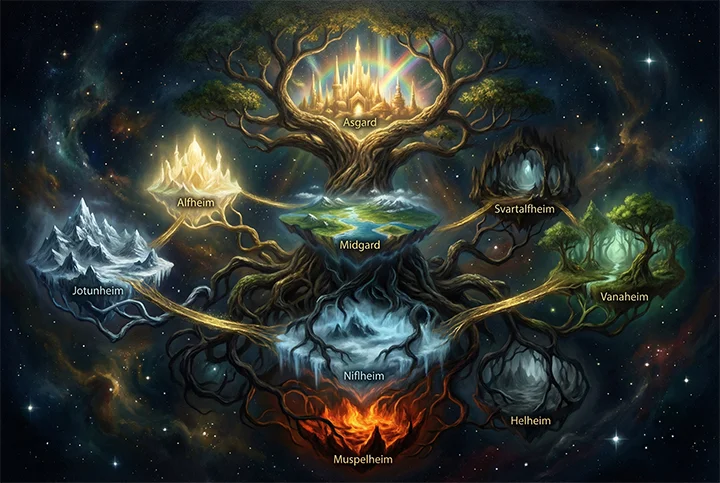
The Nine Realms, known in Old Norse as Níu Heimar, are the nine worlds that make up the entirety of the Norse universe. They are not planets or dimensions in any modern sense but distinct realms of existence, each with its own character, inhabitants and relationship to the cosmic order. All nine are contained within, upon or beneath the branches and roots of Yggdrasil, the World Tree, which serves as both the physical structure connecting them and the living axis around which all of existence is organised. To move between the realms is to travel through Yggdrasil itself, and the health of the tree is the health of the cosmos.
The sources do not always agree on the precise names or nature of all nine realms, and scholars continue to debate which worlds exactly constitute the nine. The Prose Edda and the Poetic Edda together provide the most complete picture, though it is assembled from fragments rather than any single systematic account. What is clear is that the Norse universe is not a hierarchy with one realm above all others but a complex web of relationships in which each world has its role, its dangers and its contribution to the whole. Even Niflheim at the bottom and Asgard at the top are dependent on each other for the stability of the cosmos.
The nine realms are generally identified as: Asgard (realm of the Aesir gods), Vanaheim (realm of the Vanir gods), Álfheimr (realm of the light elves), Midgard (realm of humanity), Jötunheimr (realm of the giants), Svartalfheim (realm of the dwarves), Niflheim (primordial realm of ice and mist), Muspelheim (primordial realm of fire) and Hel (realm of the dead). Together they form the complete map of Norse existence, from the highest divine to the most elemental primordial.
Origins & Mythology
The Nine Realms did not exist before the world was made. In the Norse creation myth, the cosmos began with two primordial realms only: Niflheim in the north, a world of ice and darkness, and Muspelheim in the south, a world of fire and heat. Between them lay the void of Ginnungagap, the yawning gap, and when the heat of Muspelheim met the ice of Niflheim in this void, the first living being emerged: the primordial frost giant Ymir. From Ymir's body, Odin and his brothers fashioned the world, and within that world the other realms took shape.
Asgard, the realm of the Aesir gods, was constructed above Midgard and connected to it by the Bifrost bridge. Midgard itself was made from Ymir's flesh and surrounded by an ocean whose depths became the domain of the sea goddess Rán and the ocean giant Ægir. Jötunheimr, the realm of the giants, lay beyond the ocean at the edges of the world, separated from Midgard by the sea and by the great wall the gods built from Ymir's eyebrows. Below everything, at the roots of Yggdrasil, lay Niflheim and its neighbour Hel, the realm of the dead.
The relationships between the realms are as important as the realms themselves. Asgard and Jötunheimr are in permanent tension: the gods and the giants are ancient enemies, yet they are also deeply entangled through marriage, trade, theft and shared fate. Midgard sits between these powers as the realm of mortals, protected by the gods above and threatened by the giants beyond. The dwarves of Svartalfheim forge the greatest treasures in the cosmos, including Mjölnir and Gleipnir. The light elves of Álfheimr are associated with brightness and fertility. Every realm contributes something to the whole.
Key Stories & Appearances
The Nine Realms appear throughout the Norse mythological cycle as the stages on which the great dramas are played out. Odin travels between the realms in disguise, seeking wisdom and preparing for Ragnarök. Thor ventures repeatedly into Jötunheimr to battle giants who threaten the cosmic order. Loki's children are distributed across the realms as agents of the coming destruction: Fenrir bound on an island in the middle of the world, Jörmungandr coiled at the bottom of the ocean encircling Midgard, Hel ruling the realm of the dead below Niflheim.
The cosmological poem Völuspá opens with the völva's declaration that she remembers nine worlds and nine wood-dwelling witches, establishing the Nine Realms as the fundamental framework of Norse cosmic memory. The poem traces the history of the cosmos from its creation through the age of the gods to Ragnarök and beyond, and the Nine Realms provide the geography of that history: the places where things happened, the stages on which the fate of everything was decided.
At Ragnarök all nine realms are implicated in the destruction. The forces of Muspelheim march under Surtr to burn the world. The dead of Hel sail on Naglfar under Loki's command. The giants of Jötunheimr join the assault on Asgard. The gods of Asgard stand and fall on the plain of Vígríðr. Even Midgard, the realm of mortals, sinks beneath the sea when the earth is consumed. Every realm participates in the end, just as every realm participated in the existence that preceded it.
Legacy & Significance
The Nine Realms represent the Norse tradition's most complete cosmological vision: a universe that is not one thing but many, not simple but layered, not static but in constant dynamic tension between creation and destruction, order and chaos, the divine and the monstrous. Each realm is necessary. Each realm is dangerous. Each realm contributes to and threatens the stability of the whole in ways that cannot be resolved but only managed, until the end when they cannot be managed at all.
The concept of the Nine Realms has proven extraordinarily resonant in modern culture, appearing in everything from academic scholarship on comparative mythology to blockbuster film franchises. What endures is the core insight: that existence is not a single flat stage but a complex vertical and horizontal web of different kinds of being, all connected, all interdependent, all ultimately subject to the same fate. Yggdrasil holds them all. When Yggdrasil falls, they fall together.
NORSE MYTHOLOGY ENCYCLOPEDIA — Storytelling
Listen to the story of Yggdrasil, the tree that holds the cosmos together, the beings that dwell within it, and the acts of self-sacrifice that take place on its branches a tale that spans all nine realms.