The Plain of the Last Battle Where Gods and Giants Destroy Each Other
Overview
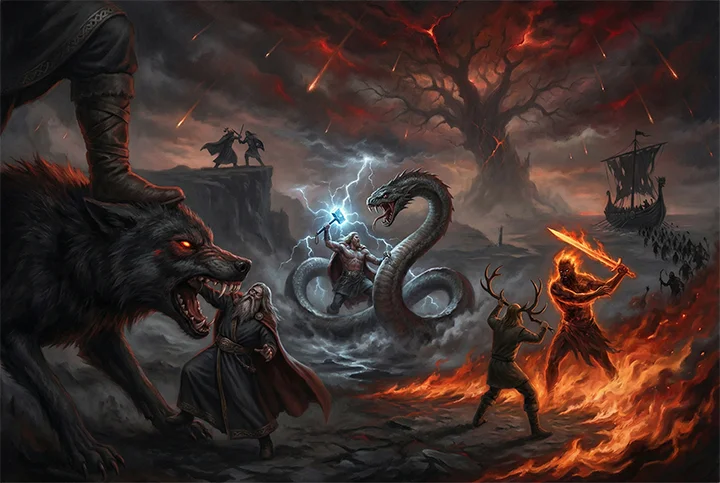
Vígríðr is the plain or battlefield on which the final conflict of Ragnarök is fought, the field where the gods, the giants, the monsters and the forces of dissolution destroy each other and the old world ends. Its name means battle-surge or storm of conflict in Old Norse, a compound of the element víg, battle or killing, and ríðr, a form related to riding or surging, suggesting a battlefield characterized by the overwhelming tide of combat rather than a static place. Vígríðr is described in the Voluspa and in the Prose Edda as a plain of vast extent, one hundred leagues wide in all directions according to Snorri, large enough to accommodate the final convergence of all the forces that have been building toward this confrontation throughout the entire history of the Norse cosmos. It is not a world in itself but a location within the mythological geography of Ragnarök, the specific place where the outcome of everything that has happened since the creation is determined.
Sources
The primary sources for Vígríðr are the Voluspa of the Poetic Edda and the Gylfaginning of Snorri Sturluson's Prose Edda. The Voluspa describes the advance of the forces of Ragnarök and their convergence on the battlefield without naming Vígríðr explicitly in all manuscripts, but the Prose Edda names the plain directly and provides its dimensions. The Vafthrudnismal contains a reference to the plain of the battle at the end of the world, providing an additional independent source for the concept of a specific location for the final battle. The Lokasenna alludes to Ragnarök in terms consistent with a convergence of forces on a single battlefield, and the skaldic poetry tradition references the final battle and its location in ways that confirm the general outline preserved in the fuller Eddic sources.
The Advance of the Forces
Vígríðr is not described in the sources as a place that exists in peacetime; it becomes the battlefield of Ragnarök when the forces that will destroy the world converge upon it. From all directions and from every realm, the beings whose fate is to participate in the final destruction move toward Vígríðr. From the north comes the ship Naglfar carrying the army of the dead from Helheim, steered by Loki who has broken free from his imprisonment. From the south comes Surtr at the head of the sons of Muspel, the fire giants whose fire will eventually consume the world after the battle is done. Fenrir runs with his mouth open so wide that his upper jaw touches the sky and his lower jaw drags along the earth. Jörmungandr advances alongside Fenrir, filling the air with its venom. The Midgard Serpent and the world wolf advance as a pair, the most dangerous creatures in the Norse cosmos moving together toward the final confrontation.
From Asgard comes the army of the gods and the Einherjar, the chosen warriors of Valhalla who have been preparing for this moment since their deaths in battle. They ride out through the five hundred and forty doors of Valhalla, eight hundred warriors through each door. Odin leads them on Sleipnir, armed with Gungnir. Thor rides beside him. Freyr advances without his sword, which he gave away to Skírnir. Tyr comes forward despite his missing hand, lost to Fenrir at the binding. Heimdall has blown the Gjallarhorn. The two armies, the forces of order and the forces of dissolution, converge on Vígríðr for the battle that will determine the end of the old world.
The Combats on Vígríðr
The battle on Vígríðr is described in the sources through its individual paired combats, each of which results in mutual death. Odin fights Fenrir. The wolf swallows him. Víðarr, Odin's son whose thick-soled shoe has been made for this purpose from the leather scraps discarded by cobblers throughout all of time, steps on Fenrir's lower jaw and tears the wolf's jaws apart with his hands. Odin is avenged but the greatest of the gods is gone. Thor fights Jörmungandr. He strikes the World Serpent dead with Mjolnir, then walks nine steps away before falling dead from the venom it has sprayed across the field. Freyr fights Surtr, the fire giant whose fire will end the world. Freyr falls, killed with the antler or branch he uses in place of his surrendered sword. Tyr fights the hound Garm, who has broken free from Gnipahellir, and they kill each other. Heimdall and Loki fight each other and both die. The individual combats cover the principal named adversary pairings, and the general fighting between the armies consumes everyone else.
When the combat is done, Surtr casts fire over the world. The sources describe it consuming everything: the earth sinks into the sea, the sky splits, and the Nine Worlds are consumed. Vígríðr itself disappears with everything else, the battlefield of the last battle becoming part of the destruction it hosted. The vast plain that was described as one hundred leagues wide in every direction is swallowed with the rest of the old world when Surtr's fire does its work.
The Size of Vígríðr
Snorri's specification in the Gylfaginning that Vígríðr is one hundred leagues wide in all directions is the most concrete physical description of the battlefield in any source. The measurement, given in Old Norse as hundrad rasta, is large enough to accommodate an army of cosmic scale: the Einherjar alone number in the hundreds of thousands if the five hundred and forty doors of Valhalla each discharge eight hundred warriors, and the forces of the giants, the dead and the monsters are described as comparable in scale. A plain of this size serves as a reminder that the final battle of Ragnarök is not a skirmish or a limited engagement but a total confrontation between every significant force in the Norse cosmos, fought on a scale commensurate with the magnitude of what is at stake.
Vígríðr and the New World
After the destruction of the old world, a new earth rises from the sea, green and fertile, and the surviving gods meet there. The Voluspa describes Víðarr and Váli surviving because neither fire nor sea affected them; Móði and Magni, Thor's sons, survive and carry Mjolnir into the new world; Baldur and Höðr return from Hel. The surviving gods meet and remember what happened, finding the golden game pieces the old Aesir had used in their games scattered in the grass. Vígríðr is not described as continuing into the new world; it was the battlefield of the end of the old world, and the new world that emerges after Surtr's fire has consumed everything has no need of a battlefield of that scale. The new world begins without the accumulated tension and enmity that made Vígríðr necessary.
Legacy and Significance
Vígríðr is the eschatological focus of the Norse mythological tradition, the point toward which the entire narrative arc of Norse mythology converges. Every event in Norse mythology, from the creation of the world from Ymir's body to the binding of Fenrir to the death of Baldur, contributes to the conditions that make Ragnarök necessary and Vígríðr the inevitable location of its resolution. The plain is significant not because of what it is, a large empty field, but because of what happens there: the final working out of all the consequences that were set in motion at the moment of creation. The Norse tradition's insistence on naming the battlefield, specifying its dimensions and describing each individual combat that takes place on it reflects the same impulse that makes Norse eschatology unique in world mythology, the desire to know exactly what happens at the end, in as much detail as possible, so that the end can be faced with full knowledge rather than ignorance.