The Lord of the Sea and the Host of the Gods' Great Feasts
Overview
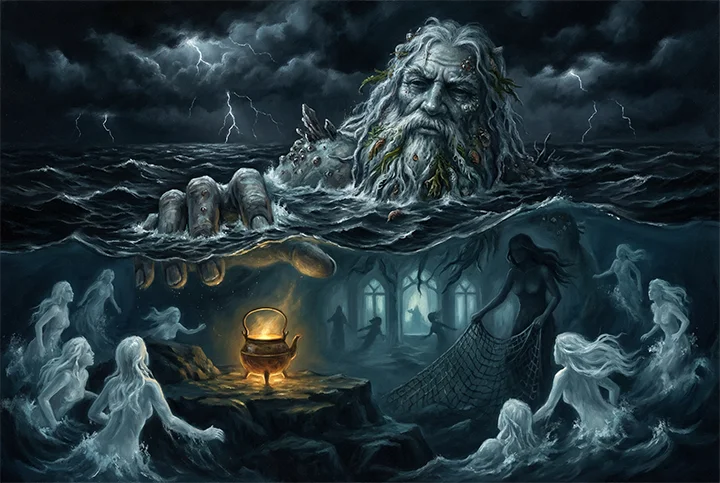
Ægir is the personification of the sea in Norse mythology, an ancient giant or semi-divine being of immense power who rules the ocean and brews the ale that he serves at feasts for the gods of Asgard. He is not classified among the Aesir or the Vanir but occupies a position of his own, respected and feared by both divine families, ancient enough that his origins predate the current order of the gods. He lives beneath the sea on an island called Hlésey, generally identified with the Danish island of Læsø, with his wife Rán, the goddess of the sea's destructive and taking aspect, and their nine daughters, who personify the different types of ocean waves. His hall beneath the sea glows with gold that illuminates the darkness of the deep water, and it is in this hall that the gods gather for the feast at which the events of the Lokasenna take place.
Ægir and his wife Rán together represent the dual nature of the sea as the Norse understood it: Ægir the abundance of the sea, its provision of fish and its role as a highway for ships, its generosity to those who work it and cross it with skill and care; and Rán the sea's destructive aspect, its capacity to take lives, her net cast over the water to catch the drowned and draw them down to her hall at the bottom. The name Rán means robbery or theft, reflecting the Norse understanding of drowning as the sea taking something that belonged to the land.
Sources
The primary sources for Ægir are the Prose Edda of Snorri Sturluson, particularly the Skaldskaparmal, which is structured as a dialogue between Ægir and the god Bragi in Ægir's hall, and the Poetic Edda, particularly the Lokasenna, which is set at a feast in Ægir's hall. Additional references appear in skaldic poetry, where the sea is frequently referred to by kennings based on Ægir's name, such as Ægir's fire for gold found at the bottom of the sea, Ægir's daughter for a wave, and Ægir's house or Ægir's hall for the sea itself.
The Skaldskaparmal opens with Ægir visiting Asgard and being received by the gods, after which Odin invites him to visit Asgard again. Ægir then hosts the gods in his hall, where Bragi entertains him with mythological stories, providing Snorri with the framing device for the mythological narratives that follow. The feast in Ægir's hall in the Lokasenna is the setting for Loki's systematic humiliation of each god and goddess in attendance, ending with Loki's departure when Thor arrives and threatens him with Mjolnir. Ægir himself is not significantly involved in the events of the Lokasenna, though Loki addresses him at the feast and insults him by calling him too eager to serve the gods.
Ægir's Cauldron
A central episode associated with Ægir is his acquisition of a cauldron large enough to brew ale for all the gods, which is the prerequisite for his hosting of the divine feasts. The Hymiskviða of the Poetic Edda describes Thor undertaking the quest to obtain this cauldron from the giant Hymir. The gods desire a feast and Ægir tells them he can brew for all of them if he has a cauldron large enough. The only cauldron of sufficient size belongs to the giant Hymir, who lives in the far east. Thor and the god Tyr travel to Hymir's hall, where they are received but watched with suspicion. After a series of tests of Thor's strength, including eating two entire oxen at a single meal, Thor and Tyr obtain the cauldron and bring it back, with Hymir and a company of many-headed giants in pursuit. Thor kills the pursuers and the cauldron is delivered to Ægir, who uses it to brew ale for the gods at every harvest season.
Rán and the Nine Daughters
Rán, Ægir's wife, is described in the sources as casting a net over the sea to catch those who drown, drawing them down to her hall. She is not described as malicious in the sources; she is simply the personification of the sea's taking nature, collecting those whom the sea claims. The Norse custom of placing gold on a drowning victim's body before burial, described in several sagas, is connected to the belief that gold would be useful to the dead in Rán's hall, just as gold was useful in the halls of the living.
The nine daughters of Ægir and Rán are named in the sources as Himinglæva, Dúfa, Blóðughadda, Hefring, Uðr, Hrönn, Bylgja, Dröfn and Kólga. Each name refers to a characteristic of waves: Himinglæva means that through which the sky is reflected, referring to the transparent quality of a calm wave; Blóðughadda means the one with the bloody hair, referring to the reddish foam on a breaking wave; Bylgja means billow; Uðr means wave; Hrönn means welling wave; Dröfn means comber; and Kólga means the cold one. In the skaldic tradition these nine daughters are also described as the mothers of Heimdall, the watchman of the gods, who is said in one source to be the son of nine mothers.
Ægir's Hall and the Kenning Tradition
Ægir's hall beneath the sea, illuminated by the gold that glows there in the darkness, is one of the most frequently referenced locations in skaldic kenning usage. The sea is called Ægir's kettle, Ægir's fire refers to gold because gold was understood to light the depths of the sea, and numerous kennings for ships, sailors, fish and sea voyages are built from Ægir's name and the names of his family. This density of kenning usage in skaldic poetry, which was a highly conventional art form relying on a shared body of mythological reference, reflects how central Ægir was to the Norse conception of the sea as a mythologically inhabited space rather than simply a physical phenomenon.
Legacy and Significance
Ægir's position in Norse mythology as an ancient, powerful being who is neither Aesir nor Vanir but is respected and feasted with by both reflects the Norse understanding of the sea as a force older and in some respects more fundamental than the divine order represented by the gods of Asgard. The sea existed before the gods shaped the world from Ymir's body; it will persist after Ragnarok when the new world rises from the waters. Ægir and Rán are not subordinate to the Aesir but exist alongside them, their power acknowledged and their hospitality reciprocated through the cycle of feasts that the Hymiskviða cauldron makes possible. The feast in Ægir's hall is one of the most important recurring social events in the mythological tradition, the context for the Bragi-Ægir dialogue that frames the Skaldskaparmal and for the Lokasenna, one of the most dramatically significant poems in the Poetic Edda.