The God of Poetry and the First Voice of the Skalds
Overview
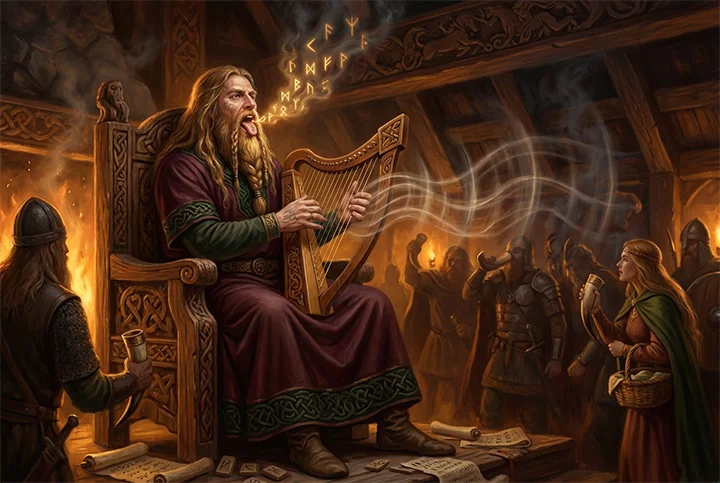
Bragi is the god of poetry, eloquence and the skaldic art, the divine patron of the poets who composed and recited the intricate verse forms that preserved the history, mythology and values of the Norse world. He is the husband of Idunn, the keeper of the apples of immortality, and he sits among the Aesir as the foremost master of words, the one who greets the newly arrived heroes in Valhalla with the recitation of their deeds and who embodies the Norse conviction that the right words, spoken or sung at the right moment, carry a power that equals or exceeds the power of any weapon. He is described in the sources as having a long beard and runes carved on his tongue, the mark of one whose gift for language was inscribed into his very body at the moment of his making.
Poetry in the Norse world was not an ornament to life but a fundamental technology of civilization. The skalds who composed in the elaborate drottkvaett meter and its relatives were not entertainers but historians, diplomats, theologians and chroniclers, men whose command of the tradition allowed them to stand in the halls of kings and speak truths that others could not say. Bragi's divine patronage of this art reflects how seriously the Norse world took the craft of language, and his presence among the Aesir is a statement that words are as essential to the functioning of the cosmos as swords.
Origins and Mythology
The primary sources for Bragi are the Prose Edda, where Snorri describes him as the most eloquent of the Aesir and as skilled in the art of poetry, and the Lokasenna, where he appears at Aegir's feast and becomes the target of Loki's particular contempt. Snorri notes the runes on his tongue and identifies him as Idunn's husband. Beyond these essentials, the mythological narratives directly involving Bragi are sparse: he is a figure whose importance is attested by his presence in the divine assembly and by the tradition of the bragarfull, the cup of vows, which was named for him and which formed a central element of Norse ceremonial life.
The question of Bragi's origins is complicated by the existence of a historical ninth-century Norwegian skald named Bragi Boddason, known as Bragi the Old, who is the earliest named skald in the Norse tradition and whose surviving verses are among the oldest examples of the skaldic art. Some scholars believe that Bragi the god was originally Bragi the man, deified posthumously as the supreme exemplar of the poetic art. Others maintain that the god and the historical skald are distinct figures who share a name. The question has not been resolved, and the ambiguity itself is characteristic of how Norse mythology developed: through the accumulation of traditions from many sources, not from a single authoritative text.
Bragi at Aegir's Feast
The most extended appearance of Bragi in the surviving sources comes in the Lokasenna, where his behavior during Loki's attack on the assembled gods reveals something important about his character. When Loki enters Aegir's hall and demands a seat, Bragi is the first to speak against him, telling him flatly that there will be no seat for him among the gods. Loki responds by recalling an ancient oath of brotherhood between himself and Odin, which forces the Allfather to make room. Bragi, unwilling to let the matter rest, offers Loki gifts: a sword, a horse and a ring, if he will only leave peacefully. Loki refuses and turns his attention to Bragi instead.
Loki's accusation against Bragi is the most cutting of all: he calls him the most cowardly of all the Aesir and the most afraid of weapons, saying that Bragi should stay away from battle and sit safely behind the benches. Bragi responds with a threat, saying that if they were outside the hall rather than inside it he would have Loki's head. Loki dismisses this as brave talk from someone who will never act on it. The exchange is brief but it exposes a tension that runs through the sources: Bragi is the god of the most valued art in the Norse world, but the Norse world was also a world that valued courage in battle, and a god whose domain is words rather than deeds occupies a complicated position in a culture that measured men by what they were willing to risk.
The Bragarfull and Ceremonial Poetry
The bragarfull, the cup of Bragi, was a ceremonial drinking vessel passed among the guests at a feast, particularly at funerary feasts following the death of a king or chieftain. As the cup was raised, the drinker was expected to make a solemn vow, binding themselves publicly to some great undertaking or act of valor. The vow was witnessed by all present and by Bragi himself, whose divine authority gave it a weight that a merely social promise would not carry. The tradition reflects the Norse understanding of words as actions: a vow spoken in the right context, before the right witnesses, was not a statement of intention but a binding commitment with real consequences for those who broke it.
Skalds who composed in Bragi's honor, or who invoked his patronage before performing, understood themselves as participants in a tradition that reached back through the historical skalds to the god himself, and from the god to the very act of creation, since the Norse cosmos was in many ways built of language: the words Odin spoke to the dead, the runes he learned at the cost of his suffering, the Eddic poems that encoded the structure of the worlds. Bragi stood at the near end of that tradition, the accessible face of a divine art.
Legacy and Significance
Bragi's legacy is inseparable from the skaldic tradition itself, and the skaldic tradition is inseparable from what we know of Norse mythology. The majority of what survives about the gods, the cosmology, the heroic legends and the moral values of the pre-Christian Norse world survives because skalds composed it, preserved it, performed it and transmitted it across generations. Bragi, as their patron and their divine exemplar, stands behind almost everything we know about the tradition he represents.
In a broader sense, Bragi embodies the Norse conviction that civilization is a linguistic achievement as much as a martial one. The warriors who died in battle went to Valhalla and were greeted by a god who recited their deeds in verse. The kings who ruled well were commemorated by skalds who ensured their names would outlast their bodies. The myths that explained the world were preserved not in stone or in sacred texts but in the living memory of poets who shaped them into forms beautiful enough to be remembered. Bragi is the god of all of that: the keeper of the record, the voice that turns what happens into what is known, the divine guarantee that the things worth remembering will not be forgotten.