Goddess of Love, War & Magic
Overview
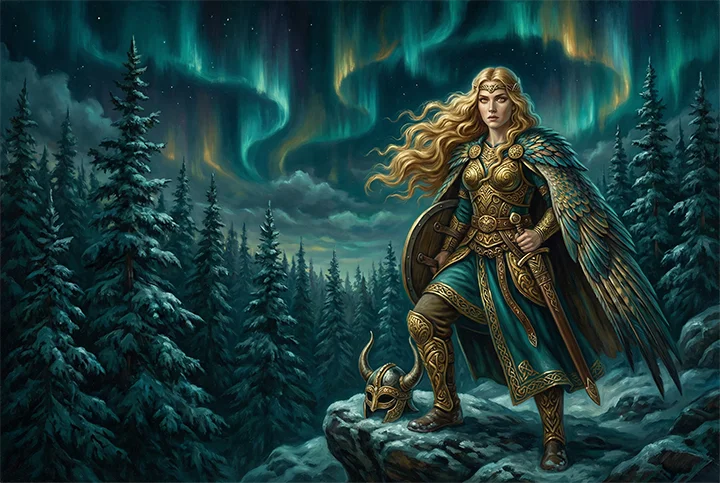
Freya, known in Old Norse as Freyja, is the most powerful goddess in the Norse pantheon and one of the most complex divine figures in all of Germanic mythology. She is the goddess of love, desire, fertility, gold and beauty, but she is equally a goddess of war, death and the darkest forms of magic. She weeps tears of red gold for her missing husband Óðr and she rides into battle to claim half of all the warriors slain in combat. She is tenderness and ferocity in equal measure, and no single attribute comes close to capturing her.
Freya belongs to the Vanir, the older tribe of Norse gods associated with nature, fertility and seiðr magic, rather than the Aesir of Asgard. She came to live among the Aesir as part of the peace settlement following the great war between the two divine tribes, bringing with her the knowledge of seiðr, the most powerful and most dangerous form of Norse magic. It was Freya who taught this art to Odin himself, making her in some sense the source of the Allfather's greatest power.
She travels in a chariot drawn by two large grey cats and wears the legendary necklace Brísingamen, the most beautiful object in the Nine Realms, which she obtained through a bargain with four dwarves. Her cloak of falcon feathers allows the wearer to transform into a falcon and fly between the worlds, and she lends it freely to gods who need it, including Loki on several of his missions. Her hall in Asgard is called Fólkvangr, the Field of the Host, where she receives half of all those who fall in battle, the other half going to Odin's Valhalla.
Origins & Mythology
The Prose Edda identifies Freya as the daughter of the sea god Njörðr and the twin sister of Freyr, the god of sunshine and abundance. The twins were born among the Vanir and sent to Asgard as hostages at the conclusion of the Aesir-Vanir war, along with their father. All three adapted to life in Asgard and became central figures in the Norse divine order, with Freya rising to a position of enormous influence and prestige among the Aesir gods.
Her husband Óðr is one of the most mysterious figures in Norse mythology. He disappears from the myths repeatedly, journeying to distant lands for reasons the sources never fully explain, and Freya wanders the world weeping for him, her tears falling as red gold wherever they touch the earth or the sea. Some scholars have proposed that Óðr is simply another aspect of Odin himself, given the similarities between the two names and the parallel themes of wandering and absence that define both figures. Whether this is true or a later conflation, the grief of Freya for her lost husband is one of the most deeply human emotions attributed to any Norse deity.
Freya's acquisition of Brísingamen is recorded in the later Sörla þáttr. She descended to the realm of the dwarves and found four craftsmen, the Brisings, who had forged a necklace of incomparable beauty. They refused gold and silver in payment and demanded instead that she spend one night with each of them. She agreed without hesitation. The necklace became her most iconic possession and a symbol of her unapologetic claim to her own desire and agency.
Key Stories & Appearances
Freya appears throughout the Norse mythological cycle as one of the most sought-after figures in all the realms. Giants and dwarves scheme and bargain endlessly for the chance to possess her, and the gods go to considerable lengths to protect her from being handed over as payment for their debts. When the giant builder who constructed the walls of Asgard demanded Freya as part of his payment along with the sun and the moon, the gods panicked and pressured Loki into finding a way to void the agreement. Her value was considered equal to the light of the world itself.
In the poem Þrymskviða, when the giant Þrymr stole Thor's hammer Mjölnir and demanded Freya as his bride in exchange for its return, Freya refused with such fury that the ground shook and her necklace Brísingamen burst from her chest. She would not be used as currency by the gods, regardless of the stakes. It was this refusal that forced Thor and Loki to devise the plan of disguising Thor as the bride instead.
As a practitioner of seiðr magic, Freya occupies a unique position in Norse spiritual life. Seiðr was associated with prophecy, fate manipulation, shapeshifting and the ability to send the spirit travelling outside the body. It was also considered socially transgressive, particularly for men, because it involved a surrender of control and will that Norse culture associated with unmanliness. That Freya taught this art to Odin speaks to her power: she gave the chief god his most feared and most intimate magical ability.
Legacy & Significance
Friday takes its name from Freya, derived from the Old English Frīgedæg, Freya's day. Her name survives across Scandinavian place names, particularly in Sweden and Norway where her cult was especially strong. Archaeological finds of small female figurines and cat imagery from the Viking Age have been connected to her worship, and the practice of burying the dead with cats has been interpreted as an offering to the goddess of Fólkvangr.
Freya endures in modern consciousness as an archetype of feminine power that refuses to be reduced to any single quality. She is not merely a love goddess in the manner of later classical traditions. She is a warrior who chooses her own fallen, a sorceress who taught the king of the gods his greatest art, a grieving wife who searches endlessly for what she has lost and a woman who negotiates for what she wants on her own terms. She represents a vision of womanhood in the Norse world that was far more expansive than later traditions would allow, and her mythology continues to speak directly to those who encounter it across the centuries.
OTHRAVAR — Musical Tribute
Experience the beauty and power of Freya through the ancient sounds of Norse folk music. This original composition draws from the skaldic tradition, performed with traditional instruments including tagelharpa, bukkehorn and frame drum.