The God of Sunlight, Rain and the Abundance of the Earth
Overview
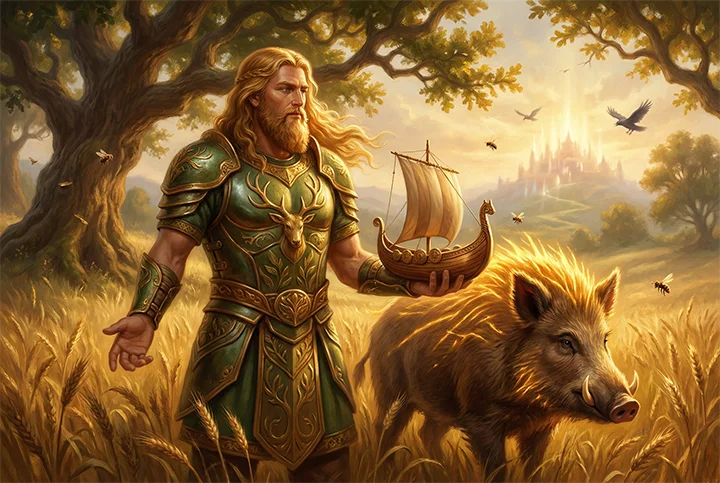
Freyr is one of the most widely worshipped gods in the Norse pantheon, a deity whose domain touches every aspect of life that depends on the generosity of the natural world. He is the god of sunlight, rain, fertility and abundance, the one who causes the crops to grow and the herds to multiply and the earth to yield what its people need to survive. He is of the Vanir, the older family of gods associated with nature and prosperity, and he came to Asgard as a hostage after the Aesir-Vanir War along with his father Njord and his twin sister Freya. Among the Aesir he became one of the most beloved of all the gods, given the realm of Alfheim, the world of the light elves, as a gift on the day of his first tooth.
Freyr is also the god of kingship and the divine ancestor claimed by the royal dynasties of Sweden and Norway. The Yngling kings of Sweden traced their lineage directly to him, and the cult of Freyr at the temple of Uppsala was one of the most important religious institutions in the pre-Christian Scandinavian world. Sacrifices were made to him for peace and for good seasons, and his image was carried across the land in ritual processions to ensure the fertility of fields and the safety of settlements. He was not a god of war; he was a god of what war is supposed to protect.
Origins and Mythology
The primary sources for Freyr are the Prose Edda, the Poetic Edda and the Ynglinga Saga. Snorri Sturluson describes him in the Gylfaginning as the most renowned of the Aesir, saying that he governs the rain and the shining of the sun and therefore the fruitfulness of the earth, and that it is good to call on him for good harvests and for peace. He notes that Freyr rules over Alfheim and that no sun shines and no rain falls without his influence.
Freyr possesses three treasures of extraordinary power. The first is Skidbladnir, the greatest of all ships, made by the dwarves of Svartalfheim, which always finds a favorable wind the moment its sail is raised and which can be folded up like cloth and placed in a pocket when not in use. The second is the golden boar Gullinbursti, also made by the dwarves, whose bristles shine so brightly that they illuminate the darkest night as it runs across land or sea. The third, and most consequential for his story, is his sword: a magical blade that fights by itself, swinging of its own accord against giants and all enemies, needing no hand to guide it. This sword Freyr gives away for love, and its absence at Ragnarok will cost him everything.
Freyr and Gerd
The most important myth concerning Freyr is his love for the giantess Gerd, told in the Skirnismal, one of the most distinctive poems in the Poetic Edda. It begins when Freyr, without permission, sits on Odin's throne Hlidskjalf and looks out across the Nine Worlds. In the realm of Jotunheim he sees a giantess whose arms are so radiant that they illuminate all the sky and sea around her. Her name is Gerd, daughter of the giant Gymir, and from the moment Freyr sees her he cannot eat, cannot sleep, cannot find peace in any of the things that formerly gave him joy.
Freyr does not approach Gerd himself. He sends his servant Skirnir to court her on his behalf, arming him with his horse and, crucially, with his magical self-fighting sword. Skirnir travels to Jotunheim and offers Gerd first gifts: eleven golden apples and the ring Draupnir, which produces eight rings of equal value every ninth night. Gerd refuses both. Skirnir then threatens her with his sword. She remains unmoved. Finally Skirnir resorts to a curse, carving runes of degradation and misery onto a staff and threatening Gerd with a fate of desolation, exile and an eternity of joyless coupling with the frost giant Hrimgrimnir unless she agrees. Gerd agrees. She will meet Freyr in nine nights in the grove of Barri.
The nine nights of waiting that follow are described as the most agonizing period of Freyr's existence. The poem ends before the meeting takes place. The cost has already been counted: Freyr has given away his sword, the one weapon that could fight on its own, to Skirnir as payment for the journey. At Ragnarok, when the fire giant Surtr comes against the gods, Freyr will face him without it. Armed only with an antler, he will fall.
Freyr at Ragnarok
The Norse sources are consistent on this point: Freyr dies at Ragnarok because he no longer has his sword. He fights Surtr, the lord of Muspelheim whose blade burns with the heat of the sun itself, and falls. The Voluspa describes Surtr advancing from the south with the destroyer of branches, and it is Freyr who meets him. The Prose Edda notes explicitly that Freyr will find the struggle hard because he lacks the good sword that he gave to Skirnir.
This detail is not presented as a moral lesson about the dangers of love or the folly of desire. The Norse tradition does not moralize that way. What it presents is a consequence: Freyr made a choice, the choice created a condition, and the condition was waiting for him at the end of the world. The myth is honest about what desire costs when the thing you give for it is irreplaceable.
The Cult of Freyr
Outside the narrative myths, Freyr's presence in the actual religious practice of the Norse world was among the most substantial of any deity. The great temple at Uppsala in Sweden contained statues of Odin, Thor and Freyr, and Adam of Bremen, writing in the eleventh century, described Freyr as the god who bestows peace and pleasure on mortals, noting that his statue was equipped with an enormous phallus, the standard iconographic symbol of fertility in the ancient world.
The Ynglinga Saga describes a ritual in which an image of Freyr was driven around the countryside in a wagon accompanied by a priestess who was considered his wife, visiting farms and settlements to bless them with fertility and prosperity. This wagon procession, a form of divine visitation that brought the god's power directly into contact with the land and the people who worked it, is one of the most vivid pieces of evidence for how Norse religion functioned in practice, as a living relationship between communities and the forces they depended on rather than a fixed body of doctrine.
Sacrifices to Freyr, called blot, were made at three key points in the year: at the beginning of winter for good harvest, at midwinter for the return of the growing season, and in spring to ensure the fertility of the coming year. The Swedish kings who claimed descent from him performed these rites as both religious obligations and demonstrations of their fitness to rule: a king who could not maintain the favor of Freyr could not guarantee his people's survival, and a king who could not guarantee his people's survival had no claim to their loyalty.
Legacy and Significance
Freyr represents a dimension of the Norse religious world that is sometimes overshadowed by the more dramatic narratives of Odin's wisdom-seeking and Thor's giant-slaying. He is the god of what works, of the systems that sustain life from one year to the next, of the quiet abundance that makes all the heroism and all the tragedy possible. Without the harvests he enables, there are no warriors to sing about. Without the peace he embodies, there is no civilization for the poets to record.
His story also carries a weight that is easy to miss if it is read only as a love story. Freyr is one of the very few figures in Norse mythology who makes a choice he cannot undo and lives with its full consequence. He sees Gerd, he loses himself, he gives away the thing that cannot be replaced, and at the end of all things that gift comes due. There is something in this that goes beyond the personal: the god of abundance, the god of peace and prosperity, falls at the world's end because he chose love over invulnerability. The Norse tradition does not say he was wrong to do so. It simply shows what it cost.