The Queen of Asgard and the Keeper of Fate's Secrets
Overview
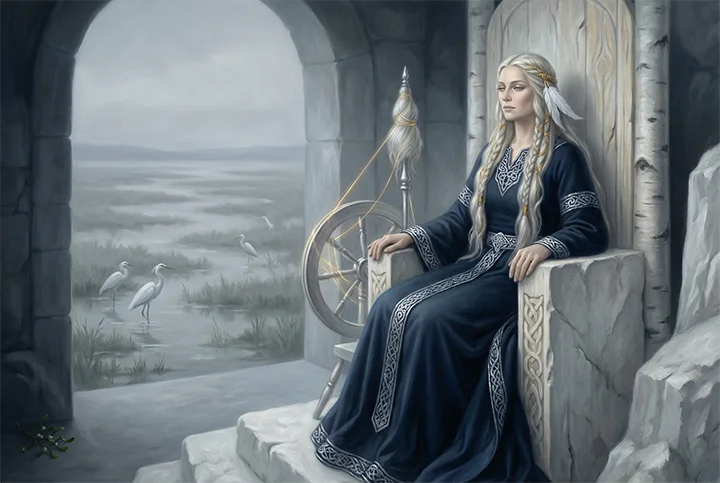
Frigg is the queen of Asgard, wife of Odin, mother of Baldur, and the highest-ranking goddess in the Norse pantheon. She sits beside Odin on the throne Hlidskjalf, from which all the Nine Worlds can be seen, and she shares with him the capacity to observe everything that happens across the cosmos. She is the goddess of marriage, motherhood, foresight and domestic order, the one who holds the keys of Asgard and whose authority among the Aesir is second to none. What sets her apart from every other figure in Norse mythology is a paradox that the sources present without resolving: Frigg knows all fates. She sees the full shape of what is coming. And she says nothing.
This silence is not passivity. The myth of Baldur's death demonstrates with terrible precision what Frigg does when she sees the fate she cannot change: she does everything that can be done. She travels to every corner of existence, extracts every oath she can extract, builds the most comprehensive protective system any being in Norse mythology has ever constructed. It fails not because she was careless but because fate is what it is. Frigg's story is the story of a being who sees the end coming and acts anyway, knowing the outcome, refusing to be defeated by foreknowledge into inaction.
Origins and Mythology
Frigg appears throughout the Prose Edda and the Poetic Edda as the preeminent goddess of the Aesir. In the Poetic Edda's Lokasenna, when Loki goes through the assembled gods and goddesses delivering his venomous catalogue of accusations, his accusations against Frigg are among the sharpest, which is itself a measure of her importance: Loki targets those whose reputations are most worth destroying. In the Grimnismal, Odin and Frigg are shown debating the merits of their respective human protégés, a scene that establishes them as intellectual and divine equals, two beings who see the same world from the same height and reach different conclusions about what matters in it.
The sources consistently describe Frigg's hall as Fensalir, the Fen Halls, a name that places her domain in marshy, liminal ground between the settled world and the wilder landscapes beyond it. The image fits her character: Frigg operates in the space between the known and the unknown, between what can be prevented and what cannot, between the domestic order she embodies and the fate she perceives but does not speak aloud.
A persistent question in Norse scholarship concerns the relationship between Frigg and Freya. The two goddesses share a number of attributes: both are associated with love and fertility, both practice seidr magic, both are connected to the fate of the dead. Some scholars have argued that they were originally the same deity who split into two distinct figures as the mythology developed. Others maintain that they were always distinct. The sources themselves do not resolve the question, and the tension between the two figures, one the composed queen of Asgard and the other the passionate and untamed Vanir goddess, is part of what gives each of them their particular weight in the tradition.
Frigg and the Death of Baldur
The fullest picture of Frigg's character comes through the events surrounding Baldur's death, and what it reveals is a figure of immense capability deployed against an immovable obstacle. When Baldur begins having prophetic dreams of his own destruction, Frigg does not grieve and accept. She acts. She travels to every substance, every creature, every force in the Nine Worlds and extracts from each a personal oath that it will not harm her son. The scope of this undertaking is extraordinary: she negotiates individually with fire, water, iron, every known poison, every disease, every animal, every tree, every stone. The gods test the result by throwing weapons at Baldur and nothing touches him.
The single exception is the mistletoe. Frigg judged it too young and too harmless to bother with, and that judgment, made in good faith with entirely reasonable logic, was the gap through which everything fell. Loki, disguised as an old woman, drew the information from her in conversation. He made a dart from the mistletoe and placed it in the hand of Baldur's blind brother Hodr. The result is the death that Frigg had seen coming and worked with everything she had to prevent.
After Baldur's death, Frigg asks which of the gods will ride to Hel to beg for his return. Hermod volunteers. When he arrives and pleads with the ruler of the dead, Hel sets the condition that every being in all the worlds must weep for Baldur. Frigg, who has already negotiated with every substance in existence, presumably coordinates the effort. Everything weeps. The giantess Thokk, who is Loki in disguise, does not. Baldur does not return. Frigg has failed not because she lacked capability or foresight or will, but because the fate she saw from Hlidskjalf was the fate the Norns had woven, and even the queen of Asgard cannot unpick what they have set.
Frigg and Odin
The relationship between Frigg and Odin is one of the most complex divine marriages in world mythology. They are equals in their capacity to see: both sit on Hlidskjalf, both perceive the Nine Worlds. But they respond differently to what they see. Odin pursues knowledge obsessively, sacrificing his eye, hanging on Yggdrasil, wandering in disguise, always seeking more information, more leverage against the fate he knows is coming. Frigg knows and keeps her knowledge close, acting precisely when action is possible and accepting when it is not.
The Grimnismal presents them in a rare moment of open disagreement, arguing about which of their human favorites deserves the better fate. Each supports their chosen mortal and each is willing to intervene in human affairs to help them. The scene is a small one but it humanizes both figures: these are not remote abstractions but beings with preferences and arguments and the willingness to take sides.
Several sources describe Odin leaving Asgard for extended periods, during which his brothers Ve and Vili take his place and, in some accounts, take Frigg as their own. The details vary and the episode is handled differently in different sources. What it establishes is that Frigg's position, for all its dignity, is not unconditionally stable, and that her story contains dimensions of difficulty that the mythology does not fully articulate but does not entirely conceal either.
Legacy and Significance
Frigg's name is the origin of the English word Friday, Frigg's day, which places her among the small number of Norse deities whose names are embedded in the weekly calendar still used across most of the world. This is a measure of how deep the Germanic religious tradition once ran in northern European culture: the days of the week are a fossilized record of a pantheon that shaped the lives of millions of people for centuries before Christianity replaced it.
In the broader comparative framework of Indo-European religion, Frigg occupies the role of the sky god's consort and the divine keeper of domestic and matrimonial order. Her association with foresight and with the keeping of secrets connects her to a widespread pattern of divine queens who know more than they say and who act with a long-term understanding of consequences that other figures lack. What makes the Norse Frigg distinctive within this pattern is the active, effortful quality of her response to foreknowledge. She does not sit with her knowledge in resigned acceptance. She takes it and works with it and tries, against the evidence of what she can see, to change what is coming. That she cannot is the tragedy. That she tries is her character.
OTHRAVAR — Musical Tribute
Experience the quiet power of Frigg's foresight and the grief of a mother who saw everything coming through the ancient sounds of Norse folk music. This original composition draws from the skaldic tradition, performed with traditional instruments including tagelharpa, langeleik and bone flute.