The Eternal Watchman
Overview
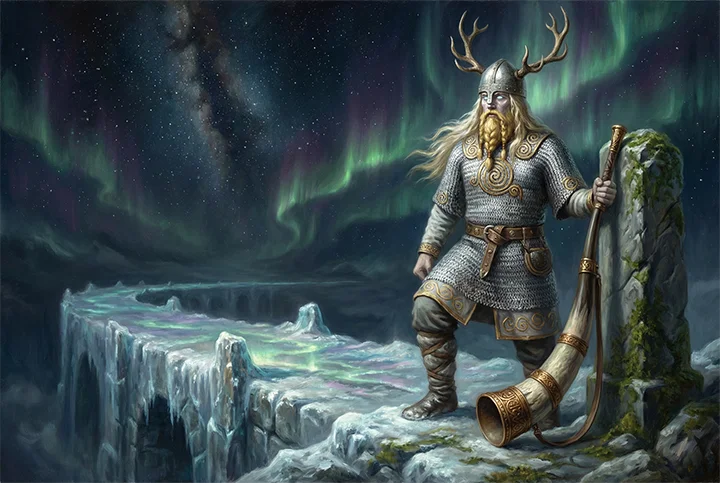
Heimdall, known in Old Norse as Heimdallr, is the eternal watchman of the Norse gods, the guardian who stands at the boundary between Asgard and all other realms. He is stationed at the end of Bifröst, the rainbow bridge connecting the divine realm to the rest of the Nine Realms, and his duty is absolute: to watch, to listen and to sound the great horn Gjallarhorn at the first sign of the enemies of the gods. He will be the one to wake the Aesir when Ragnarök begins, and when that horn sounds across the Nine Realms every living being will hear it.
Heimdall possesses senses that surpass those of any other being in Norse mythology. He can see for hundreds of miles in every direction, by day and by night equally. He can hear the grass growing in the fields of Midgard and the wool growing on the backs of sheep. He requires less sleep than a bird. These gifts were given to him precisely because his role demands them: the guardian of the gods cannot afford the ordinary limitations of perception that constrain other beings, divine or mortal.
He is described in the sources as white, bright and gleaming, with the epithet hvítastr ása, the whitest of the Aesir. He has golden teeth, wears white armour and rides a horse named Gulltoppr, Golden Mane. His brightness is not merely aesthetic but functional: he is a god of light and clarity, the one who sees through darkness and confusion to perceive the truth of what approaches from the edges of the known world.
Origins & Mythology
Heimdall's origins are among the most unusual in the Norse tradition. The Prose Edda states that he was born of nine mothers, all of them sisters, and scholars have long debated the identity of these mothers and what this extraordinary birth signifies. Some interpretations connect the nine mothers to the nine waves of the sea, suggesting that Heimdall has a fundamental connection to the ocean and was nourished in his infancy on the strength of the earth, the coldness of the sea and the blood of a boar. He emerged from this remarkable beginning as a being of extraordinary vitality and endurance.
His position at Bifröst places him at one of the most significant locations in Norse cosmology. The rainbow bridge is the only passage between Asgard and the lower realms, a structure of burning fire and extraordinary beauty that bears the weight of constant divine traffic. Heimdall monitors everyone and everything that crosses it, and his authority over this threshold makes him one of the most strategically important figures in the entire pantheon. Without him, Asgard is blind to what approaches from below.
The Eddic poem Rígsþula presents a remarkable side of Heimdall that differs entirely from his role as watchman. Travelling under the name Rígr, he walks through Midgard and stays as a guest in three households: the home of a poor couple, the home of a farming family and the home of a noble household. In each case he shares the bed of the wife and fathers a child. From these unions came the three classes of humanity: the thralls, the farmers and the nobles. In this tradition Heimdall is not merely the guardian of the gods but the progenitor of the human social order itself.
Key Stories & Appearances
Heimdall's most celebrated confrontation in the myths is his ancient and absolute enmity with Loki. The two are described in the sources as eternal enemies, and their conflict runs like a fault line beneath the surface of Norse mythology. In one account they fought each other in the shapes of seals on a reef called Singasteinn, competing for possession of the necklace Brísingamen which Loki had stolen from Freya. Heimdall recovered it. Their enmity is so fundamental that they are both prophesied to kill each other at Ragnarök, the final settling of an account that has been running since before human memory.
At Ragnarök, when the boundaries of the worlds begin to collapse and the enemies of the gods mass for their final assault, it is Heimdall who will raise Gjallarhorn to his lips and blow. The sound of that horn carries across all the Nine Realms and will wake every god, every warrior in Valhalla and every living being who will play a part in the final battle. It is the signal that cannot be recalled, the announcement that everything is ending. Heimdall has stood at his post since the beginning of the current age of the world waiting for the moment he hopes will never come.
His horn Gjallarhorn is connected in the Prose Edda to the well of Mímir, where Odin sacrificed his eye for wisdom. One tradition holds that Gjallarhorn is hidden beneath the roots of Yggdrasil near Mímir's well, kept safe until the moment it is needed. Another tradition presents it as always in Heimdall's possession, raised to his lips at Bifröst. Both versions agree on its function: it is the loudest sound that will ever be heard in any of the Nine Realms, and when it sounds there will be no confusion about what it means.
Legacy & Significance
Heimdall occupies a position in Norse mythology that is easy to overlook precisely because his role is defined by waiting and watching rather than action. He does not go on adventures or collect myths the way Odin and Thor do. He stands at his post. In a tradition that celebrates warriors and wanderers, this kind of steadfast, unglamorous duty can seem less dramatic than it is. But Heimdall's vigil is the condition that makes all the other myths possible: every journey Thor takes into giant territory, every scheme Odin hatches across the Nine Realms, every moment of divine life in Asgard exists within the safety that Heimdall's endless watchfulness provides.
His role as the father of the three human classes in Rígsþula gives him a significance in Norse social thought that extends far beyond his function as guardian. He is the divine origin point of human society itself, the god whose wandering through Midgard produced the entire range of human social existence from the lowest thrall to the highest noble. The watchman who guards the boundary between gods and humans turns out to be, in the deepest sense, the bridge between them.
OTHRAVAR — Musical Tribute
Experience the eternal vigil of Heimdall through the ancient sounds of Norse folk music. This original composition draws from the skaldic tradition, performed with traditional instruments including tagelharpa, bukkehorn and frame drum.