Ruler of the Dead
Overview
Hel is the ruler of the Norse realm of the dead, the goddess who receives all those who die of illness, old age or any cause other than battle. She is the daughter of Loki and the giantess Angrboða, sister of the World Serpent Jörmungandr and the great wolf Fenrir. Her realm shares her name: Niflheimr, or simply Hel, a vast cold world beneath the roots of Yggdrasil where the majority of the dead spend eternity. She is not a goddess of punishment or torment in the way later traditions would imagine such a figure. She simply receives, and she does not give back.
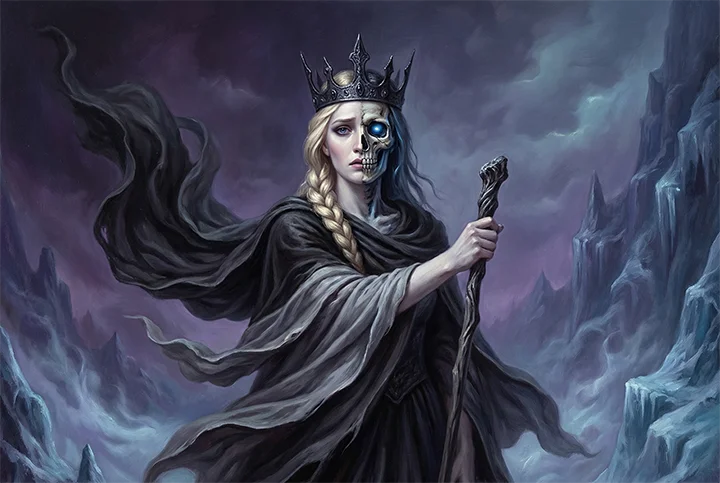
Hel's appearance in the sources is striking and deliberately unsettling. She is described as half living and half dead: one side of her body the normal colour of human flesh, the other side blue-black, the colour of a corpse. She is downcast in expression and gloomy in bearing. Her hall is called Éljúðnir, Damp with Sleet, her dish is Hunger, her knife is Famine, her threshold is Stumbling Block, her bed is Sick Bed and her curtains are Glimmering Misfortune. Every element of her dwelling is named to reflect not active cruelty but the slow, cold inevitability of death by degrees.
She rules her domain with absolute authority. The Prose Edda states that Odin himself cast her into Niflheim and gave her power over nine worlds, commanding her to provide board and lodging to those sent to her. She has jurisdiction over all who come to her, regardless of rank, origin or deed in life. Kings and thralls arrive at her gate by the same road, and none leave without her permission. She gave that permission only once, and even then it was not enough.
Origins & Mythology
Hel's origins begin with the union of Loki and the giantess Angrboða in the dark forest of Járnviðr, the Ironwood. The three children born of this pairing were considered so dangerous that the gods took prophylactic action against all of them. Fenrir was raised in Asgard and eventually bound with the magical fetter Gleipnir. Jörmungandr was thrown into the ocean encircling Midgard, where he grew until he bit his own tail. Hel was cast into Niflheim, the realm of primordial cold and mist beneath the world, and made its ruler.
The Norse understanding of her realm is important to grasp clearly. Hel is not hell in the Christian sense. It is not a place of punishment for the wicked. It receives everyone who does not die in battle: the elderly, the sick, the drowned, the unlucky, the ordinary. The vast majority of humanity ends up in Hel's domain, and the sources describe it not as a place of torment but as a dim, cold, quiet continuation of existence, a place where the dead sit in their halls and exist without the warmth or glory of life but also without active suffering.
The great exception to this general understanding is Náströnd, a shore within Hel's realm where murderers, oath-breakers and adulterers are sent to wade through rivers of venom and be gnawed by the serpent Níðhöggr. This represents something closer to punitive judgment within the Norse afterlife, but it is a specific corner of a much larger realm, not the whole of it.
Key Stories & Appearances
Hel's most significant appearance in Norse mythology is her role in the aftermath of Baldur's death. When Baldur was killed by the mistletoe dart and descended to her realm, the gods sent the messenger Hermóðr riding on Sleipnir to negotiate for his return. Hel received Hermóðr and listened to his plea. Her response was neither cruel nor warm: she said that if what Hermóðr claimed was true, that all beings in all the Nine Realms wept for Baldur, then she would release him. The condition was not a trick but a test of cosmic grief, a demand that the loss be genuinely felt by all of creation before she would reverse it.
Every creature wept. Every rock and tree shed tears. Only the giantess Þökk, widely understood to be Loki in disguise, refused. And Hel kept Baldur. There is no anger in her decision, no satisfaction either. The condition was stated and the condition was not met. She is a ruler who operates by the absolute logic of her domain: what comes to her, stays with her, unless the terms are satisfied entirely. Baldur remains in her hall until after Ragnarök, when he will return to the living world as part of its renewal.
Hel also appears indirectly in the accounts of Odin's preparations for Ragnarök. Knowing that the dead in her realm will march with Loki and the forces of destruction at the end of the world, Odin gathers the Einherjar in Valhalla to counterbalance them. The army of the dead from Hel, sailing on the ship Naglfar, represents one of the great forces that will fight against the gods at the final battle. Her realm does not stand apart from the end of the world: it feeds it.
Legacy & Significance
The name Hel passed directly into the English language through the Old English hel and hell, one of the most complete linguistic inheritances from the Norse tradition. What changed was the meaning: the Christian adoption of the word filled it with heat, punishment and moral judgment that the original Norse concept never carried. The Norse Hel is cold, not hot. It is inevitable, not punitive. It receives without discrimination and holds without malice.
Hel embodies something that the Norse tradition understood with unusual clarity: that death comes for most people not in glory but in ordinary circumstances, and that the realm of the ordinary dead deserves its own ruler, its own order and its own dignity. She is not lesser than Odin because her realm receives the unheroic dead. She is simply different, governing a different truth about human existence, the truth that most lives end quietly and that quiet endings deserve a place in the cosmos too.