The Keeper of the Apples of Immortality
Overview
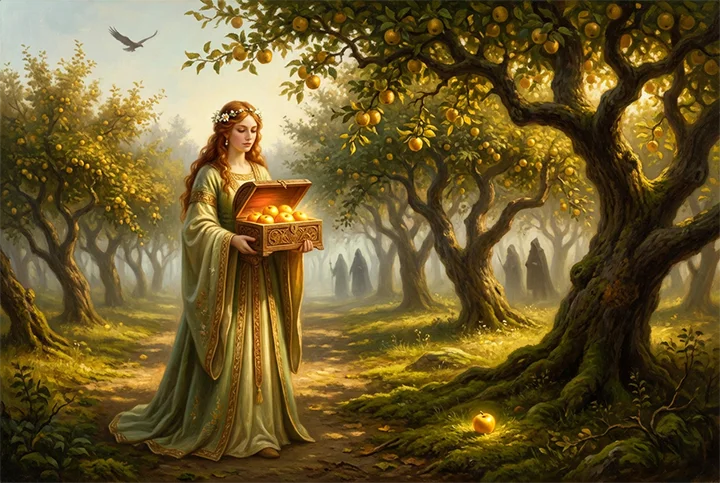
Idunn is the goddess who keeps the apples that prevent the gods of Asgard from aging, the single point of biological vulnerability in the entire divine order. Without her apples the Aesir grow old, their strength fails, their sight dims, and they become what they are not supposed to be: mortal. She is the wife of Bragi, the god of poetry, and she tends her apples in a box or casket that she carries with her, distributing them to the gods when they need to renew their youth. She is not a warrior, not a magician, not a seer. She is the keeper of the one thing that makes everything else possible, and her abduction is the closest Norse mythology comes to an existential crisis for the gods.
Idunn appears in relatively few sources but her importance is structural rather than narrative: she is the mechanism by which divine immortality is maintained, and every day that the gods remain vital and capable is a day that depends on her continued presence in Asgard. The myth of her abduction by the giant Thiazi, set in motion by Loki's characteristic combination of recklessness and cowardice, demonstrates with uncomfortable precision how fragile the gods' power really is and how quickly everything they represent can begin to unravel.
Origins and Mythology
The primary source for Idunn's myth is the Haustlong, a skaldic poem attributed to the tenth-century Norwegian skald Thjodolf of Hvinir, and the account Snorri Sturluson provides in the Prose Edda's Skaldskaparmal, which draws heavily on the same tradition. The myth begins when Odin, Loki and Hoenir are traveling together and stop to cook an ox. The meat will not cook, no matter how long they tend the fire. A great eagle sitting in a nearby tree tells them that this is his doing and that it will not cook until he has been given his share of the meal. They agree. The eagle takes the largest portions, more than his share, and Loki, infuriated, strikes him with a pole. The pole sticks to the eagle and Loki's hands stick to the pole and the eagle flies away, dragging Loki through rocks and trees until he is nearly torn apart.
The eagle is the giant Thiazi in disguise. He will release Loki only on one condition: Loki must bring Idunn and her apples out of Asgard. Loki agrees. He returns to Asgard and tricks Idunn into leaving with him, telling her he has found apples in the forest that she should compare with her own. Once outside Asgard's boundaries, Thiazi swoops down in eagle form and carries her away to his hall in Jotunheim.
The Aging of the Gods
Without Idunn's apples, the gods begin to age. The sources describe this with striking directness: the Aesir grow gray-haired and old, their bodies weakening, their powers fading. The image of the gods of Asgard aging is one of the most unsettling in the entire mythology because it reveals the condition that underlies all their strength and wisdom: they are not naturally immortal. Their immortality is maintained, tended, kept in a box by a goddess who can be taken away. The moment Idunn is gone, the clock that was never supposed to start begins to run.
The gods discover that Loki was the last to be seen with Idunn before she disappeared. They threaten him with death and torture until he agrees to retrieve her. Loki borrows Freya's falcon cloak, which allows him to fly, and travels to Jotunheim. He finds Idunn alone in Thiazi's hall while the giant is away at sea. He transforms her into a nut, takes her in his talons, and flies back toward Asgard at full speed.
Thiazi returns, discovers Idunn is gone, puts on his eagle form and pursues. The chase across the sky is one of the most vivid sequences in Norse mythology: the falcon carrying the nut, the eagle gaining behind, the walls of Asgard visible ahead. The gods see them coming and build a great fire at the walls. Loki flies low over it with Idunn. Thiazi cannot stop in time and flies into the fire. He is killed, and Idunn is restored to Asgard. The gods eat her apples and their youth returns.
The Consequence and Skadi
Thiazi's death does not go unanswered. His daughter Skadi comes to Asgard in full armor to demand compensation for her father's killing. The gods agree to terms that include making her laugh, an apparently impossible task given the circumstances, which Loki accomplishes through a comic performance involving a goat. They also agree that she may choose a husband from among the Aesir by looking only at their feet, a condition that leads to her choosing Njord when she intended to choose Baldur. The chain of consequences that begins with Loki's cowardice on the road, runs through Idunn's abduction and Thiazi's death, and ends with Skadi's arrival and her difficult marriage to Njord, is one of the most carefully constructed narrative sequences in the Eddic tradition.
Legacy and Significance
Idunn's significance in Norse mythology is easy to underestimate because she is not an actor in the dramatic sense. She does not fight, plan, prophesy or transform. She tends her apples and she is present in Asgard, and those two facts are sufficient to keep the divine order functioning. Her importance is the importance of the thing whose absence is catastrophic rather than the thing whose presence is spectacular.
The apple as a symbol of immortality and divine youth is a recurring motif in Indo-European mythology, appearing in various forms across Greek, Celtic and Norse traditions. What is distinctive about the Norse version is its fragility: Idunn's apples are not an inexhaustible divine gift but a resource that requires protection, tending and the continued safety of the goddess who keeps them. The gods are not immortal by nature; they are immortal by arrangement, and the arrangement can be broken. That is the quiet, vertiginous truth at the center of Idunn's myth.