The World Serpent That Encircles Midgard and Awaits Ragnarök
Overview
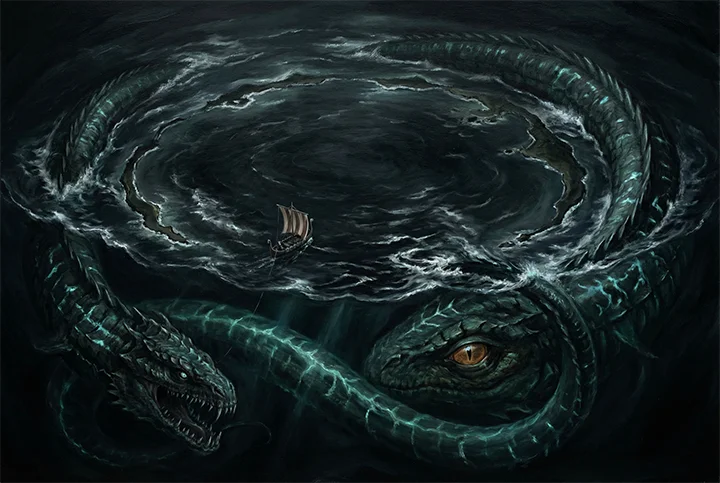
Jörmungandr, also called the Midgard Serpent or Miðgarðsormr, is one of the three monstrous children of Loki and the giantess Angrboða, a creature of such immense size that it encircles the entire world of Midgard and bites its own tail. It is the fated adversary of Thor, and the two are destined to kill each other at Ragnarök: Thor will strike the serpent dead with Mjolnir, walk nine steps away from the body, and fall dead from the venom that Jörmungandr has sprayed across the field. In the interval between its casting into the ocean at the beginning of mythological time and its release at Ragnarök, Jörmungandr appears in three major narrative contexts: in the fishing trip with the giant Hymir where Thor drags it to the surface, in the disguised encounter at Útgarðaloki's hall where it appears as a great grey cat, and in the Voluspa's description of its advance at the onset of Ragnarök.
Sources
The primary sources for Jörmungandr are the Hymiskviða and the Voluspa in the Poetic Edda, and the Gylfaginning and Skaldskaparmal of the Prose Edda. Snorri Sturluson provides the fullest prose account of the serpent's origin, its casting into the ocean, and its roles at Ragnarök and in the fishing trip. The Hymiskviða gives the poetic account of the fishing expedition. Skaldic poetry, particularly the Ragnarsdrápa of Bragi Boddason, the earliest named Norse skald, provides early evidence for the Thor-Jörmungandr conflict in visual art described in verse. The Altuna runestone in Uppland, Sweden, carved in the eleventh century, depicts the fishing trip scene with the characteristic detail of Thor's feet pressing through the bottom of the boat.
Origin and Casting into the Sea
Jörmungandr was born to Loki and Angrboða in Jötunheimr along with its siblings Fenrir the wolf and Hel the goddess of the dead. When the gods became aware of these three children through prophecy, they acted against each of them. Hel was sent to rule the realm of the dead in Niflheim. Fenrir was brought to Asgard and eventually bound on the island of Lyngvi with the fetter Gleipnir. Jörmungandr was thrown by Odin into the ocean that encircles Midgard. There it grew until it was large enough to encircle all of Midgard and bite its own tail, the image known as the ouroboros. The Prose Edda states that it lies in the deep sea surrounding all lands and that Odin cast it there because he knew from prophecy what destruction would come from it and its siblings.
The Fishing Trip with Hymir
The most extensively narrated pre-Ragnarök encounter between Thor and Jörmungandr is the fishing expedition described in the Hymiskviða and in prose in the Gylfaginning. Thor, disguised as a young man, travels to the hall of the giant Hymir to obtain a cauldron large enough for Ægir's feast. He and Hymir go fishing in deep water. Thor takes the head of Hymir's largest ox, Himinhrjótr, as bait. He rows far out beyond the fishing grounds Hymir considers safe, into the deep ocean, and drops the line baited with the ox head. Jörmungandr takes the bait. Thor hauls the serpent upward with such force that his feet press through the bottom of the boat. He draws the serpent to the surface and looks it in the eye.
At this moment Hymir cuts the fishing line in fear. The serpent sinks back into the ocean. Thor throws Mjolnir after it. Snorri notes in the Gylfaginning that some say Thor struck the serpent's head and drove it to the bottom, and that this is why it is still alive at Ragnarök, but he also notes that others say Thor missed entirely. The Hymiskviða is less explicit about the outcome. The Altuna runestone in Uppland, Sweden, depicting a figure in a boat with his feet through the hull pulling a serpent upward on a line while a second figure cuts the line below, is the most direct visual contemporary representation of this myth available in the archaeological record.
The Encounter at Útgarðaloki's Hall
A different encounter between Thor and Jörmungandr appears in the Gylfaginning in the story of Thor's visit to the hall of the giant king Útgarðaloki. The giant subjects Thor and his companions to a series of seemingly simple tests that they all fail. Thor is asked to lift a large grey cat from the floor. He struggles with all his strength and manages only to raise one paw. The cat is subsequently revealed to be Jörmungandr in disguise. Útgarðaloki explains that the fact Thor could raise one paw at all was remarkable given that the serpent encircles all of Midgard and its weight is effectively the weight of the world. The episode reframes Thor's inability to lift the cat not as a failure of strength but as a statement about the immensity of what he was attempting.
Jörmungandr at Ragnarök
At Ragnarök, Jörmungandr releases its tail from its mouth, comes up out of the ocean and advances onto the land. The Voluspa describes it spewing venom across the sky and the sea as it moves. It advances alongside Fenrir toward the gods assembled on the plain of Vígríðr. Thor meets it and kills it with Mjolnir. He then walks nine steps away from the serpent's body before falling dead from the venom Jörmungandr has sprayed across the battlefield during its advance. The nine steps Thor walks mirror the nine nights Odin hung on Yggdrasil: both are the measure of the greatest cost in the Norse tradition, the price paid for the most significant act. Thor and Jörmungandr die by each other's agency in the same moment, each the instrument of the other's destruction.
Jörmungandr in Skaldic Kennings
Jörmungandr appears extensively in the kenning tradition of skaldic poetry. Thor is frequently identified by circumlocutions that reference his relationship with the serpent: the enemy of the Midgard Serpent, the killer of the great serpent, the adversary of Jörmungandr. Jörmungandr itself is referred to as the enemy of the gods, the enemy of Thor, the girdle of the earth, the great serpent of the ocean and numerous other periphrastic expressions. This density of kenning usage in a highly conventional poetic tradition reflects how central the Thor-Jörmungandr conflict was to the Norse mythological imagination, present not only in the narrative texts but woven into the fabric of Norse poetic language at every level.
Legacy and Significance
Jörmungandr represents the principle of cosmic encirclement and cosmic threat in Norse mythology: the force that surrounds the known world and, at the moment of Ragnarök, comes in from the boundaries to destroy it. Its relationship with Thor is the most clearly predetermined conflict in the Norse mythological tradition, more fully documented across more sources and media than any other pair of adversaries. The serpent and the thunder god are mirror images of each other in the structure of the Norse cosmos: Jörmungandr encircles Midgard and Thor protects it, and their mutual destruction at Ragnarök dissolves both the threat and the protection simultaneously, leaving the new world that rises afterward to organize itself without either of them.
OTHRAVAR — Musical Tribute
Experience the weight of the world serpent rising from the ocean depths and the thunder of Mjolnir at the edge of Ragnarök through the ancient sounds of Norse folk music. This original composition draws from the skaldic tradition, performed with traditional instruments including tagelharpa, bukkehorn and frame drum.