The Moon and the Sun: The Children Who Drive the Chariots Across the Sky
Overview
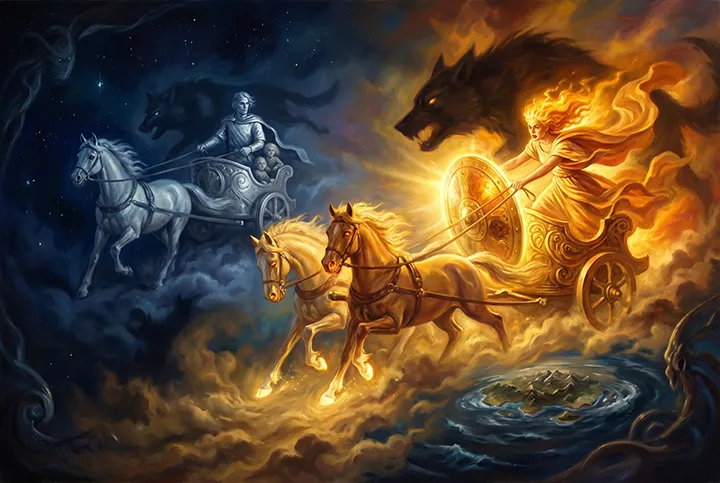
Máni and Sól are the personifications of the moon and the sun in Norse mythology, siblings described as the children of a man named Mundilfari who named them after the celestial bodies in an act of pride that the gods punished by taking the children and placing them in the sky to drive the chariots that carry the moon and sun across the heavens. They are among the most ancient figures in the Norse religious tradition, reflecting a widespread Indo-European tendency to personify the sun and moon as divine beings and to understand their daily movement as the action of a conscious being rather than as a physical mechanism. In the Norse tradition this personification is complicated by the addition of the wolves who pursue them: Sköll chases Sól and her sun chariot across the sky every day, and Hati chases Máni every night, and at Ragnarök they will catch them, extinguishing the sun and moon and leaving the world in darkness before it is destroyed and renewed.
Sources
The primary sources for Máni and Sól are the Prose Edda of Snorri Sturluson, particularly the Gylfaginning, which provides the most detailed account of their origin, their chariots and their pursuers, the Voluspa of the Poetic Edda, which describes the sun knowing not what home she has and the moon knowing not what power it has, suggesting that both celestial bodies are in some sense uncertain of their cosmic role or status, and the Vafthrudnismal, the Alvissmal and the Grimnismal, which contain relevant cosmological details. The Prose Edda's Gylfaginning account is the fullest single description of the two figures and their mythology.
Mundilfari and the Naming
The origin of Máni and Sól in the Norse tradition begins with their father Mundilfari, whose name has been interpreted as meaning pole or axis, a connection to the cosmic axis that might suggest he was understood as a figure of cosmic significance rather than simply a human parent. Mundilfari had two children of extraordinary beauty, and in his pride at their appearance he named the boy Máni, Moon, and the girl Sól, Sun. The gods found this presumptuous, regarding the naming of human children after the celestial bodies as an act of hubris that challenged the divine order, and they responded by taking the children and placing them in the sky to serve the heavenly bodies whose names they had been given. This punishment is consistent with the Norse mythological tradition's tendency to respond to human presumption by incorporating the presumptuous into the divine order rather than by destroying them: Mundilfari's children become the drivers of the celestial chariots, eternally serving the heavenly bodies they were named for.
Sól and the Sun Chariot
Sól drives the chariot of the sun across the sky, drawn by the two horses Árvakr and Alsviðr, whose names mean Early Awake and Very Quick, appropriate names for the horses who must maintain the daily course of the sun. The sun itself is a blazing object that the gods placed in the sky from the sparks and embers of Muspelheim during the creation, set on its course to give light to the world. The chariot that carries it across the sky must move quickly enough to prevent the sun from scorching the earth it passes above, and the shield Svalinn, whose name means the cooling one, is placed between the sun and the earth to moderate its heat.
Behind Sól and her chariot runs the wolf Sköll, whose name means treachery or mockery, chasing her across the sky every day. Sól's daily journey across the sky is therefore simultaneously a necessary cosmic function and a continuous flight from destruction: she drives the sun chariot because the gods placed her there, and she drives it as fast as she does in part because she is being chased. At Ragnarök, after Fimbulwinter has brought three winters with no summer between them and the social bonds of the world have dissolved, Sköll catches Sól and swallows her. The sun is extinguished.
Máni and the Moon Chariot
Máni drives the moon chariot across the sky by night, governing the waxing and waning of the moon as he goes. Snorri describes Máni as taking two children from the earth named Bil and Hjúki, who had been fetching water from the well Byrgir with the bucket Sœgr and the pole Simul on behalf of a man named Viðfinnr. Máni took them with him as he passed, and they can be seen following the moon across the sky, a detail that Snorri's source tradition connected to the changing appearance of the moon's surface, the pattern of light and shadow on the moon's face being interpreted as the two children carrying their water bucket and pole. This tradition has been connected by some scholars to the worldwide phenomenon of the man in the moon and related folk traditions about figures visible in the moon's surface.
Behind Máni runs the wolf Hati, whose name means one who hates, also called Mánagarmr, the moon's hound or moon's dog. Like Sköll who chases Sól, Hati chases Máni across the night sky, and at Ragnarök, in the same catastrophe in which Sköll catches the sun, Hati catches the moon. The moon is extinguished. The world is left without light for the darkness that precedes its destruction and eventual renewal.
Sköll and Hati
Sköll and Hati are described in several sources as the children of the great wolf Fenrir or of a wolf in Jarnvid, the Iron Wood, a forest in Jötunheimr associated with the wolf-giants. Their pursuit of the sun and moon is framed in the Norse sources not as a natural or inevitable process but as an ongoing threat, a race that has been running since the beginning of time and which will end at Ragnarök when the predators finally catch their prey. The daily movement of the sun and moon across the sky is therefore simultaneously the necessary provision of light for the world and a perpetual close-run chase between the celestial drivers and the wolves who pursue them.
Sól's Daughter
The Voluspa contains a striking detail about Sól that is not elaborated in other sources: it describes a daughter who will be born to Sól before Ragnarök, who will ride her mother's paths after the old world has ended. This daughter of the sun is described in the context of the new world that rises after Ragnarök, a world in which the fields grow without having been sown and where the surviving gods meet and remember what was. The sun's daughter who rides her mother's paths in the new world connects the renewal of the cosmos to the continuity of the solar function: the sun's daily journey across the sky, which ended when Sköll caught and swallowed Sól at Ragnarök, resumes in the new world in the person of Sól's daughter. The new world has a sun because the old sun had a child.
Legacy and Significance
Máni and Sól represent the Norse tradition's understanding of the daily movement of the heavenly bodies as an expression of conscious effort and ongoing threat rather than as a mechanical or predetermined process. The sun and moon cross the sky because their drivers make them do so, and they do so as fast as they do because they are being chased. The eventual failure of this effort at Ragnarök, when Sköll and Hati finally catch the sun and moon, is not a malfunction or a surprise but the predetermined conclusion of a chase that has been running since creation. In this framework the daily provision of light for the world is understood as an act of will maintained against destruction, and the value of sunlight and moonlight is given a specific and personal character: they are the contribution of Sól and Máni to a world that would be dark without them, maintained in the face of permanent threat until the moment when the threat finally overwhelms them.
OTHRAVAR — Musical Tribute
Experience the galloping of Árvakr and Alsviðr across the sky and the howling of Sköll and Hati in pursuit of the sun and moon through the ancient sounds of Norse folk music. This original composition draws from the skaldic tradition, performed with traditional instruments including tagelharpa, lur and frame drum.