Guardian of All Wisdom
Overview
Mímir is one of the most enigmatic figures in Norse mythology, the guardian of the well of cosmic wisdom that bears his name and the keeper of knowledge so vast and so deep that even Odin himself was willing to sacrifice his eye for a single drink from it. He is neither warrior nor ruler in the conventional sense; his power is the power of knowing, of having witnessed everything that has passed and understanding everything that will come. In a tradition that values wisdom alongside strength, Mímir occupies a unique position: he is the one even the gods consult when their own understanding reaches its limit.
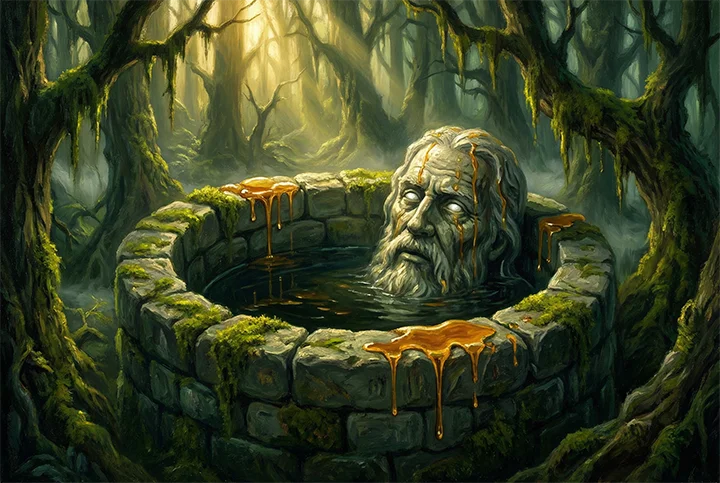
Mímir's well, Mímisbrunnr, lies beneath one of the three roots of Yggdrasil, the great World Tree. Its waters contain the accumulated wisdom of all ages, fed by the underground streams that flow through the deepest strata of the Norse cosmos. Whoever drinks from it receives insight into the hidden workings of the world, into the nature of fate and the shape of things past and present. The price of that drink is always commensurate with what is sought: Odin paid with his eye, and even that was considered a fair exchange for what he received.
Mímir himself is described in the sources in ways that suggest he is older than the current order of the gods, a being whose origins predate the Aesir and whose knowledge encompasses what came before them. He is in some sense the memory of the cosmos itself, a living archive of everything that has existed. His counsel is sought precisely because it cannot be fabricated or manipulated: Mímir simply knows, and what he knows is true.
Origins & Mythology
Mímir's origins are debated among scholars. The Prose Edda and the Poetic Edda present him in ways that are not entirely consistent with each other, suggesting that he may represent the convergence of several older mythological traditions. In some accounts he is presented as one of the Aesir gods, in others as a being of more ambiguous nature associated with the primordial depths of the world. What is consistent across all sources is his association with wisdom of the deepest kind, the kind that requires sacrifice to access.
The most significant event in Mímir's mythology is his death and what followed from it. During the Aesir-Vanir war, hostages were exchanged between the two divine tribes as part of the peace settlement. The Aesir sent Mímir and Hœnir to live among the Vanir. Hœnir proved useless as a counsellor without Mímir beside him, giving only evasive non-answers whenever Mímir was absent. The Vanir, feeling deceived, cut off Mímir's head and sent it back to the Aesir.
Odin's response to receiving Mímir's severed head is one of the strangest and most revealing moments in Norse mythology. Rather than treating it as a casualty of war, Odin preserved the head with herbs and embalmed it with his magic, and then spoke galdrar, incantations, over it until it could speak again. From that point on, Mímir's head continued to advise Odin, carrying all the wisdom it had accumulated in life into its new and permanent form. Death had not ended Mímir's function; it had only changed his shape.
Key Stories & Appearances
Mímir's most famous appearance is the episode of Odin's eye. Odin came to Mímisbrunnr seeking wisdom beyond what he already possessed, the kind of insight that would help him understand the forces working toward Ragnarök and find any means of delay or preparation. Mímir, the keeper of the well, demanded payment. The price was Odin's eye. Odin removed it and cast it into the well, and Mímir gave him a drink of the water. Odin's missing eye is said to lie at the bottom of Mímisbrunnr still, seeing in the depths what the living eye sees in the light.
Mímir appears again, obliquely, in the Eddic poem Völuspá, one of the primary sources for Norse cosmological understanding. The völva who narrates the poem refers to Odin consulting with Mímir's head before Ragnarök, seeking final counsel from the one source that has knowledge of what the end truly means. This image of Odin turning to the preserved head of his ancient adviser in the last moments before the world's destruction is one of the most haunting in all of Norse literature: the king of the gods, facing the end of everything, still seeking wisdom rather than comfort.
Gjallarhorn, Heimdall's great warning horn, is also associated with Mímir's well in some traditions. One account states that the horn is hidden beneath the roots of Yggdrasil near Mímisbrunnr, kept safe until the moment of Ragnarök. Whether or not this represents a consistent mythological tradition, it reinforces the sense that Mímir's well is a place of safekeeping for things of ultimate importance, a vault at the roots of the world where what matters most is stored until it is needed.
Legacy & Significance
Mímir represents something that the Norse tradition understood with unusual clarity: that the deepest knowledge is not free and cannot be inherited. It must be paid for, and the payment must be proportionate to what is sought. Odin did not receive cosmic wisdom because he was the chief god; he received it because he was willing to pay the price that Mímir set. The wisdom of the well is democratic in the most demanding sense: it is available to anyone willing to sacrifice sufficiently for it.
The image of Mímir's head, still speaking after death, still advising the gods from beyond the boundary of the living, speaks to the Norse understanding of wisdom as something that transcends the individual life that accumulated it. Knowledge, once truly possessed, does not die with its possessor. It can be preserved, passed on, spoken into the dark. Mímir's head at the roots of Yggdrasil is the Norse tradition's most striking image of that conviction: the voice of accumulated wisdom, still speaking at the bottom of the world.