The God of Sea, Wind and Coastal Abundance
Overview
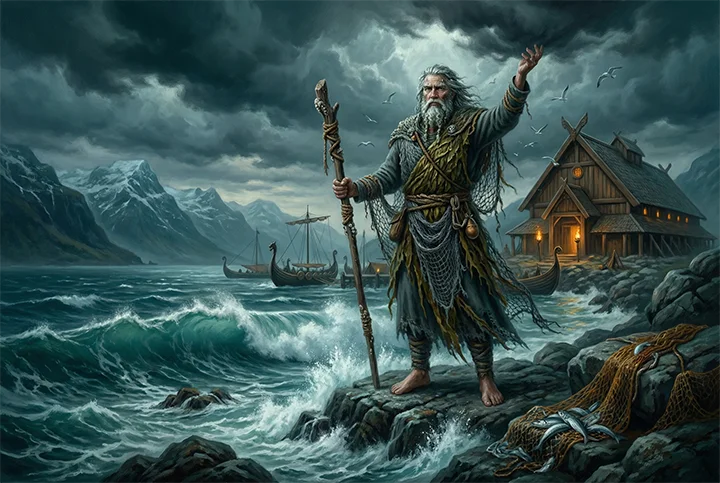
Njord is the Vanir god of the sea, wind, fishing and coastal prosperity, one of the oldest and most widely venerated deities in the Norse world. He governs the winds that fill the sails of ships, the waters that yield fish to those who work them, and the wealth that flows into harbors and trading settlements from the sea. He is the father of Freyr and Freya, two of the most important gods in the entire pantheon, and he came to Asgard as a hostage at the end of the Aesir-Vanir War, where he was accepted among the Aesir and given a permanent place in their company. His hall is Noatun, the Place of Ships, built on the shore where the sea meets the land, and it is from there that he calms the ocean and stills the fire of the waves when sailors call on him.
Njord occupies a position in Norse cosmology that is quieter than that of the great warrior gods but no less essential. The Norse world was built on the sea. Its trade routes, its raiding, its settlement of new lands, its fishing that fed entire communities through the winter: all of it depended on the sea being survivable, and the sea being survivable depended, in the Norse understanding, on the goodwill of Njord. He was not a god of war or wisdom or fate. He was the god of the thing that made everything else possible.
Origins and Mythology
The primary sources for Njord are the Prose Edda and the Poetic Edda, particularly the Grimnismal and the Lokasenna. Snorri Sturluson describes him in the Gylfaginning as the ruler of the winds and the stiller of sea and fire, noting that sailors and fishermen call on him and that he is so wealthy that he can give riches and land to those who ask him for them. The image of Njord as a god of abundance as much as a god of the sea is consistent across the sources: he is not only the one who makes the crossing possible but the one who ensures there is something worth returning to.
Njord's origins are in the Vanir, the older family of gods whose association with nature, fertility and prosperity predates the more martial culture of the Aesir. After the Aesir-Vanir War ended in a truce, Njord was sent to Asgard along with his children Freyr and Freya as part of the exchange of hostages that sealed the peace. His counterpart, sent from Asgard to the Vanir, was the god Hoenir. Njord adapted to life among the Aesir and became one of the twelve principal gods who sit at the councils of Asgard, but his nature remained rooted in the coastal world he came from.
Njord and Skadi
The most important myth concerning Njord is his marriage to the giantess Skadi, a story that is as much about the impossibility of reconciling two incompatible natures as it is about any conventional courtship. Skadi came to Asgard to demand compensation for the death of her father Thiazi, whom the gods had killed after he abducted Idunn and her apples of immortality. The gods agreed to her terms, which included the right to choose a husband from among the Aesir, with the condition that she must choose by looking only at the gods' feet.
Skadi assumed that the most beautiful feet would belong to Baldur, the god of light. She chose the finest pair she could see and discovered she had chosen Njord. The marriage took place. It was not a success. Skadi was the goddess of skiing, hunting and winter mountains, and she could not endure the sound of the seabirds at Noatun, which she found shrill and sleepless-making after the silence of her mountain home Thrymheim. Njord could not endure the sound of the wolves howling in the mountains, which disturbed him after the soothing sound of the waves. They agreed to divide their time, spending nine nights in Thrymheim and then nine nights in Noatun. Neither was content. The marriage eventually dissolved, and Skadi returned to her mountains.
The episode is one of the most honestly domestic in all of Norse mythology. There is no villain, no betrayal, no supernatural force driving the couple apart. There are simply two beings whose idea of home is incompatible, and the myth follows that incompatibility to its quiet conclusion without apportioning blame to either side.
Njord at Ragnarok
Njord's fate at Ragnarok is unusual among the gods. The sources indicate that he will return to the Vanir after the final battle, going back to the world from which he came rather than dying in the conflict or surviving into the new world that rises afterward. This departure sets him apart from most of the other gods and is a reminder of his origins: Njord was always a visitor in Asgard, accepted and respected but never entirely of the place. At the end, he goes home.
Legacy and Significance
Njord's importance in the actual religious practice of the Norse world is attested by the large number of place names in Norway and Sweden that incorporate his name, indicating sites where his cult was active and where communities turned to him for the protection and prosperity they needed from the sea. He was worshipped alongside Freyr in many of the same contexts, the two Vanir gods of abundance complementing each other across the boundary between land and water.
In the broader picture of Norse cosmology, Njord represents the principle that the world's wealth is not created by conquest but yielded by nature to those who know how to work with it. He does not fight. He does not scheme. He stands at the edge of the sea and ensures that those who sail it can return, and that there is enough in the waters to sustain those who depend on them. In a world that was genuinely dangerous, genuinely uncertain, and genuinely dependent on the sea's generosity, that was not a small thing to ask for.