Goddess of the Sea
Overview
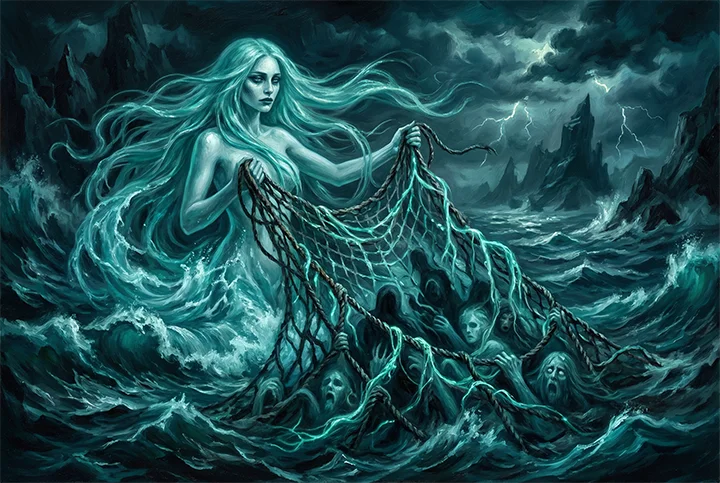
Rán is the Norse goddess of the sea, the divine force that governs the ocean's capacity to take the living and keep them. Her name means roughly "robbery" or "plunder" in Old Norse, and it captures her essence precisely: she does not welcome the drowned so much as claim them, pulling sailors and seafarers down into her vast underwater hall with the net she casts across the surface of the waves. She is the sea not as a route or a resource but as an appetite, the dark and indifferent hunger of deep water that takes without asking.
Rán is married to Ægir, the personification of the ocean itself, with whom she rules the underwater realm. Together they have nine daughters, the wave maidens, each named for a different aspect of the sea's movement: Himinglæva (the transparent wave through which the sky is seen), Dúfa (the pitching wave), Blóðughadda (the wave with blood-red hair), Hefring (the rising wave), Uðr (the frothing wave), Hrönn (the surging wave), Bylgja (the billow), Dröfn (the foam fleck) and Kólga (the cold wave). Between them, Rán and her daughters embody every mood and motion of the sea.
She is one of the few Norse divine figures whose primary association is neither with battle glory nor with cosmic order but with the simple, terrible fact of drowning. In a culture whose entire existence depended on the sea, whose men sailed vast distances in open boats across the North Atlantic and the Baltic, Rán was the presence that waited beneath every voyage. She was not prayed to for fair weather; she was propitiated so that if she did take you, she would at least receive you well.
Origins & Mythology
Rán and Ægir appear together in several of the most important sources of Norse mythology. Their hall at the bottom of the sea is described as luminous, lit by gold that gleams in the deep water, and it is one of the few underwater settings depicted in detail in the Norse tradition. The gods themselves are said to have visited Ægir's hall for feasts, and the atmosphere of these visits combines the warmth of divine hospitality with the constant undercurrent of the sea's alien otherness. It is a beautiful and unsettling place, like the sea itself.
The Norse relationship with drowning was complex and charged. Death at sea was not considered equivalent to death in battle; those taken by Rán did not go to Valhalla or to Fólkvangr. They went to Rán's hall, which the sources describe as a place where the drowned continue to exist in a manner similar to the living, feasting and drinking in the cold deep. Some accounts suggest this was not entirely unwelcome, that being received by Rán was a form of afterlife with its own dignity. Others carry a darker tone, emphasising the loss and displacement of dying far from land.
One of the most striking pieces of evidence for how seriously the Norse took Rán is the practice, recorded in several sagas, of carrying gold before a sea voyage specifically so that if one drowned, one would arrive in Rán's hall with something to offer. Gold was her attribute: it was what gleamed at the bottom of the sea, what her hall was lit by, what a drowned man could bring her as a guest-gift. Arriving at Rán's hall without gold was arriving empty-handed at a feast, and the Norse understood that to be a form of dishonour.
Key Stories & Appearances
Rán appears most vividly in the sagas as the force behind maritime disaster. In Egils saga, the skald Egill Skallagrímsson loses his son Böðvarr to the sea and in his grief composes a lament in which he rails against Rán directly, accusing her of theft and demanding to know what she intended by taking his son. The raw personal grief of the poem and the directness of its address to the goddess captures something essential about how the Norse understood her: not as a cosmic abstraction but as a specific, locatable presence responsible for a specific, irreversible act.
In Njáls saga and other saga literature, the expression "to be in Rán's hands" became a kenning for drowning or being lost at sea. The phrase treats death by water not as an accident but as a deliberate seizure by a divine agent. The kenning "Rán's road" or "Rán's way" was used for the sea itself, and Rán's net was a recurring image for the way the ocean seemed to actively hunt its victims rather than simply receive them passively.
Rán's net is one of her most distinctive attributes. Loki is said to have borrowed it on one occasion when he needed to catch Andvari, the dwarf who had transformed himself into a pike to hide in a waterfall. The fact that Loki sought out Rán's net specifically for a task requiring the capture of something slippery and evasive says something about how the Norse conceived of it: as a device of absolute capture, something from which escape was not possible once you were inside it.
Legacy & Significance
Rán represents something that the Norse mythological tradition does unusually well: the acknowledgment that the sea is not neutral. It is not simply a space through which you travel or from which you draw fish. It is an entity with will and appetite, and the people who depended on it for their survival understood that dependency as a relationship with something that could and would take from them without warning or justification. Rán gives that understanding a name and a face and a net.
She endures as one of the most psychologically honest figures in Norse mythology precisely because she does not offer comfort or resolution. She takes. She keeps. Her hall glitters with gold at the bottom of the cold sea, and the men and women who drown find themselves there, guests of a goddess who claimed them against their will. The Norse did not soften this with reassurance. They brought gold, and they sailed anyway.