Thor's Golden-Haired Wife and the Goddess of Earth and Harvest
Overview
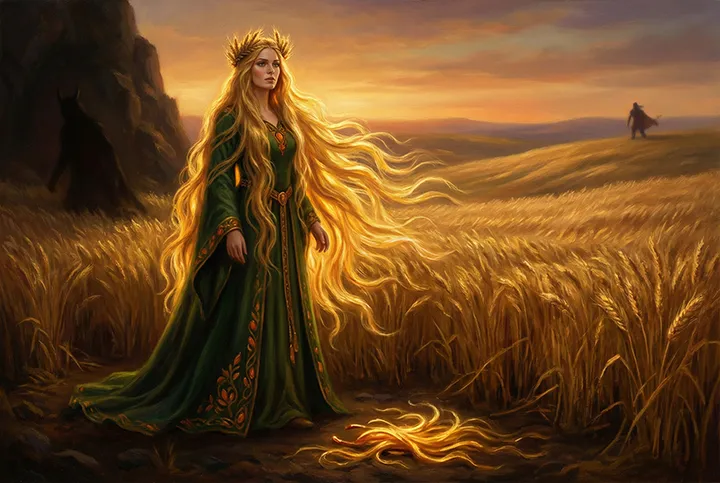
Sif is one of the Aesir goddesses of Norse mythology, the wife of Thor and the mother of Þrúðr by Thor and of Ullr by an unnamed first husband. She is described in the sources primarily through two attributes: her extraordinary golden hair, which Snorri Sturluson identifies as being like gold and associates with the grain fields of harvest time, and her marriage to the most physically powerful god of the Norse pantheon. Sif's role in the surviving mythology is not extensive, but the episode in which Loki cuts off her hair while she sleeps and the chain of events that follows from this act of malice is one of the most consequential in the entire Norse mythological tradition: it directly results in the manufacture of Gungnir, Skidbladnir, Gullinbursti, Draupnir and Mjolnir, the most important divine weapons and treasures in the Norse cosmos.
Sources
The primary sources for Sif are the Prose Edda of Snorri Sturluson, particularly the Skaldskaparmal which provides the most detailed account of her and of the hair-cutting episode, the Lokasenna in the Poetic Edda, and scattered kenning references in skaldic poetry. Snorri describes Sif as a prophetess in addition to giving her golden hair as her primary attribute, but this prophetic dimension is not developed further in the surviving sources. The kenning tradition in skaldic poetry uses Sif and her golden hair as the basis for kennings for gold, which appears in the tradition as the hair of Sif, the tresses of Sif and various elaborations of this formula, making Sif's hair one of the most productive sources of kennings for a single concept in the Norse poetic tradition.
Sif's Golden Hair
The golden hair of Sif is her defining characteristic in the Norse tradition, the attribute through which she is most consistently identified in both the mythological narratives and the skaldic kenning system. Snorri's identification of Sif's hair with grain, and specifically with the golden grain fields of the harvest, has led many scholars to interpret Sif as a goddess of the earth and agricultural fertility, whose golden hair represents the ripe grain standing in the fields before harvest. This interpretation is consistent with her marriage to Thor, the god of thunder whose storms bring the rain that fertilizes the grain, and with the seasonal logic that connects the golden grain of late summer to the golden hair of the goddess who is the earth's surface.
The mythological significance of Sif's hair is established most vividly through its destruction and replacement. When Loki cuts off Sif's hair while she sleeps, the narrative presents this as a serious violation, not simply an aesthetic offense but an act of damage to something cosmologically significant. Thor's response, threatening Loki with death unless the damage is repaired, reflects the weight of what has been damaged: the golden hair of the earth goddess, the grain-like covering of the earth's surface, has been removed, and the world is the worse for it. Loki's journey to Svartalfheim to have the dwarves replace it, and the competitive escalation that produces Mjolnir as a side effect of this repair, frames the damage to Sif's hair as the inciting event of one of the most significant episodes of divine craftwork in the Norse tradition.
Loki's Cutting of Sif's Hair
The Skaldskaparmal of the Prose Edda provides the primary account of this episode. Loki, who is described in many sources as finding in mischief and malice an end in itself, cut off all of Sif's hair while she slept. When Thor discovered what had been done, he seized Loki and threatened to break every bone in his body unless he replaced the hair. Loki agreed, went to Svartalfheim, and contracted with the dwarves known as the Sons of Ivaldi to make new hair for Sif from gold, hair that would grow like natural hair. The Sons of Ivaldi produced the golden hair, along with two additional gifts: the ship Skidbladnir for Freyr, a vessel that could sail on any sea but fold small enough to fit in a pocket, and the spear Gungnir for Odin, that never misses its mark.
Emboldened by the quality of these three objects, Loki then wagered his head with another dwarf named Brokkr that Brokkr and his brother Sindri could not produce three objects of equal or greater value. The result of this wager was Gullinbursti the golden boar for Freyr, Draupnir the gold ring that produces eight equal rings every ninth night for Odin, and Mjolnir the hammer for Thor. The gods judged Mjolnir the most valuable of all six gifts because it was the most essential for their defense. Loki's original malicious act against Sif therefore indirectly caused the manufacture of the six most important divine treasures in Norse mythology, transforming an act of spite into the origin story of the entire Norse divine armory.
Sif in the Lokasenna
Sif appears briefly in the Lokasenna, the poem in which Loki enters a divine feast and systematically insults every god and goddess present. When Loki reaches Sif, she offers him mead and attempts to exempt herself from his insults by noting that she alone among the goddesses has done nothing to deserve his malice. Loki responds by claiming to have lain with her, making her the only goddess he credits with sexual fidelity to her husband by contrast. The exchange is brief but reveals Sif as a figure who is aware of Loki's previous offense against her and who attempts to manage his hostility diplomatically rather than through confrontation. Whether Loki's claim of sexual intimacy with Sif is presented as true, false or ambiguous is a matter of interpretation; the Lokasenna's claims against the gods are generally understood as a mixture of slander, partial truth and exaggeration rather than as straightforward factual assertions.
Sif as Goddess of Earth and Harvest
The scholarly consensus on Sif's function in Norse religious life tends toward identifying her as a goddess associated with the earth's surface and with agricultural fertility, based primarily on the grain symbolism of her golden hair and on her marriage to Thor whose rain enables the harvest. This identification is supported by the comparative evidence from other Germanic traditions, where earth goddesses are documented as significant objects of worship in the agricultural communities of early medieval Scandinavia and Germany. Sif's relative scarcity in the surviving mythological narratives compared to her prominence in the kenning system, where gold as Sif's hair is one of the most standard formulas, suggests that she may have been more important in religious practice than the literary tradition, which was composed predominantly by and for the warrior elite, chose to represent.
Legacy and Significance
Sif occupies a paradoxical position in the Norse mythological tradition: she is one of the most consequential figures in terms of the events her story generates, since the cutting of her hair is the direct cause of the manufacture of the six great divine treasures, while simultaneously being one of the least narratively developed goddesses in the surviving sources. Her golden hair is the most productive single kenning source in the Norse poetic tradition for the concept of gold, and her agricultural symbolism connects her to the most practically important concerns of Norse communities, yet the literary tradition gives her relatively little direct narrative attention. The tension between her cosmological importance, her kenning productivity and her narrative underdevelopment makes her one of the most interesting cases of a deity whose significance is recoverable primarily through inference rather than through direct description.
OTHRAVAR — Musical Tribute
Experience the golden fields of harvest, the violated sleep and the extraordinary manufacture that followed through the ancient sounds of Norse folk music. This original composition draws from the skaldic tradition, performed with traditional instruments including tagelharpa, langeleik and frame drum.