Goddess of Winter & the Hunt
Overview
Skaði, pronounced approximately as "Skah-thee" in Old Norse, is the goddess of winter, mountains, hunting, skiing and the wilderness. She is one of the most fiercely independent figures in the Norse pantheon, a deity who armed herself, crossed the threshold of Asgard alone to demand justice for the death of her father, and negotiated her own terms with the gods as an equal rather than a supplicant. She is of giant blood, daughter of the frost giant Þjazi, and yet she stands among the Aesir not as a captive or a hostage but as a figure of genuine power and dignity.
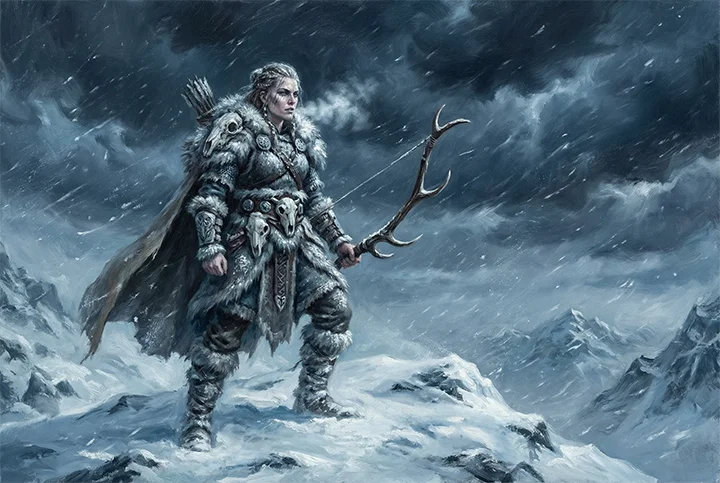
Skaði is always depicted in her element: snowshoes on her feet, bow in hand, moving through the frozen mountain wilderness with the certainty of someone entirely at home in conditions that would destroy most living things. She is associated with the deep cold of the Norse winter, with the silence of snow-covered peaks, with the patience and precision of the hunter who waits. Where other gods command fire, thunder or the sea, Skaði commands the vast indifferent cold of the high mountains, and she does so without apology.
Her story is one of loss, anger, negotiation and an ultimately unsatisfying compromise that illuminates something true about the Norse understanding of grief and justice. She comes to Asgard not as a worshipper but as an avenger, fully armed and entirely serious, and the gods must reckon with her on her own terms. In a mythology full of gods who take what they want, Skaði is one of the few who successfully demands what she is owed.
Origins & Mythology
Skaði's father Þjazi was one of the most powerful frost giants in Norse mythology. He kidnapped the goddess Iðunn, the keeper of the golden apples of immortality, forcing the Aesir to negotiate through Loki for her return. When Þjazi was killed by the gods during Iðunn's rescue, Skaði armed herself in full battle gear and marched to Asgard to demand recompense. The image of a lone giantess, armoured and furious, standing at the gates of the divine realm and refusing to leave until justice was done, is one of the most striking in the entire Norse tradition.
The gods offered her two forms of compensation. First, one of them would make her laugh, a seemingly impossible task given the circumstances. Loki achieved this through a notoriously undignified performance involving a rope and a goat, an act whose details the sources record with a mixture of relish and embarrassment. Second, she could choose a husband from among the gods, but she could only see their feet when making her choice. She chose the most beautiful feet, assuming they belonged to the radiant Baldur. They belonged instead to the sea god Njörðr.
The marriage between Skaði and Njörðr is one of the few explicitly unhappy unions in Norse mythology and one of the most honestly told. She wanted the mountains; he needed the sea. They tried living alternately in each other's realms, nine nights in her mountain home Þrymheimr and nine nights in his coastal hall Nóatún. Neither could bear the other's world. The seabirds kept Njörðr awake in the mountains; the crashing of the waves and the crying of gulls drove Skaði from the shore. They parted without bitterness, each returning to the landscape that made them whole.
Key Stories & Appearances
After her separation from Njörðr, later sources connect Skaði with Odin himself, with whom she is said to have had several sons. Whether this represents a genuine mythological tradition or a later addition is debated, but it speaks to the enduring significance of Skaði's position within the Norse divine world. She was not diminished by the failure of her first marriage; she remained a figure of power and authority, moving through the mythology on her own terms.
Skaði also plays a role in the punishment of Loki after the death of Baldur. When the gods finally captured Loki and bound him in the cave beneath the earth, it was Skaði who placed the serpent above his face to drip venom on him for eternity. This was her settling of a personal account: Loki had been instrumental in the death of her father Þjazi, having engineered the situation that led to the giant's destruction during Iðunn's rescue. Skaði's justice was patient and permanent.
Her name has given rise to the word Scandinavia itself, from the Proto-Germanic Skaðinawjō, which many scholars interpret as the island or peninsula of Skaði. Whether this etymology is accepted or disputed, the connection points to how deeply embedded she was in the identity of the Norse world: not a minor deity at the edges of the tradition but a figure whose name may have shaped the very land that the myths came from.
Legacy & Significance
Skaði endures as one of the most compelling figures in Norse mythology precisely because she refuses the role assigned to her. She comes to Asgard as an enemy and leaves as a member of the divine family, but on her own terms and without surrendering what she is. The mountains remain hers. The hunt remains hers. The cold, the silence and the wilderness remain hers. She accepts compensation but she does not accept diminishment.
In the modern revival of Norse paganism, Skaði is widely venerated by those who find in her a deity of boundaries, of winter endurance, of the fierce self-sufficiency required to survive conditions that offer no comfort. She is a goddess for those who love the wilderness not despite its harshness but because of it, who understand that the cold and the silence of high places are not things to be escaped but things to be inhabited. She asks nothing of those who come to her cold mountain. She simply expects them to be equal to it.
OTHRAVAR — Musical Tribute
Experience the cold majesty of Skaði through the ancient sounds of Norse folk music. This original composition draws from the skaldic tradition, performed with traditional instruments including tagelharpa, bukkehorn and frame drum.