Lord of Fire & Destruction
Overview
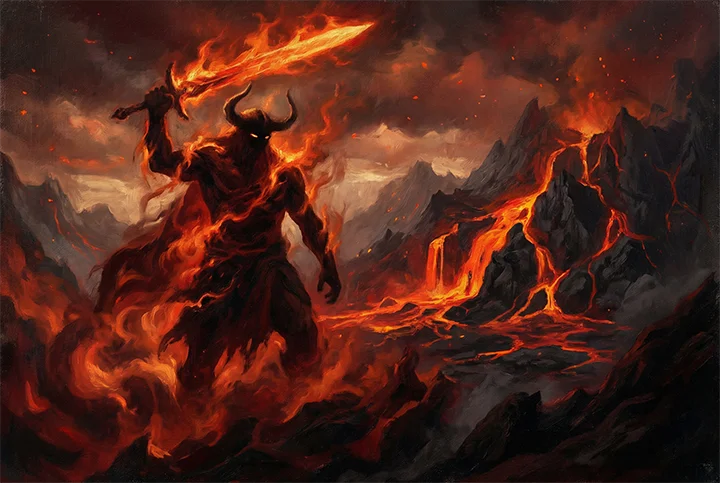
Surtr is the lord of Muspelheim, the primordial realm of fire that existed before the world was formed, and the most powerful agent of destruction in Norse cosmology. His name means "the black one" or "the swarthy one" in Old Norse, a reference not to darkness but to the blackening that fire leaves behind: char, ash, the scorched remnant of what was. He stands at the southern boundary of existence with a flaming sword that blazes brighter than the sun, waiting with a patience older than the gods themselves for the moment when he will be unleashed to burn the world to nothing.
Surtr is not a god in the Aesir sense, nor precisely a giant in the conventional Norse understanding. He is something older and more elemental: a primordial force, one of the first principles of the cosmos alongside the ice of Niflheim. Before Odin and his brothers shaped the world from Ymir's body, before the first humans drew breath, before Asgard rose above the plains of heaven, Surtr was already there at the edge of Muspelheim, sword in hand, fire spreading endlessly behind him. He predates the current order entirely and will outlast it.
His significance in Norse mythology is almost entirely eschatological. He does not feature prominently in the myths of the gods' adventures or in the cycles of creation and governance that occupy most of the Eddas. He waits. And at Ragnarök, his waiting ends, and everything the gods built and everything humans lived for is consumed in his fire.
Origins & Mythology
The Prose Edda describes Muspelheim as one of the two primordial realms that existed before the world was made, the other being Niflheim, the realm of ice and cold. Between these two extremes, fire and ice, the world came into being: the heat of Muspelheim melted the ice of Niflheim in the void of Ginnungagap, and from that interaction the first living being, the primordial frost giant Ymir, was formed. Surtr presided over Muspelheim throughout this entire process, keeper of the fire that made creation possible and that will ultimately unmake it.
Surtr's flaming sword is one of the most significant weapons in Norse mythology, mentioned in the Eddic poem Völuspá as the instrument that will set the world ablaze at Ragnarök. The sword is described as brighter than the sun, an image that captures the terrifying scale of what Surtr represents: not merely a destructive force on a battlefield scale, but a cosmic conflagration that will consume everything that exists. Mountains will crumble, the sea will boil, the sky will split, and the earth will sink beneath the waves when Surtr releases what he has been holding back since before time began.
His sons or followers, the Múspellsmegir, the sons of Muspel, are described as riding with him at Ragnarök, a host of fire that will cross the Bifrost bridge, breaking it beneath their weight, and advance on the plain of Vígríðr where the final battle will be fought. Their arrival on Bifrost is said to cause the bridge to collapse, sealing the separation between the divine realm and what comes after.
Key Stories & Appearances
Surtr's most significant appearance in the Norse sources is his role at Ragnarök, described in the Völuspá and elaborated in the Prose Edda. When the signs of the end begin to manifest — the winter without summer, the breaking of Fenrir's chain, the serpent rising from the sea — Surtr leads his forces from Muspelheim. He advances on the gods with his flaming sword, and at the end of the great battle he fights Freyr, the god of sunshine and abundance.
Freyr's encounter with Surtr is one of the great tragic ironies of Norse mythology. Freyr had given away his magical sword, the sword that fought on its own when wielded by a worthy hand, as a bride price to win the giantess Gerðr. Without it, he faces Surtr armed only with an antler, and he falls. The sword that could have defended against the lord of fire was sacrificed for love, and the world pays the price. It is one of the clearest examples in Norse mythology of how the decisions made in ordinary time have catastrophic consequences at the end of time.
After the battle is done and the gods have fallen, Surtr fulfils his ultimate purpose. He raises his sword and sweeps fire across the entire world. The earth burns, sinks into the sea, and disappears. Everything that existed is gone. And then, in the tradition's most remarkable turn, a new earth rises green and fertile from the waters, and the surviving gods return, and Baldur comes back from Hel, and the world begins again. Surtr's fire is not merely destruction; it is the precondition for renewal. Nothing new can grow until the old has been completely burned away.
Legacy & Significance
Surtr represents the Norse tradition's unflinching engagement with the idea of total destruction. Other mythological traditions imagine apocalypse as punishment or as a temporary catastrophe from which the world recovers while remaining recognisably itself. The Norse tradition imagines something more radical: a complete unmaking, a fire so total that nothing of the current world survives it. Surtr is the agent of that unmaking, and the Norse sources do not present him as a villain so much as a force: inevitable, primordial and ultimately necessary.
The volcanic landscape of Iceland, where much of the Norse mythological tradition was preserved and elaborated, likely contributed to the vividness of the Surtr mythology. A culture that lived with active volcanoes, that watched fire pour from the earth and swallow the landscape, understood Surtr not as an abstraction but as something with a local habitation and a visceral reality. The fire at the end of the world was not hard to imagine for people who could see it on the horizon.