The God of the Hunt, the Bow and the Winter Sky
Overview
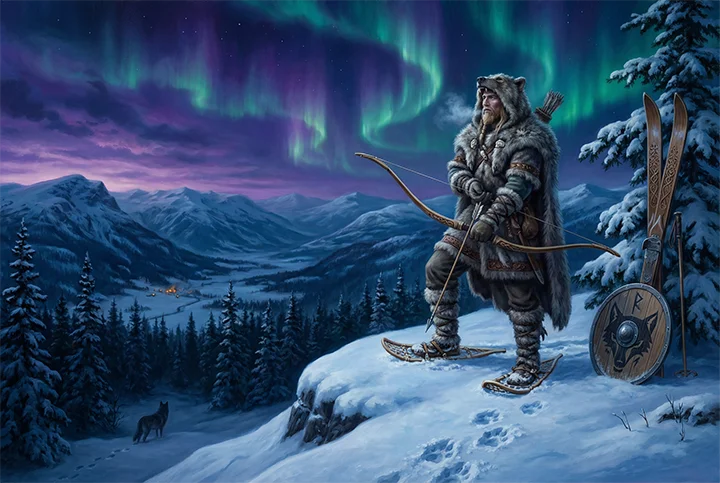
Ullr is one of the oldest gods in the Norse pantheon, a deity associated with hunting, archery, skiing, winter and the sky, who appears to have been widely worshipped in Scandinavia during an earlier period of Norse religious history before receding in the surviving literary sources to a secondary position. The sources that do mention him consistently describe him in superlatives: he is so skilled at archery that no one can rival him; he is the finest on skis; he is so fair in appearance and so skilled in every warlike exercise that his praise should be sought in any single combat. He is the son of Sif and therefore the stepson of Thor, and he lives in his own hall called Ýdalir, the valley of yews, which connects him to the yew tree and by extension to the bow made from yew wood that was the primary hunting and combat bow of the ancient world.
The most striking fact about Ullr in the scholarly literature is the disproportion between the abundance of place names in Scandinavia that incorporate his name and the relative scarcity of narrative material about him in the surviving texts. Place names compounded with Ullr are found in large numbers in Sweden and Norway, particularly in eastern Norway and in Uppland and Västmanland in Sweden, indicating that he was the center of a significant cult in these regions during the Viking Age and earlier. The texts of the Prose Edda and Poetic Edda, compiled in Iceland in the twelfth and thirteenth centuries, preserve very little about him by comparison. This suggests either that traditions about Ullr were more fully developed in the areas where his place names cluster and less well known in Iceland, or that material about him was lost before the Eddic compilations were made.
Sources
The primary sources for Ullr are sparse. Snorri Sturluson mentions him in the Gylfaginning section of the Prose Edda, describing him as Sif's son by a father other than Thor, noting his skill in archery and skiing and his beauty, and identifying his hall as Ýdalir. Snorri also mentions him in the Skaldskaparmal as a basis for kennings, noting that a shield can be called Ullr's ship, which several commentators have interpreted as a reference to a mythological episode in which Ullr used his shield as a vessel, though no full account of such a story survives.
The Poetic Edda mentions Ullr in the Grímnismál, where Odin in disguise describes the halls of the gods including Ýdalir, and in the Atlakviða, one of the heroic poems, where an oath is sworn on Ullr's ring, suggesting that Ullr's ring was an oath-object of comparable status to the ring of the god Ullr in a cultic context. The Gesta Danorum of Saxo Grammaticus, written in Latin in Denmark in the early thirteenth century, contains a story in which a figure called Ollerus, widely identified with Ullr, temporarily rules the gods in Odin's absence, suggesting that in some traditions Ullr was a figure of considerably greater importance than the Eddic sources imply.
Saxo's account states that when Odin was exiled from Asgard for a period due to disgrace, the other gods chose Ollerus, described as a man of great ability, to take his place, and that Ollerus was accepted by foreign peoples in Odin's stead. When Odin returned and reclaimed his position, Ollerus withdrew to Sweden, where he was eventually killed. The identification of this Ollerus with the Norse Ullr is generally accepted by scholars on etymological grounds, and the episode, if it reflects a genuine mythological tradition, suggests that Ullr was at some point regarded as a rival or successor to Odin rather than merely a hunting deity of secondary importance.
Ýdalir and the Yew
Ullr's hall Ýdalir, the yew dales or yew valleys, connects him directly to the yew tree, which in Norse and wider Germanic culture was associated with archery, with death and the underworld, and with the world tree Yggdrasil itself. The name Yggdrasil has been interpreted by some scholars as meaning yew column or yew pillar rather than the more commonly accepted Odin's horse, based on the identification of the tree with a yew rather than an ash. The yew's extreme longevity, its toxicity, its association with old graveyards and its production of the finest bow wood in northern Europe made it a tree of powerful symbolic associations, and Ullr's dwelling in a valley of yews places him at the intersection of hunting skill, death and the deep time of the cosmos.
Ullr and Winter
Ullr's association with skiing is mentioned explicitly in the sources, and it places him among the most practically important gods in the Norse world during the winter season, when skiing was the primary means of travel across the snowbound landscapes of Norway and Sweden and when hunting on skis was central to the subsistence economy of many Norse communities. The worship of Ullr in the regions of Norway and Sweden where deep winter snow was most consistent reflects the real practical importance of a divine patron of winter travel and hunting.
The association of Ullr with the sky, reflected in the Old Norse poetic formula that calls him the sky god or the god who rules the sky, connects his archery and hunting associations to a celestial dimension. The bow as an image of the rainbow, the trajectory of an arrow as a path across the sky, and the hunting of celestial animals in various mythological traditions worldwide provide context for understanding why a god of archery might also be a sky deity.
Ullr's Ring and Oath-Taking
The reference in the Atlakviða to swearing an oath on Ullr's ring is significant because it places Ullr in the same category as the gods whose sacred objects served as oath-guarantors in Norse legal and religious practice. The most prominent example of a divine oath-ring is the ring of Odin or the ring associated with the god at the altar of the Norse temple, on which legal oaths were sworn before proceedings at the Thing. That Ullr possessed a comparable ring suggests either that he had his own temple cult with its own oath-ring, or that in some traditions his ring served the oath function that Odin's ring served in the more widely attested tradition.
Place Names and Cult Evidence
The place name evidence for the cult of Ullr is concentrated in eastern Norway, particularly in the districts of Uppland, Hedmark and Trøndelag, and in the Swedish provinces of Uppland, Västmanland and Södermanland. Place names include Ullinshof, Ullevi, Ullin, Ullasen and numerous variants, with the element Ullr compounded with words meaning temple, cult site, field, farm and valley. The distribution of these place names in the agricultural heartlands of southern and eastern Scandinavia, rather than in the coastal and fjord regions where the sea-related cults of Odin, Thor and the Vanir were strongest, suggests that Ullr's cult was particularly important to inland agricultural and hunting communities.
Legacy and Significance
Ullr represents a dimension of Norse religious practice that the surviving literary sources record incompletely. The concentration of place name evidence in regions not well represented in the Icelandic literary tradition suggests that the Norse mythological corpus as preserved in the Eddas reflects the traditions of western Norway and Iceland more fully than those of eastern Norway and Sweden, and that a complete account of the Norse gods would include Ullr in a considerably more prominent role. The Saxo evidence for a tradition in which Ullr temporarily displaced Odin suggests that in at least one regional or period tradition he was a major divine figure rather than a specialist deity of hunting and winter sports.