The Choosers of the Slain Who Ride Between Asgard and the Battlefield
Overview
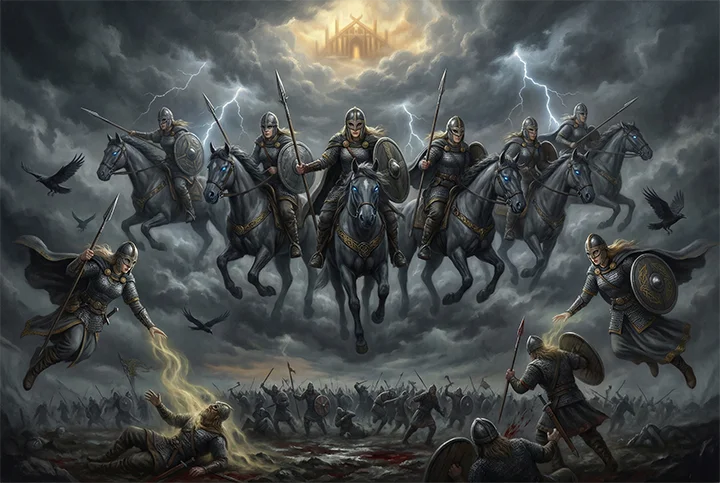
The valkyries are female supernatural beings in Norse mythology who serve Odin by riding over battlefields, choosing which warriors will die, and carrying the selected dead to Valhalla where they will feast and prepare for Ragnarök as the Einherjar. Their name means choosers of the slain, from the Old Norse verb at velja, to choose, and substantive valr, the slain. They are simultaneously agents of death, guides of the honored dead, and servants of the divine military apparatus that Odin maintains in preparation for the final battle. In the sources they appear in multiple registers: as supernatural beings who determine the outcome of battles, as shield-maidens who ride armed through the sky, as cup-bearers in Valhalla who serve mead to the Einherjar, and in the heroic poetry as individual figures with names, personalities and relationships with specific human heroes.
Sources
The primary sources for the valkyries are the Poetic Edda, particularly the Grimnismal, the Voluspa, the Helgakviða Hundingsbana poems and the Sigrdrifumal, the Prose Edda of Snorri Sturluson, and the skaldic poetry tradition. Snorri names thirteen valkyries in the Gylfaginning: Hlökk, Göndul, Geirskögul, Skögul, Geirönul, Randgríðr, Ráðgríðr, Reginleif, Ölrún, Hrist, Mist, Skeggjöld and Þrúðr. The Voluspa names Skuld among the valkyries, the same name as the youngest of the three Norns, which has generated scholarly discussion about the relationship between the valkyrie function of determining death and the Norn function of determining fate. Skaldic poetry, particularly the Darraðarljóð, the Song of the Spear, preserved in Njáls saga, presents the valkyries weaving the web of battle with spears as the loom and severed heads as weights.
The Function of the Valkyries
The valkyries serve Odin in his capacity as the god of death in battle and the lord of Valhalla. Their primary function is the selection of the slain: they ride over battlefields and choose which warriors will die and, of those who die, which will be taken to Valhalla as Einherjar. The criteria for selection are not exhaustively described in the sources, but they are consistently martial rather than moral: the valkyries select warriors for their valor and their fighting ability, not for their ethical character. A warrior who dies in battle with courage is a candidate for Valhalla regardless of whether he was a good person in the wider sense; a warrior who dies of illness in his bed, however virtuous, goes to Hel.
The valkyries also influence the outcome of battles directly, not only by selecting who will die but by determining which side will prevail. This active role in shaping the battlefield outcome is described in several heroic poems, where a valkyrie's choice to favor or abandon a particular hero determines whether he wins or loses the battle. In the Helgakviða Hundingsbana poems, the valkyrie Sigrún protects the hero Helgi in battle, making him effectively invincible while her protection lasts. The withdrawal of valkyrie protection is as fatal as any enemy's weapon.
Individual Valkyries in the Heroic Tradition
Beyond their collective function as choosers of the slain, several individual valkyries are developed as significant characters in the heroic poetry of the Poetic Edda. The most important of these is Brynhild, the valkyrie who appears in the Sigrdrifumal and in the Volsunga Saga cycle as the sleeping warrior-woman surrounded by a ring of fire, placed there by Odin as punishment for disobeying him in battle by granting victory to the wrong king. She is the woman Sigurd wakes, teaches him runes and wisdom, swears oaths of love with him, and whose eventual fate is inseparable from the catastrophe that destroys the Volsung dynasty.
Sigrún, the valkyrie of the Helgakviða poems, is described as a shield-maiden who rides in armor with her companions and who loves the hero Helgi Hundingsbane. After Helgi's death she is told that he has been seen riding into the burial mound with a company of warriors, and she goes to the mound to meet him for one night before he rides away again and she sees him no more. The episode is one of the most poignant in the heroic poetry, a brief reunion between the valkyrie and the dead warrior she loved before death separates them permanently.
The Darraðarljóð, preserved in chapter 157 of Njáls saga and attributed to the period of the Battle of Clontarf in 1014, describes twelve valkyries weaving the web of battle at a loom made from severed heads and human entrails, with spears as the beams and arrows as the shed. The poem is among the most vivid descriptions of valkyrie activity in any source, presenting them not as passive observers but as active weavers of the fate of the battle, riding out at its conclusion to choose the slain.
Valkyries, Norns and the Question of Fate
The relationship between the valkyries and the Norns in the Norse tradition raises questions about the distribution of fate-determining power between these two groups of supernatural females. The Norns weave the fate of every individual at birth, determining the length and character of each life. The valkyries choose who will die in battle at the moment of death. Whether these functions are complementary, overlapping or in tension depends on how one understands the Norse concept of fate: if the Norns have already determined at birth who will die in a particular battle, the valkyries' choice is simply the execution of a predetermined script; if the valkyries have genuine agency in their choices, they are modifying what the Norns established. The sources do not resolve this question explicitly, and the presence of Skuld, a Norn's name, among the valkyries in the Voluspa suggests that the boundary between the two categories was not always clearly maintained.
Valkyries in Visual Art and Material Culture
Valkyries appear in Norse visual art on several categories of object. The Gotlandic picture stones, particularly those dated to the late Viking Age, frequently depict a female figure holding a drinking horn and greeting a mounted warrior, an image generally interpreted as a valkyrie welcoming an Einherjar to Valhalla. Small female figurines holding drinking horns, found at several Scandinavian archaeological sites, have been identified as valkyrie figures and may have been used in religious contexts. Gold bracteates from the migration period occasionally depict a female figure in association with a male figure and a horse, possibly representing a valkyrie in a mythological context predating the Viking Age literary sources.
Legacy and Significance
The valkyries represent one of the most distinctive and influential concepts in Norse mythology, the idea of female supernatural beings who actively determine the outcome of human conflict, who are simultaneously agents of death and guides to a privileged afterlife, and who exist in the space between the mortal world and the divine order as mediators and executors of Odin's will. Their influence on subsequent literary and artistic tradition has been extensive, from Richard Wagner's Ride of the Valkyries, which draws on the image of armed warrior-women riding through the sky, to the very broad dissemination of the valkyrie concept in contemporary popular culture. The tension in the sources between the valkyries as impersonal functionaries of divine death-selection and the valkyries as individual beings with their own loves, loyalties and tragedies is one of the most productive ambiguities in the Norse tradition.
OTHRAVAR — Musical Tribute
Experience the ride of the valkyries over the battlefield and the choice that determines who lives and who dies through the ancient sounds of Norse folk music. This original composition draws from the skaldic tradition, performed with traditional instruments including tagelharpa, lur and frame drum.