The Primordial Giant Whose Body Became the World
Overview
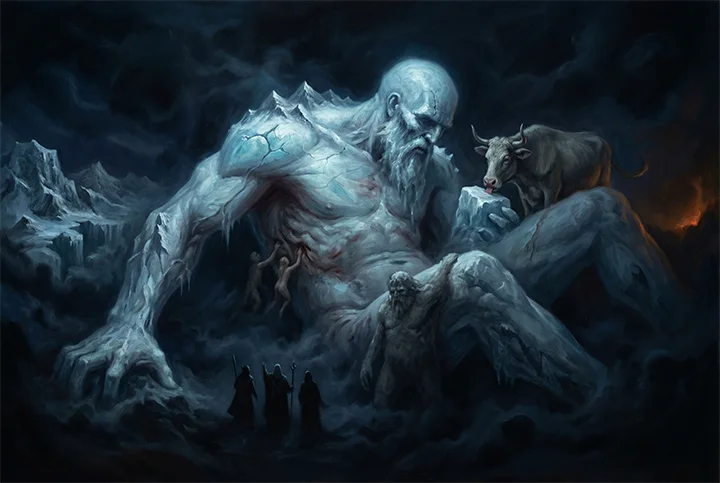
Ymir is the first being in Norse mythology, the primordial frost giant who emerged from the dripping ice of Ginnungagap where the heat of Muspelheim met the cold of Niflheim, and whose body became the raw material from which Odin and his brothers constructed the world. He is not a god; he is older than the gods, predating the divine order that Odin's line would establish. He is not a creature that chose evil or chaos; he simply existed as the first manifestation of life in a cosmos that had previously contained only the two primordial forces of fire and ice. He was killed by Odin, Vili and Vé, and from his body they made everything in the world: his flesh became the earth, his blood the sea, his bones the mountains, his teeth the stones, his hair the trees, his skull the sky and his brain the clouds. The giants who descended from him, the frost giants who survived the flood of his blood, will spend the entire mythological tradition in opposition to the divine order built from his corpse, and will finally tear it apart at Ragnarök.
Sources
The primary sources for Ymir are the Voluspa and the Vafthrudnismal in the Poetic Edda, and the Gylfaginning of Snorri Sturluson's Prose Edda. The Voluspa gives the briefest account of the creation in prophetic verse. The Vafthrudnismal, in the form of a wisdom contest between Odin and the giant Vafthrudnir, provides more cosmogonic detail including information about Ymir's generation and the generation of his descendants. Snorri's Gylfaginning provides the fullest prose account of Ymir's origin, his death, and the construction of the world from his body, drawing on the poetic sources and on additional mythological material that does not survive independently.
The Formation of Ymir
Before Ymir existed there was Ginnungagap, a void of magical potential, with Niflheim to the north and Muspelheim to the south. The eleven rivers of the Élivágar flowed from Niflheim into Ginnungagap and froze. The heat from Muspelheim melted the ice where the two regions met at the center of Ginnungagap, and from the dripping ice emerged Ymir. The Prose Edda describes his formation as passive and ungoverned: he was not born but appeared, created by the interaction of the two primordial forces without any will or design involved. He is described as a frost giant, hrimþurs, and as the progenitor of the entire giant race.
Simultaneously with Ymir, the cow Auðumbla emerged from the melting ice. She nourished Ymir with four rivers of milk from her udders, and she herself fed by licking the salty ice. As Auðumbla licked, a man emerged from the ice over three days: first his hair on the first day, then his head on the second, then his entire body on the third. This man was Búri, the first of the divine lineage. Búri's son Borr married the giantess Bestla, and their three sons were Odin, Vili and Vé.
The Generation of the Giants from Ymir
While Ymir slept, he sweated, and from his sweat the first frost giants were generated: a man and a woman appeared from under his left arm, and from the contact of his two legs a son was born. These were the ancestors of the frost giant race. The Vafthrudnismal records that these first giants were not the product of any union but of Ymir's own body, making the giant race self-generated in a way that the divine race, which required the union of Borr and Bestla, was not. The frost giants who descend from Ymir are thus older than the divine lineage in the Norse cosmos, predating Odin's grandfather Búri who emerged from the ice that Auðumbla licked.
The Death of Ymir and the Making of the World
Odin, Vili and Vé killed Ymir. The Prose Edda describes so much blood flowing from Ymir's wounds when he was killed that it drowned the entire race of frost giants except Bergelmir, who escaped with his wife by climbing onto a mill-chest or a boat. From Bergelmir and his wife descends the entire subsequent race of giants, which is why the giants have a grievance against the gods that will not be resolved until Ragnarök: the world was built from their ancestor's body, and the blood of that killing drowned most of their people.
Odin and his brothers took Ymir's body to the center of Ginnungagap and made the world from it. His flesh became the earth. His blood became the sea and all the waters of the world. His bones became the mountains. His hair became the trees. His skull became the sky dome, which the brothers set over the earth and held at its four corners by four dwarves named Norðri, Suðri, Austri and Vestri, meaning North, South, East and West. His brain was thrown into the air and became the clouds. His eyelashes were used to make the fence of Midgard that protects the world of humans from the outer regions. Sparks from Muspelheim were placed in the sky to become the stars, and the sun and moon were given their courses across the sky.
The Dwarves from Ymir's Flesh
The Prose Edda records that when the gods examined Ymir's flesh they found maggots moving in it. They gave these maggots intelligence and the form of men. These became the dwarves, who live in the earth and in the rocks of Ymir's transformed body and who are the foremost craftsmen in the Norse cosmos. The dwarves are the makers of the finest objects in Norse mythology: Gleipnir the unbreakable fetter, Skidbladnir Freyr's foldable ship, Gungnir Odin's spear, Mjolnir Thor's hammer, the Mead of Poetry brewed from Kvasir's blood, and the golden hair of Sif. The dwarves' origin from Ymir's flesh places them in the same material continuum as the earth, the mountains and the rocks they inhabit.
Ymir in the Vafthrudnismal
The Vafthrudnismal, the poem in which Odin in disguise engages the giant Vafthrudnir in a wisdom contest, provides important details about Ymir that supplement the Prose Edda account. Vafthrudnir identifies Ymir as the most ancient of all beings and as the source of the world's constituent parts, and describes Bergelmir as having been laid on the lúðr, the mill-chest or boat, when Ymir's blood was flooding everything. The poem's wisdom contest format, in which Vafthrudnir demonstrates his knowledge of cosmogony and Odin tests him to the limit of it, positions the creation narrative including Ymir's role as the kind of deep cosmological knowledge that the wisest beings in the Norse cosmos possess.
Legacy and Significance
Ymir is the most fundamental figure in Norse cosmology because every physical element of the world is his transformed body. The earth on which humans walk is his flesh. The ocean that Jörmungandr inhabits is his blood. The mountains that form the boundaries of Midgard are his bones. The sky that covers all the Nine Worlds is his skull. Human beings live inside a body, in a world that is literally made of the first giant. This cosmological fact carries a weight that the Norse tradition acknowledges implicitly: the world is not a neutral medium in which the drama of gods and giants plays out, but a material participant in that drama, the dead giant's body being slowly returned to dissolution by the conflict between the order imposed on it and the chaos that preceded it. Ragnarök is, among other things, Ymir's body coming apart.