The Bear-Warriors Who Fought in a Trance of Battle Fury
Overview
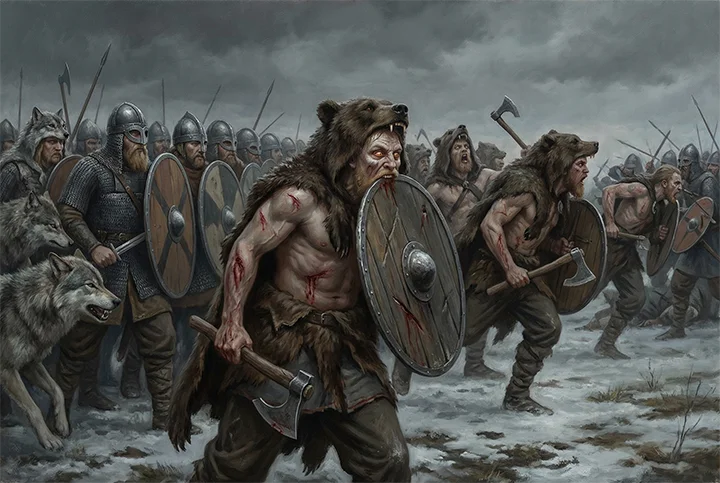
The berserkers were a class of Norse warriors described in the sagas and in skaldic poetry as fighters of extraordinary ferocity who entered a state of battle fury during combat, becoming temporarily impervious to pain and fear, possessed of superhuman strength, and so consumed by violence that they were as dangerous to their allies as to their enemies. The name berserker, Old Norse berserkr, is most commonly interpreted as bear-shirt or bear-warrior, connecting the fighters to the bear totem that features in Norse ritual and religion, though an alternative etymology reading it as bare-shirt or bare-chested has also been proposed. The berserker state was understood in the Norse tradition as a form of divine possession, specifically associated with Odin, the god of battle fury, death, and the sacrifice of warriors. They appear in sources from the ninth century onward and were objects of both awe and social ambiguity, feared and prized as fighters but difficult to integrate into the order of settled life.
Sources
The primary sources for the berserkers are the Icelandic family sagas, the Kings' Sagas in Snorri Sturluson's Heimskringla, skaldic poetry, and the Ynglinga saga which provides the most explicit description of the berserker state as Odin-sent battle fury. The skaldic poem Haraldskvæði, attributed to Þorbjörn hornklofi and describing the forces of Harald Fairhair at the Battle of Hafrsfjord around 872, includes the earliest datable reference to berserkers, describing them as Odin's men who bite their shields and advance without armor. The Ulfhéðnar, wolf-warriors, who appear alongside berserkers in several sources, represent a parallel tradition in which the wolf rather than the bear is the totem animal of the frenzied fighter.
The Berserker State
The berserker state, berserksgangr, is described across multiple sources with a consistency that suggests it reflects a recognized and specific phenomenon rather than simply a literary convention. The sources describe a sequence of physiological and behavioral changes: before entering the state, the berserker might tremble, teeth chattering, face changing color; during the state, he was characterized by enormous physical strength, insensibility to wounds, and extreme aggression directed indiscriminately at enemies and sometimes at allies; after the state, he was exhausted and weakened for a period, sometimes described as lasting a day.
The Ynglinga saga of Snorri Sturluson provides the most explicit theological account of the berserker state, describing Odin's men as going to battle without armor, biting their shields, and being as strong as bears or bulls; no fire or iron harmed them; and when the fury left them they were so weak they could barely stand. Snorri attributes this ability directly to Odin, framing it as a divine gift given to those whom Odin chose to receive it. This framing connects the berserker tradition to the wider Norse understanding of battle as a domain presided over by Odin, who decided the outcome of every fight and claimed the dead for his own.
Possible Explanations
Scholars have proposed several explanations for the berserker phenomenon. The most widely discussed involves the consumption of psychoactive substances, with fly agaric mushrooms, Amanita muscaria, proposed as the most likely candidate on the basis of their widespread presence in Scandinavia, their known psychoactive properties including agitation, hallucination and dramatically increased physical strength in some users, and their ritual use in Siberian shamanic traditions with which Norse culture had documented contact. The fly agaric hypothesis has been influential but remains unproven, and other scholars have proposed that the berserker state represented an extreme form of combat-induced adrenaline response that some individuals could enter voluntarily through training and ritual preparation.
A third explanation, proposed by some scholars, draws on the close association between berserkers and shamanistic practices in Norse religion: the berserker state may have been understood as a form of the same spirit-journey that the völva undertook in seiðr, in which the practitioner's consciousness left the body and was replaced by an animal spirit, in the berserker's case the spirit of the bear or the wolf. This interpretation is consistent with the transformation imagery that surrounds berserkers in the sources, including descriptions of berserkers in the form of animals and references to their ability to change shape.
Berserkers in Society
The relationship between berserkers and Norse society was one of productive tension. They were valuable as shock fighters in battle, capable of breaking through enemy formations and creating panic, and their association with Odin gave them a religious prestige that reinforced their military value. Harald Fairhair's use of berserkers as an elite fighting force is described in the sources as a deliberate military policy, and several later Norwegian kings maintained similar berserker bodyguards. At the same time, the uncontrollable nature of berserker fury made them dangerous in peacetime, and the sagas frequently portray them as troublemakers who abuse their fighting reputation to extort and bully settled communities.
The Icelandic sagas contain a recurring narrative type involving the berserker as social problem: a group of berserkers arrives at a peaceful community, demands hospitality and women by threatening violence, and is eventually killed by the hero of the saga who manages to confront and defeat them without entering the berserker state himself. This narrative pattern reflects a real social tension: the warrior values that made berserkers useful in the context of raiding or formal warfare were disruptive in the context of the settled farming and trading communities that constituted most of the Norse world.
The Christianization of Scandinavia in the eleventh and twelfth centuries contributed to the formal suppression of berserker practice. Norwegian law codes from the twelfth century explicitly prohibit going berserk, treating it as a criminal offense punishable by outlawry. This legal prohibition reflects the transformation of Norse society from a warrior culture that valued battle fury as a divine gift to a Christian agricultural society that viewed uncontrolled violence as a social and religious danger.
Legacy and Significance
The berserkers are among the most distinctive and most persistently misrepresented figures in the Norse tradition, simultaneously the most dramatic embodiment of the Norse warrior ethos at its most extreme and the most problematic element of that ethos from the perspective of social order. The word berserker has entered the English language as a common noun meaning someone engaged in frenzied, uncontrolled action, a linguistic inheritance from a Norse tradition that associated extreme violence with divine possession, animal transformation, and the personal gift of Odin. The berserkers represent the point at which the Norse warrior culture most directly confronted the tension between the value of violence and the necessity of social order, and their eventual legal suppression represents the resolution of that tension in favour of order.