793–1066 CE
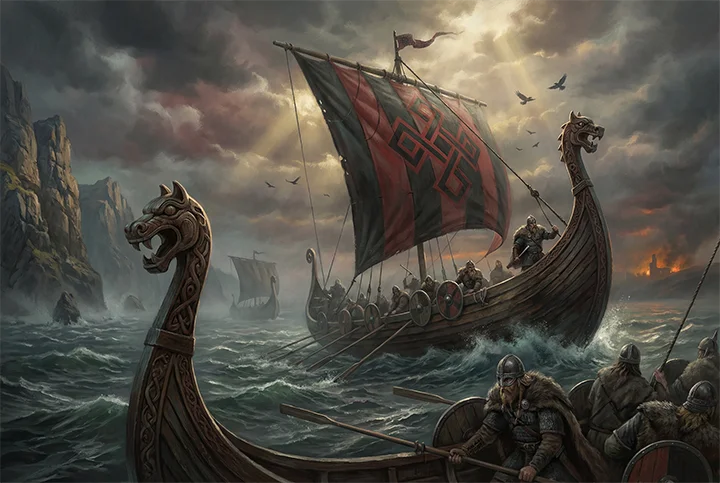
Overview
The Viking Age is the period of Scandinavian history conventionally dated from 793 CE, the year of the raid on the monastery of Lindisfarne on the northeast coast of England, to 1066 CE, the year of the Battle of Stamford Bridge and the Norman Conquest of England. For roughly two and a half centuries, the Norse peoples of Denmark, Norway and Sweden expanded outward from their Scandinavian homelands with a combination of maritime technology, military capability and commercial ambition that brought them into contact with virtually every corner of the known world. They raided, traded, settled, ruled and explored from the coasts of North America to the markets of Constantinople, leaving traces of their presence that are still visible in the genetic, linguistic and cultural record of dozens of modern nations.
The term Viking is itself worth examining. In Old Norse, víkingr referred specifically to a pirate or raider, someone who went í víking, on a raiding expedition. Not all Scandinavians of this period were Vikings in this sense; the majority were farmers, craftspeople and traders who never participated in a raid. The word has since expanded in modern usage to describe all Norse people of the period, which flattens a considerably more complex reality. The civilization that produced the raiders also produced remarkable poetry, sophisticated legal systems, extensive trading networks and a mythology of extraordinary depth and beauty.
The Viking Age was not a single unified phenomenon but a complex series of distinct movements driven by different peoples in different directions for different reasons. Danish Vikings moved primarily westward and southward, raiding and eventually settling in England, France and Ireland. Norwegian Vikings pushed north and west, settling Iceland, Greenland and briefly North America. Swedish Vikings moved primarily eastward, following the river systems of Eastern Europe to reach the Byzantine Empire and the Abbasid Caliphate. These were not coordinated operations but parallel expressions of the same underlying pressures and capabilities.
Origins & Causes
The causes of Viking expansion have been debated for centuries and no single explanation has achieved consensus. Population pressure in Scandinavia almost certainly played a role: the Norse system of inheritance, which typically passed land to the eldest son, left younger sons without property and with strong incentives to seek wealth elsewhere. The development of the longship, a vessel of exceptional seakeeping ability that could navigate both open ocean and shallow rivers, gave these landless men the means to act on those incentives. The relative weakness of political authority in early medieval Europe, particularly in the wake of Charlemagne's death in 814, created opportunities that capable, mobile forces could exploit.
The monasteries and coastal settlements that the Vikings targeted in their early raids were wealthy, largely undefended and accessible by sea. The raid on Lindisfarne in 793, which shocked the Christian world and is traditionally used to mark the beginning of the Viking Age, was almost certainly not the first Norse raid on Britain, merely the first to be recorded in detail by horrified monastic chroniclers. By the time the historical record catches up with events, the Norse had already developed raiding into a systematic activity with established routes, seasonal patterns and increasingly sophisticated objectives.
It is important not to reduce the Viking Age to raiding alone. Trade was at least as important as warfare in the Norse expansion, and the two activities were not always clearly distinguished: a Norse merchant who arrived at a market town with a fully crewed longship was in a position to trade on favourable terms whether his host liked it or not. The establishment of trading towns at Dublin, York, Kyiv and Novgorod, and the Norse penetration of the Silk Road trade networks through the Volga and Dnieper river systems, represent a commercial achievement at least as significant as any military one.
Key Events & Figures
The reign of Ragnar Lothbrok, whether historical or legendary, captures the spirit of the early Viking Age: the combination of martial prowess, cunning and restless ambition that characterised the most successful Norse leaders. His sons, Ivar the Boneless, Björn Ironside, Halfdan Ragnarsson and Ubba, led the Great Heathen Army that invaded England in 865 and came within reach of conquering the entire island before being checked by Alfred the Great of Wessex.
The settlement of Iceland beginning around 870 CE represents one of the most significant colonisation events of the Viking Age. Norse settlers, many of them displaced chieftains and their followers fleeing the centralisation of power under Harald Fairhair in Norway, established a society on the island that preserved the Old Norse language and literature in a form that has survived to the present day. The Íslendingasögur, the Icelandic family sagas, are among the greatest literary achievements of medieval Europe and constitute the primary source for much of what we know about Viking Age society.
The voyages of Leif Eriksson and his predecessors to Vínland, the Norse name for a part of North America, around 1000 CE represent the furthest geographical extension of the Viking Age. Archaeological evidence from L'Anse aux Meadows in Newfoundland confirms Norse presence in North America some five centuries before Columbus. The Norse settlement did not persist, likely due to conflict with the indigenous populations the sagas call Skrælingar, but the achievement of the crossing and the establishment of even a temporary settlement stands as one of the most remarkable feats of navigation in human history.
Legacy & Significance
The Viking Age ended not with a single dramatic event but with a gradual process of integration and transformation. The Norse kingdoms became Christian, centralised and increasingly indistinguishable from their European neighbours. The Norman conquerors of England in 1066 were themselves the descendants of Norse settlers in northern France, and in a real sense the Battle of Hastings represents the last major political consequence of Viking Age expansion. The last outpost of genuine Norse culture, the Greenland settlements, disappeared quietly sometime in the fifteenth century.
What the Viking Age left behind is substantial and enduring. The English language contains thousands of words of Old Norse origin: sky, window, knife, husband, egg, get, give, take, call, want. The legal and political traditions of Scandinavia, Iceland and parts of Britain bear the imprint of Norse governance structures. The genetic heritage of the Norse dispersal is measurable in populations from Ireland to Russia. And the mythology, literature and artistic traditions of the Viking Age have entered the modern imagination so deeply that they continue to shape storytelling, philosophy and cultural identity across the world.