The Art of the Court Poets Who Preserved the Norse World in Verse
Overview
Skaldic poetry was the court poetry tradition of the Norse world, composed and performed by professional poets called skalds who served at the courts of Norse kings and chieftains from the ninth to the thirteenth century. It was distinguished from the anonymous Eddic tradition by its highly complex metrical forms, its elaborate system of poetic circumlocution called kennings, its attribution to named individual poets, and its primary function as praise poetry commemorating the deeds of specific patrons. The skalds were simultaneously poets, historians and diplomats, the primary medium through which Norse political culture represented itself to itself and to outsiders. Their poetry is also the most reliable historical source for many events of the Viking Age, closer in time to the events it commemorates than any other surviving text.
Sources and Preservation
Skaldic poetry survives primarily in the prose sagas and histories of medieval Iceland, quoted as verse evidence within prose narratives. The Kings' Sagas of the Heimskringla contain hundreds of skaldic stanzas attributed to named poets who witnessed the events described. Snorri explicitly uses skaldic poetry as historical evidence in the preface to the Heimskringla, arguing that its metrical constraints make corruption or alteration easier to detect than in prose tradition. The Skáldskaparmál section of the Prose Edda is explicitly a manual of skaldic poetics, explaining the kenning system and its mythological foundations and preserving substantial bodies of verse as illustrations.
The Dróttkvætt Meter
The most prestigious skaldic meter was dróttkvætt, the court meter, a highly demanding form with specific requirements for syllable count, internal rhyme, alliteration and the distribution of stressed and unstressed syllables in each half-line. A dróttkvætt stanza consists of eight lines, each of six syllables, with specific alliteration patterns linking the half-lines and internal rhyme or half-rhyme within each line. The constraints of the meter were so tight that the composition of a syntactically coherent, semantically complex stanza in dróttkvætt required considerable technical skill and extensive knowledge of the kenning system. Other important skaldic meters include hrynhent, a variant of dróttkvætt with eight syllables per line, and ljóðaháttr used in different poetic contexts.
The Kenning System
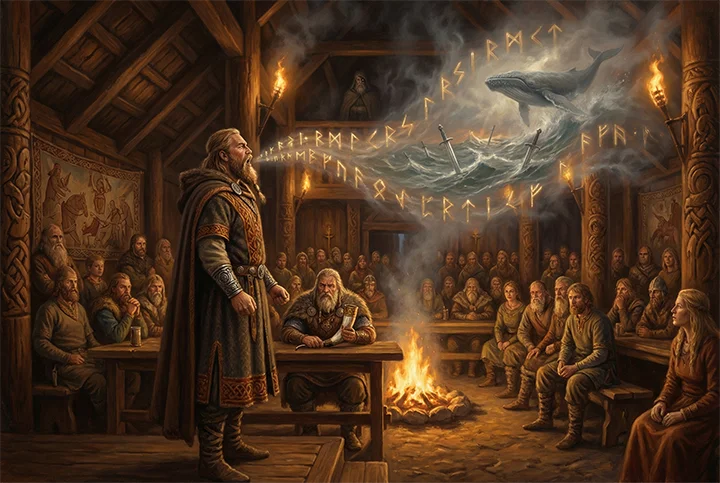
The kenning system was the defining feature of the skaldic poetic language, a system of compound periphrastic expressions that replaced direct nouns with elaborate circumlocutions built from mythological and natural imagery. A kenning consisted of a base word and a determinant that together produced a new meaning: sword becomes wound-snake, sea becomes whale-road, gold becomes fire-of-the-sea, battle becomes storm-of-swords, warrior becomes feeder-of-ravens. More complex kennings could be built by substituting a kenning for one element of an existing kenning, producing chains of multiple elements. The kenning system presupposed detailed knowledge of Norse mythology on the part of both composer and audience, since many kennings refer to mythological stories or characters without explaining them. Snorri's Skáldskaparmál is the primary systematic account of the kenning system, organized around different referents and illustrated with verse quotations, simultaneously a poetic manual and a mythological compendium.
Notable Skalds
Bragi Boddason, known as Bragi the Old, is the earliest named skald in the Norse tradition, active in the early ninth century. His surviving Ragnarsdrápa describes a shield painting depicting mythological scenes including the fishing trip of Thor and Jörmungandr, making it one of the earliest textual representations of these myths. Egill Skallagrímsson is the most fully developed individual in the skaldic tradition. His Höfuðlausn, composed overnight in a York prison to buy his head from King Eiríkr Blóðöx, is the oldest complete long dróttkvætt poem attributed to a named individual. The Sonatorrek, his lament for his drowned son, contains a direct accusation against Odin for breaking the compact between them and is the most theologically radical text in the skaldic corpus. Þorbjörn hornklofi, active at the court of Harald Fairhair in the late ninth century, composed the primary early skaldic sources for Harald's unification of Norway. Sigvatr Þórðarson, active at the courts of Óláfr Haraldsson and Knútr in the early eleventh century, is one of the most prolific surviving skalds, with a large body of verse preserved in the Kings' Sagas.
Legacy and Significance
Skaldic poetry is the primary literary evidence for the Viking Age as experienced by those who lived it, the closest approximation to a contemporary historical record for many events and periods. Its preservation in the prose sagas of medieval Iceland, where it was quoted as historical evidence, saved it from the oblivion that consumed most other oral poetic traditions when the cultures that produced them converted to Christianity. The body of surviving skaldic poetry represents a window into the Viking Age that no other source type can replicate.