The Hall of the Slain, Hel's Kingdom and the Worlds Beyond Death
Overview
The Norse afterlife is not a single destination but a complex of different realms, each receiving different categories of the dead according to the manner of their death and the life they lived. Valhalla, Odin's hall of the slain, is the most famous, but it was only one of several places where the Norse dead could find themselves, and it was by no means the destination of everyone. The majority of the dead went to Hel, the realm of the dead presided over by the goddess of the same name, a grey and quiet place under the roots of Yggdrasil. The drowned went to Rán's hall beneath the sea. Some were claimed by Freya, who received half of those who fell in battle. Others remained close to their burial mounds, present in the land they had worked and the family that remembered them.
The Norse afterlife reflects the Norse world's fundamental engagement with the question of what makes a life meaningful. Valhalla was not a reward for virtue in the abstract sense: it was the destination of those who had died in battle, specifically those chosen by Odin and the valkyries for their excellence as fighters. The criteria were martial, not moral. A man who died in his bed of old age, however good his character, went to Hel. A man who died with sword in hand, however complicated his life, had the possibility of being chosen for Valhalla. This is not indifference to ethics but a specific, consistent statement about what the Norse tradition valued most.
Valhalla: The Hall of the Slain
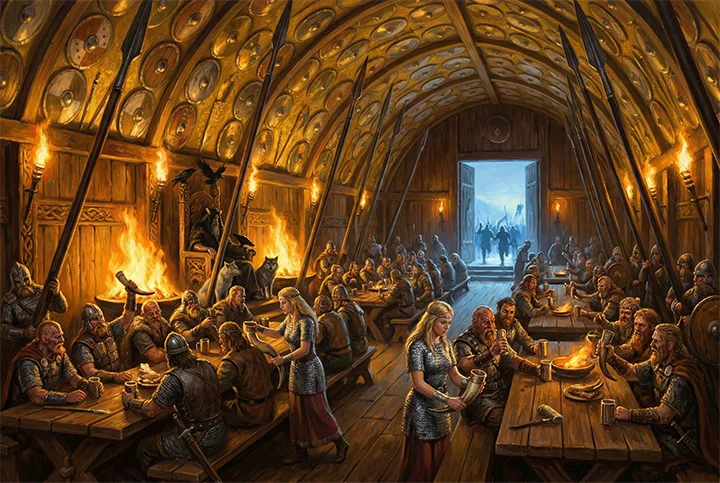
Valhalla, literally the hall of the slain, is described in detail in the Prose Edda and the Grimnismal. It stands in Asgard, within Odin's domain of Gladsheim. The hall has five hundred and forty doors, each wide enough for eight hundred warriors to march through abreast. Its roof is made of shields, its rafters of spears, its benches strewn with coats of mail. The Einherjar, the chosen warriors who dwell there, spend their days fighting in the courtyard outside: they kill each other, are restored to life, and return to the hall to eat and drink when evening comes. The food is the flesh of the boar Saehrimnir, which is slaughtered and consumed every day and is always whole again by morning. The drink is mead that flows from the udder of the goat Heidrun, who grazes on the branches of Yggdrasil.
The purpose of this daily combat and feasting is not pleasure, or not primarily pleasure. The Einherjar are being prepared for Ragnarok. When the final days come, the five hundred and forty doors will open and eight hundred warriors will march through each one, filling the plain of Vigrid for the last battle. Valhalla is not a paradise of eternal rest; it is a training ground, and the warriors who dwell there know they are being shaped for a purpose that will end in their destruction along with everything else.
The valkyries are the mechanism by which Odin selects his warriors. They ride over battlefields, choosing those who will die and who among the dying will be taken to Valhalla. Their names carry the vocabulary of battle: Hlokk means noise of battle, Goll means screaming, Skeggjold means axe-age, Gondul means wand-carrier or perhaps transformer. They are not gentle guides but active agents of the outcome of combat, and their choices determine both who dies and where the dead go.
Hel and the Common Dead
Hel, the realm of the dead, is presided over by the goddess Hel, daughter of Loki and the giantess Angrboda and sister of Fenrir and Jormungandr. She was sent by Odin to rule the realm of the dead before the events of the main mythological narratives begin, and her authority there is absolute: not even Odin can override her decisions, as the myth of Baldur's attempted return demonstrates. She is described as half living and half dead in appearance, her body divided between the colors of flesh and the colors of a corpse.
Hel's realm is not a place of punishment. It is simply where most people go when they die. The sources describe it as grey and quiet, a place of reduced existence rather than of suffering, and the dead who dwell there are not in torment but in a diminished form of the life they knew. Baldur sits in the hall of Hel in the place of honor, calm and dignified, which is not the description of a suffering being but of a being in a condition of reduced vitality. The Norse conception of Hel is closer to the Greek Hades in its original form than to the Christian hell, a place of the dead rather than a place of punishment for the wicked.
Other Destinations: Rán, the Burial Mound and Freya's Folkvangr
Those who drowned at sea went to the hall of Rán, the goddess of the sea's destructive aspect and wife of the sea giant Aegir. Rán is described as casting a net over the waters to catch the drowned, drawing them down to her hall at the bottom of the sea. This was a distinct and recognized afterlife destination, and the Norse sagas describe drowned men appearing in the burial feasts given in their honor, suggesting that the dead remained present in some sense even when physically separated from the living community.
Freya receives half of those who fall in battle, her share equal to Odin's. Her realm is called Folkvangr, the field of the people, and her hall within it is Sessrumnir. The sources say little about what existence in Folkvangr was like, but the parity between Freya's share and Odin's makes her a significant afterlife power, receiving as many battle-dead as Valhalla itself.
Beyond these destinations, the Norse tradition preserved a strong sense that the dead remained connected to the world of the living through their burial mounds. The mound-dwellers, called haugbuar, could interact with the living, protect their families, provide counsel in dreams, and be disturbed by improper treatment of their remains or their memory. The Norse afterlife was not a clean departure but a continuing presence, and the relationship between the living and the dead was one of the most practically important aspects of Norse religious life.
Legacy and Significance
The Norse afterlife system is a direct expression of the values the Norse world held most important. Valhalla's requirement of a death in battle is not bloodlust but a statement about what kind of life and what kind of death were considered to reflect the highest human virtues. The warrior who dies in battle has accepted the full terms of the heroic life: not just the glory but the cost, not just the fighting but the willingness to be killed in the act of fighting. That willingness, freely chosen and fully enacted, is what makes the valkyries look twice.
The plurality of afterlife destinations also reflects a democratic impulse in Norse religion that is sometimes overlooked in the emphasis on Valhalla. Most people went to Hel, and Hel was not a disgrace. The drowned went to Rán. The battle-dead were split between Odin and Freya. The mound-dead stayed close to home. Each category of death had its own dignity and its own destination, and the Norse dead were not sorted by the moral quality of their lives but by the specific circumstances of their deaths. This is a theology of experience rather than of judgment, and it produced a relationship with death that was less about fear of punishment than about the careful management of relationships that continued across the boundary between the living and the dead.
OTHRAVAR — Musical Tribute
Experience the thunder of the Einherjar and the quiet of Hel's grey halls through the ancient sounds of Norse folk music. This original composition draws from the skaldic tradition, performed with traditional instruments including tagelharpa, bukkehorn and frame drum.