The Thing, Honour Codes and the Legal World of the Norse
Overview
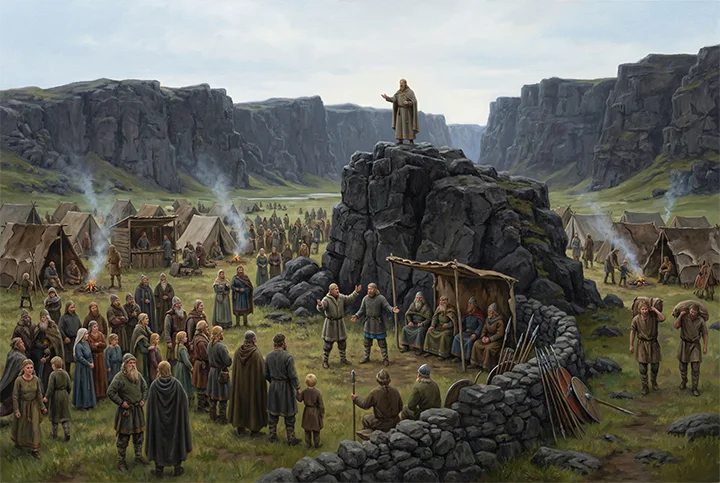
Norse society in the Viking Age was governed not by the absolute authority of a king but by a system of customary law administered through assemblies of free men called Things, regional and local gatherings at which legal disputes were heard, laws were made and enforced, and the social norms of the community were maintained through collective decision-making. The Thing system was one of the most distinctive features of Norse political organization, reflecting a conception of governance as a shared responsibility of free men rather than a monopoly of royal power. The Icelandic Althing, founded in 930, is the best-documented example of the Thing system and the institution that gave Iceland its unique character as a commonwealth governed without a king for three and a half centuries.
The Thing System
The Thing, Old Norse þing, was a gathering of free men at a fixed location and time for the purpose of legal and political business. Things operated at multiple levels: the local herað or district thing dealt with minor disputes and local administration; the regional fylkisting or provincial thing addressed matters affecting a larger area; and the national or supra-regional thing, of which the Icelandic Althing is the primary example, addressed matters affecting the entire community. The authority of the Thing rested on the collective presence of free men, whose attendance and participation gave its decisions legitimacy. Decisions were made through acclamation, with the assembly expressing approval or disapproval by clashing weapons on shields. Legal cases at the Thing followed a formalized procedure that was highly technical, and the outcome of a case often depended as much on procedural correctness as on the substantive merits of the claim.
Outlawry
The most severe legal penalty in Norse law was full outlawry, skóggangr, which placed the convicted person outside the protection of all law. An outlaw could be killed by anyone without legal consequences, could not be sheltered, fed or assisted by anyone without that person becoming an accomplice, and forfeited all property. Full outlawry was typically imposed for the most serious crimes: major killings, particularly of respected or protected persons, and serious violations of the sanctuary of the Thing. The lesser penalty of lesser outlawry, fjörbaugsgarðr, excluded the convicted person from their home district for three years but allowed them to travel to specific foreign destinations.
Outlawry was the mechanism that drove much of the Norse expansion. Eirik the Red was outlawed from Norway and emigrated to Iceland, then outlawed from Iceland and explored and settled Greenland. The saga literature is full of outlawed men who emigrated to Iceland, Ireland, the Faroes, Greenland and Vinland as a consequence of legal judgments against them. The Norse world's frontiers were populated in part by men who had been placed outside the law of their home communities.
Honour, Shame and the Feud
Norse society operated according to an honour code in which personal and family reputation were among the most practically important assets a person possessed. Honour was not merely a matter of social prestige but a legal and economic resource: a man of established honour could stand surety for others in legal proceedings, his oath was credible in disputes, and his word commanded respect in commercial transactions. The feud, Old Norse hefnd, was the mechanism through which honour was maintained and injuries were balanced. When a member of a kin-group was killed or injured, the obligation of vengeance fell on the surviving members of the group. The feud was not simply a cycle of violence but a structured social institution: excessive or disproportionate vengeance was itself a source of dishonour, and the opportunity to convert a feud into a legal case and a financial settlement was always available and often preferred. The Thing system existed in part to provide an alternative to feud violence, and the most skilled operators in the sagas are often those who successfully navigate between the demands of honour and the opportunities provided by law.
Women in Norse Law
Norse women had a distinctive legal position that was neither the full civic equality of men nor the complete legal subordination found in many contemporary medieval legal systems. Women could own property, inherit, conduct commercial transactions and bring legal cases in their own names. They could not, however, hold public office, speak at the Thing, or serve as witnesses in legal proceedings. The legal concept of the mundr, the bride-price paid by the groom to the bride's family, and the heimanfylgja, the dowry brought by the bride, established the economic structure of marriage as a transaction between two kin-groups in which the woman was a participant with property rights rather than simply an object of exchange. Divorce was available to both men and women in Norse law on grounds that included incompatibility, and the legal provisions for the division of marital property on divorce were relatively detailed.
The Icelandic Commonwealth
Iceland, settled from approximately 870 and organized as a political community from 930, is the best-documented example of the Norse Thing system at its fullest development. The Althing, held annually at Þingvellir in southwestern Iceland, was the supreme legal and political assembly of the Icelandic commonwealth. It was presided over by the Lawspeaker, lögsogumaðr, who memorized the laws and recited a third of them each year from the Law Rock, lögberg. The Althing had no executive power; it could make and adjudicate law but could not enforce it, which meant that the execution of legal judgments depended on the willingness of the kin-groups involved to carry them out. This structural limitation gave the Icelandic Commonwealth its distinctive character as a society governed by law but enforced by social pressure and private violence rather than by a state monopoly of force. Njáls saga, the greatest of the Icelandic family sagas, is essentially a sustained examination of how this system worked and why it failed: its central figure Njáll Þorgeirsson is the greatest lawyer in Iceland, and the saga's tragedy is the tragedy of a legal system that cannot prevent the violence it was designed to contain.
Legacy and Significance
The Norse Thing system is one of the oldest documented forms of representative political assembly in European history, predating the development of parliamentary institutions in England and elsewhere by several centuries. The Icelandic Althing, refounded as a national assembly in 1845, claims continuous institutional descent from the assembly founded in 930, making it one of the oldest legislative institutions in the world still in operation. The names of contemporary Scandinavian legislative bodies, the Norwegian Storting, the Danish Folketing and the Icelandic Althing, all preserve the þing element, reflecting the enduring importance of the Thing tradition in Scandinavian political culture.