The Son of Ragnar Who Raided the Mediterranean and Built a Dynasty
Overview
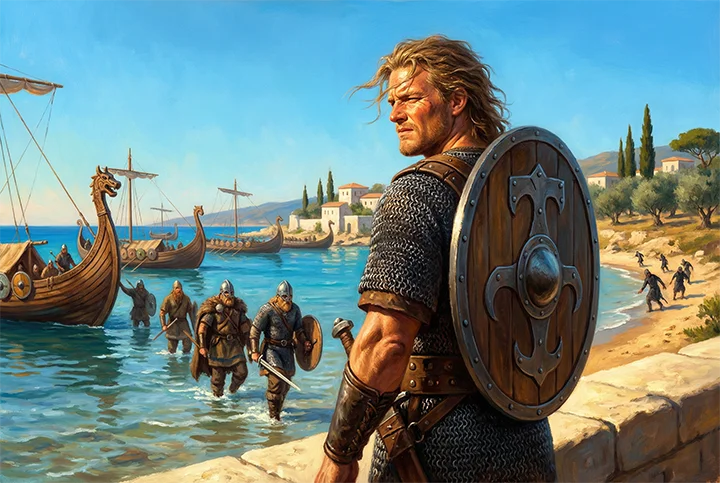
Björn Ironside, Old Norse Björn Járnsíða, was a Norse warlord of the ninth century, the son of Ragnar Lothbrok according to the saga tradition, and one of the most widely traveled Viking commanders in the historical and legendary record. He is primarily known for leading, together with the Norse leader Hasteinn, a major raiding expedition through the Iberian Peninsula, into the Mediterranean Sea, along the coasts of North Africa and southern France, and into the Italian peninsula, a campaign that lasted from approximately 859 to 861 and represents one of the most geographically ambitious operations in the entire Viking Age. He subsequently became a king in Sweden, and the saga tradition makes him the ancestor of the Munsö dynasty.
Sources
The primary sources for Björn Ironside are the Icelandic saga tradition, particularly the Ragnars saga Lodbrókar and the Ragnarssona þáttr, and the contemporary or near-contemporary Frankish and Iberian chronicles that record the Mediterranean expedition. The Frankish sources include the Annales Bertiniani, which record the departure of a Norse fleet from the Loire in 859 and its subsequent activities. The chronicle of the Arab historian Ibn al-Athir and the Iberian Arabic sources provide additional information about the Norse incursions into the Iberian Peninsula and North Africa.
The Mediterranean Expedition of 859 to 861
In 859 a fleet of Norse ships, reported variously as between sixty and one hundred in number, sailed from the Loire estuary in western France and moved south along the Iberian coast. The fleet raided the Galician coast, attacked the important trading city of Algeciras near Gibraltar and burned its mosque, and then crossed the Strait of Gibraltar into the Mediterranean. In the Mediterranean the fleet raided the North African coast in the area of modern Morocco and Tunisia, capturing Berber prisoners who were subsequently sold as slaves in Ireland, where the Irish annals describe them as blue men or black men. The fleet then moved north along the Spanish and southern French coast, raiding the Camargue region at the mouth of the Rhône, and overwintered on an island there.
In 860 the fleet moved along the Italian coast and raided settlements including Pisa. A famous episode recorded in several sources describes the Norse attacking a city they believed to be Rome, subsequently identified as Luna in northern Italy. According to this account, Hasteinn sent word to the bishop that he was dying and wished to receive Christian last rites. He was brought inside the city gates on a bier. He then rose, killed the bishop at the altar, and his crew broke in and sacked the city. On discovering it was not Rome he was reportedly furious. The return voyage around the Iberian Peninsula was more difficult than the outward journey. Frankish forces and a Moorish fleet attacked the Norse as they passed through the Strait of Gibraltar; approximately sixty ships were captured or destroyed. The survivors returned to the Loire with substantial plunder including gold, silver and slaves.
The Cognomen Ironside
The cognomen Járnsíða, Ironside, suggests extraordinary resilience in battle, a body so hardened by combat or so well protected by armor that weapons could not penetrate it. The name follows a common pattern of Norse battle cognomens that attribute metallic or inorganic qualities to exceptional warriors. The saga sources do not explain the specific origin of the name beyond the general implication of battle prowess.
Björn in Sweden and the Munsö Dynasty
The saga tradition presents Björn as having become a king in Sweden after the Mediterranean expedition, ruling over a territory in Uppland. The Ragnarssona þáttr describes him as the ancestor of the Munsö dynasty, a line of Swedish kings whose existence is confirmed by independent sources and who ruled Svealand in the ninth and tenth centuries. The genealogical connection between the legendary Björn Ironside and the historical Munsö dynasty cannot be verified through external sources, but the tradition is consistent across multiple medieval Icelandic texts and is treated as foundational in medieval Scandinavian royal genealogy.
Björn and the Great Heathen Army
The saga tradition makes Björn one of the brothers who led the Great Heathen Army into England in 865 in revenge for their father Ragnar's death. The Anglo-Saxon Chronicle does not name the individual leaders of the army in its early entries, which makes it difficult to confirm the extent of Björn's participation from the English sources. The saga account is consistent in making him a major participant, second only to Ivar in his role in the campaign's direction.
Legacy and Significance
Björn Ironside's Mediterranean expedition is one of the most geographically ambitious operations in the Viking Age, demonstrating the range and adaptability of Norse naval and military capability in a maritime environment far outside the northern waters in which Norse seafarers had developed their skills. The expedition reached a larger number of distinct political and cultural zones than any other single Norse operation of the period, engaging with Frankish, Iberian Christian, Moorish, North African and Italian opponents in succession. His legacy as the ancestor of the Munsö dynasty connects the legendary tradition of Ragnar's sons to the verified political history of early medieval Sweden.