Sacrifice, Feast and the Living Relationship Between Gods and People
Overview
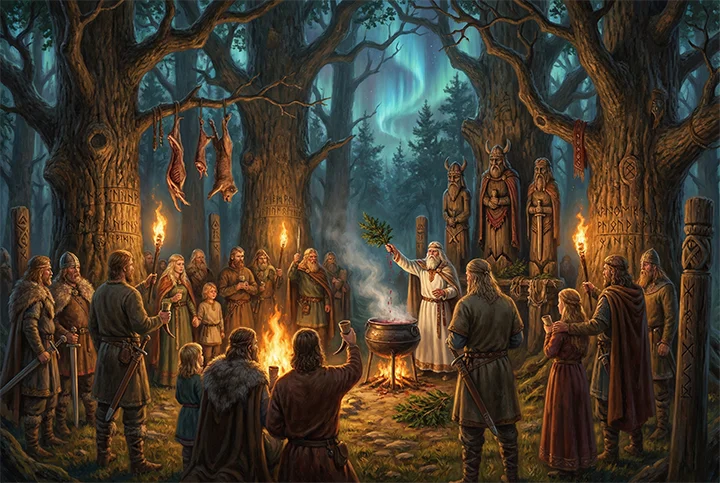
Blót was the central ritual act of Norse religion, a sacrificial feast in which animals and sometimes other offerings were given to the gods in exchange for their favor, protection and continued generosity. The word blót means sacrifice or blood offering, and the practice was performed at set points throughout the year, at significant transitions in the agricultural and seasonal calendar, and at moments of communal need such as before a battle, at the outset of a voyage or during a period of famine or illness. It was not a private act of individual piety but a communal ceremony that bound together the participants, the land they worked, the gods they honored and the ancestors who had performed the same rituals before them.
Norse religion had no priesthood in the Christian sense, no professional clergy separated from ordinary life by ordination and dedicated exclusively to religious functions. The blót was led by the chieftain or king, whose role as religious leader was inseparable from his role as political leader. The right to perform sacrifice was one of the most important prerogatives of Norse leadership, and the quality of a leader's relationship with the gods, expressed through the success or failure of the harvests and battles that followed his sacrifices, was among the primary measures of his fitness to rule. A king whose blót produced good harvests commanded loyalty. A king whose blót produced famine faced questions about whether the gods still recognized his authority.
The Structure of Blót
The blót followed a recognizable structure across different times and places. Animals were selected, typically cattle, horses, pigs or other livestock, and consecrated to the gods. They were then killed, usually by a blow to the skull or by throat-cutting, and their blood was collected in a vessel called a hlautbolli. The officiating leader used a bundle of twigs called a hlautteinn to sprinkle the blood on the altar, the walls of the hall, and the participants gathered around. The consecrated blood, called hlaut, carried the divine power of the sacrificed animal and the acceptance of the gods, and its application to the participants and the space of the ritual marked them as included in the relationship the sacrifice had established.
The animal was then butchered, cooked and eaten at a communal feast. The eating was not incidental to the ritual but central to it: consuming the flesh of the consecrated animal was a direct participation in the exchange with the gods, an ingestion of the divine power that the animal had carried. The mead and ale consumed at the feast were also consecrated, drunk in toasts called minneskål that named specific gods, ancestors or recently dead members of the community. The feast was the completion of the sacrifice, the moment when the divine favor purchased by the offering was distributed among the participants.
The Three Great Annual Blóts
The Norse ritual calendar organized itself around three major blóts, each tied to a critical point in the agricultural year and each dedicated primarily to specific divine powers.
Dísablót was performed at the beginning of spring, in the period that corresponds roughly to late January or early February. It was dedicated to the dísir, female supernatural beings associated with fate, fertility and the protection of families and households, and it was often performed by women or with women in a leading role. The dísablót was concerned with the fertility of the coming growing season and the protection of the household through the vulnerable period of early spring before the harvest could be anticipated.
Sigrblót or Vårblót was performed at the onset of spring proper, dedicated to Odin or to victory, and was concerned with the success of military campaigns and other endeavors that would be undertaken in the coming months. This was the sacrifice associated most directly with the warrior aristocracy and with the royal sacrifices described in the sources as being performed on behalf of the whole community.
Vetrnætr, the Winter Nights blót, was performed at the beginning of winter, in the period corresponding to late October or early November. It was dedicated to the dísir again, and to Freyr and the Vanir gods of fertility, and was concerned with the successful preservation of the community through the winter and with the relationship between the living and the dead, whose presence was felt most strongly at the boundary between the growing season and the dark months. A separate midwinter blót, Yule or Jól, was performed at the winter solstice and was dedicated to Odin and to the continuity of the world through its darkest point.
Human Sacrifice and Historical Evidence
The sources describe human sacrifice in the context of Norse religion, most extensively at the great temple of Uppsala in Sweden, where Adam of Bremen, writing in the eleventh century, reported that every nine years a great festival was held at which nine males of every species, including humans, were sacrificed and their bodies hung in the sacred grove beside the temple. This account has been treated with varying degrees of skepticism by scholars: Adam was writing as a Christian missionary with an interest in emphasizing the barbarism of the pagans he was working to convert, and his account of Uppsala may contain significant exaggeration.
Archaeological evidence confirms that human sacrifice did occur in some Norse and broader Germanic contexts. Bog bodies from across northern Europe, preserved by the acidic conditions of the peat, show signs of ritual killing, and some Norse burial sites contain the remains of individuals who appear to have been killed to accompany the principal dead. The account in the Rus' primary chronicle of the funeral of a Norse chieftain on the Volga, recorded by the Arab traveler Ibn Fadlan in 921, describes in detail a ceremony that included the killing of a slave woman to accompany her master into death. These are not the large-scale public sacrifices of Adam's Uppsala account, but they establish that human sacrifice was a recognized practice within the Norse world.
Legacy and Significance
Blót was not an occasional or marginal practice; it was the structural center of Norse religious life, the mechanism by which the relationship between the human and divine worlds was maintained, renewed and expressed. The gods required acknowledgment and offering; the community required divine favor and protection; the land required the ritual attention that kept it fertile; the dead required the memory and the feasting that kept them connected to the living. Blót addressed all of these requirements simultaneously, gathering the community together, establishing its relationship with the supernatural, honoring its dead and celebrating its continued existence.
The Christianization of Scandinavia between the ninth and twelfth centuries replaced blót with the Mass, substituting the sacrifice of Christ for the sacrifice of animals and the feast of the Eucharist for the communal feast of the blót. The structural similarity between the two ritual forms was not lost on the missionaries who promoted the transition or on the communities that made it: the exchange between the human and divine worlds, mediated by blood and flesh and communal eating, was a pattern deep enough in human religious imagination that it survived the change of religion, expressing itself in new terms while maintaining the underlying logic it had always followed.